
Is your property portfolio building your wealth, or is it simply buying you a second job you didn’t ask for? Many investors believe that self-managing is the only way to protect their rental yield, but the reality of 2 AM repair calls and chasing late payments often tells a different story. You’ve worked hard to secure your assets, and it’s natural to feel protective over every dollar of cash flow while fearing that high management fees will eat your profits.
Efficient property management singapore is about more than just fixing leaks; it’s about mastering a system that scales. Whether you’re navigating the complexities of the BMSMA or managing a high-yield co-living space, you need a strategy that prioritizes your time. This guide will help you unlock the right approach for your goals in 2026, ensuring you understand your legal obligations as a landlord while maximizing your returns. We’ll compare the DIY route against professional agents to provide a clear blueprint for your journey toward true financial freedom.
Key Takeaways
- Distinguish between unit-level oversight and MCST management to ensure your property management singapore approach is tailored for maximum efficiency and asset protection.
- Evaluate the heavy time commitment of DIY landlording against the security of professional management to safeguard your portfolio from legal pitfalls in Tenancy Agreements.
- Analyze standard fee structures for local residential and industrial assets to see how reducing vacancy periods can significantly accelerate your path to positive cash flow.
- Identify the essential accreditation and niche expertise required to select a partner capable of handling specialized high-yield investments like co-living or B1/B2 industrial spaces.
- Learn why mastering asset strategy is the ultimate blueprint for financial freedom and how our Residential Acceleration Program helps you move beyond simple management to true portfolio growth.
What is Property Management in the Singapore Context?
Property management in Singapore is far more than just collecting a monthly cheque. It’s the disciplined oversight of residential, commercial, or industrial real estate to ensure the asset performs at its peak. Whether you’re holding a co-living unit in the Core Central Region or an industrial B1 space in Tai Seng, you’re running a business. To truly understand What is Property Management, you have to view it as a holistic system that covers tenant sourcing, rent collection, and rigorous maintenance schedules. In our local market, this entire framework is anchored by the Building Maintenance and Strata Management Act (BMSMA), which has governed the management and maintenance of strata-titled properties since it came into operation in 2005.
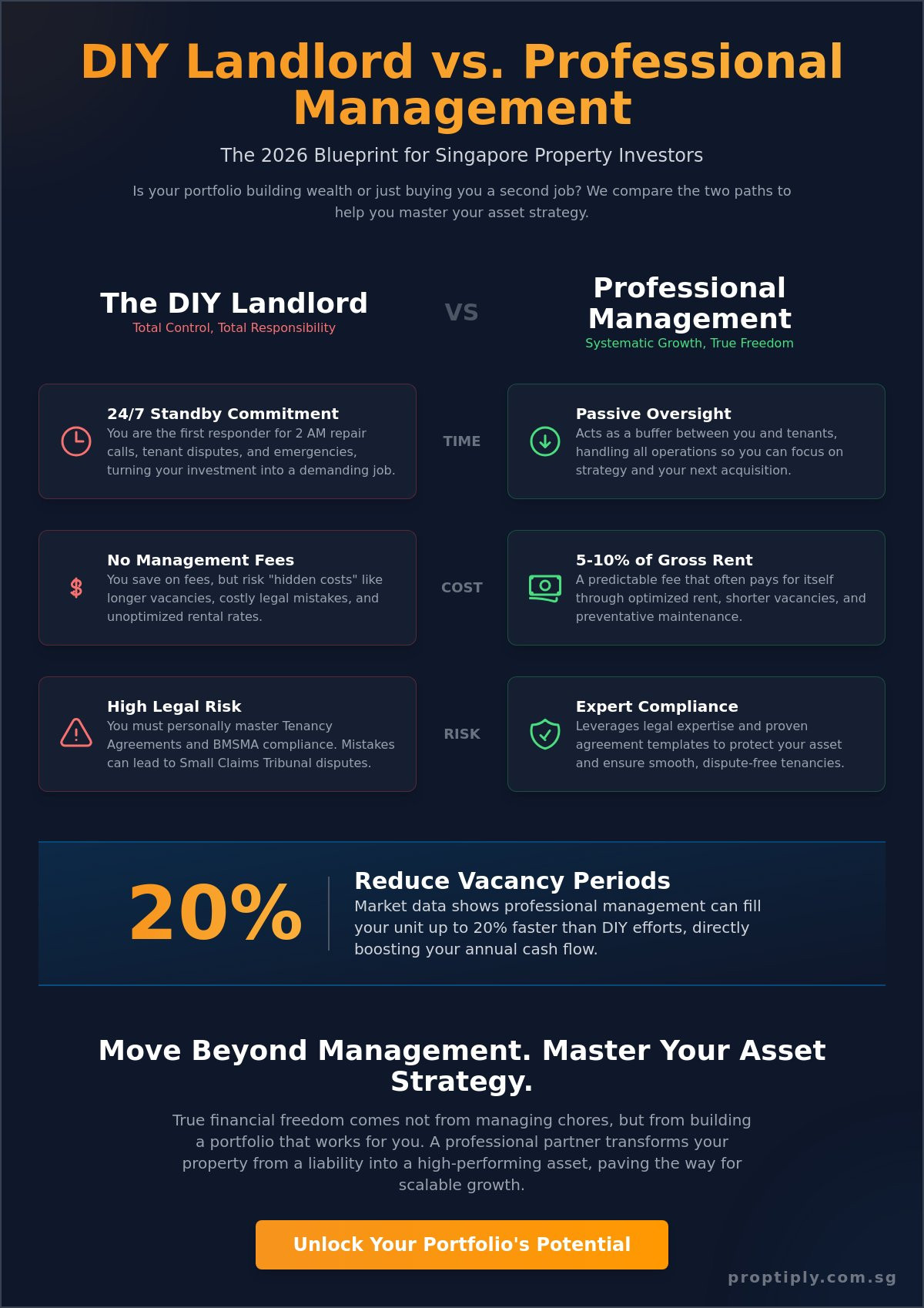
Mastering property management singapore means navigating the fine line between keeping your tenants happy and protecting your bottom line. It’s about asset progression. If you don’t manage the property effectively, your “passive income” quickly turns into a full-time headache. Market data indicates that professional management can reduce vacancy periods by as much as 20% compared to DIY efforts. You need a proven blueprint to handle everything from leaking pipes to complex tenancy agreements without losing your mind or your profit margins.
The Role of the Managing Agent (MA)
Don’t confuse your personal property manager with the Managing Agent (MA). The MA is a professional firm appointed by the Management Corporation Strata Title (MCST) to look after the common property. They ensure the condo pool is clean, the security guards are on duty, and the cargo lifts in industrial parks are operational. While the MA keeps the estate running, they won’t help you find a tenant or fix a broken aircon inside your unit. Savvy investors recognize that even with a top-tier MA on-site, they still need a dedicated strategy for their specific unit to ensure consistent cash flow.
Individual Unit Management vs. Estate Management
Estate management focuses on the big picture of the entire development. Individual unit management, however, is where the “landlord’s burden” lives. This involves the day-to-day grind: screening profiles, chasing late rent, and managing wear and tear. Many beginners underestimate the time required to manage a single HDB or condo unit. We view this as asset management rather than just chores. By applying a systematic framework to your property management singapore strategy, you transform a physical space into a wealth-building tool that generates reliable, high-yield returns while you focus on your next acquisition.
DIY Landlord vs. Professional Property Management: A Comparison
Choosing between DIY management and hiring an expert determines whether your property is a passive asset or a demanding second job. Most Singaporeans fall into the “accidental landlord” trap, which occurs when an owner rents out a former home or inherited unit without a clear operational blueprint, only to find their personal time evaporated by constant tenant demands. Successful property management singapore requires a shift from a hobbyist mindset to a professional investor’s perspective to ensure long-term sustainability.
The Self-Managed (DIY) Route
Managing your own unit gives you absolute control and saves you the standard management fee. You get to handpick your tenants and build a direct rapport. However, this comes with a heavy 24/7 standby commitment. When a ceiling leaks or an air-con unit fails during a public holiday, you are the first responder. Beyond repairs, legal risks are significant. You must master the nuances of the Tenancy Agreement (TA) and ensure security deposits are handled correctly to avoid Small Claims Tribunal disputes. In strata-titled properties, you also need to ensure compliance with the Building Maintenance and Strata Management Act, which governs how owners interact with the Management Corporation (MCST). If you lack a proven framework for screening, you risk onboarding “professional tenants” who delay rent and damage your asset.
The Professional Management Route
Professional firms bring a systematic, results-driven approach to your portfolio. They use sophisticated data tools like PULSE to track maintenance schedules and market rental rates, ensuring your unit stays competitive. While they typically charge a fee of 5% to 10% of your monthly gross rent, they provide a vital buffer between you and tenant drama. They handle the heavy lifting of rent collection and repair coordination, allowing you to focus on asset progression rather than fixing toilets. This professional layer is essential for effective property management singapore because it removes the emotional friction that often leads to poor business decisions.
Scalability is the biggest differentiator here. You might manage one or two units on your own, but managing 10 units yourself is a recipe for burnout and expensive mistakes. Professional managers allow you to unlock true passive income by removing yourself from the daily operations. If you want to scale your portfolio toward financial freedom, you need to master the art of delegation early in your journey. This shift allows you to move from being a stressed operator to a strategic owner who makes decisions based on real-world data and proven frameworks. Investors serious about scaling should also understand how to apply the quadrant framework to transition from a single-unit owner into a sophisticated portfolio investor capable of diversifying across residential and industrial asset classes.
The Hidden Costs and ROI of Management Services
Many landlords view professional property management singapore as a drain on their monthly cash flow. That’s a rookie mistake. You’ve got to treat it as strategic leverage. If you spend S$200 a month to save S$2,000 in emergency repair costs and avoid a two-month vacancy, you’ve already won. Effective management turns a passive asset into a high-performing wealth machine. Professional oversight ensures you aren’t just “owning” property, but actually “investing” in it. Follow our real estate investment advice to understand how these operational efficiencies compound over a ten-year horizon.
Quantifying the Management Fee
Expect to pay a standard commission of one month’s rent for a two-year lease to secure a tenant. On top of that, monthly management fees for residential and industrial units typically range from 2% to 5% of your gross rental income. If the management firm is GST-registered, you’ll need to account for the current 9% GST on these services. Don’t let the sticker price scare you. These fees are generally tax-deductible against your rental income in Singapore. This lowers your effective cost while you enjoy professional oversight and freedom from midnight tenant calls.
Preventative maintenance is your shield against “emergency” bills. Replacing a worn-out aircon compressor before it fails is significantly cheaper than an emergency Sunday call-out. Reactive repairs often cost 30% more due to urgency and the lack of bulk-contractor rates. Professional managers use their volume-based networks to get you trade prices you can’t access as an individual. They also slash vacancy periods. A unit sitting empty for just 30 days wipes out roughly 8.3% of your annual yield. Speed is profit. Every dollar lost to vacancy or unnecessary depreciation is capital that could instead be redirected away from the Singapore automotive market’s depreciating assets and into appreciating property investments. For investors eyeing growth corridors, understanding how infrastructure projects like TEL Stage 4 is reshaping rental demand and capital appreciation along the East Coast is essential to redirecting capital into the right assets.
Impact on Rental Yield and Asset Value
A well-managed property doesn’t just provide rent; it builds equity. Buyers pay a premium for units with a documented history of upkeep and high-quality tenants. If you want to supercharge your returns, explore the “Co-living” management model. By renting out individual rooms rather than the whole unit, you can often see a 30% to 50% increase in gross yield. Our Ultimate Guide to Co-Living breaks down how this strategy works within URA guidelines. It’s a proven blueprint for maximizing every square foot of your investment. Professional managers who specialize in this niche handle the increased tenant turnover, ensuring your net yield remains superior to traditional “buy-to-rent” models. Investors looking for a concrete example of how entry-price mechanics and suburban location combine to drive strong returns should study the Midwood condo investment thesis as a repeatable blueprint for identifying high-growth OCR opportunities.
Key Criteria for Selecting a Property Management Company
Choosing the right partner for property management singapore determines whether your investment remains a passive income engine or turns into a high-stress liability. Don’t prioritize low management fees over actual expertise. A manager charging 2% less might cost you S$5,000 in missed rental increases or poor vendor oversight. You need a partner who treats your asset like their own property and understands the nuances of the local market.
- Verify accreditation with the Singapore Institute of Surveyors and Valuers (SISV) to ensure professional accountability and adherence to industry standards.
- Audit their contractor network. A manager is only as good as the plumbers, electricians, and handymen they can call at 2 AM.
- Demand a track record in your specific niche, whether it’s high-yield co-living spaces or industrial B1/B2 units.
- Evaluate their communication style to ensure they provide proactive updates rather than just reacting to crises.
Vetting and Credentials
Effective management requires local “boots on the ground” to handle physical inspections and urgent repairs. You can’t manage a Singaporean asset effectively from a remote call center. During your first consultation, skip the pleasantries and ask direct questions about tenant disputes. Ask how they specifically handled a tenant who refused to vacate or how they managed a major ceiling leak during the monsoon season. Their answers will reveal if they have a proven framework for conflict resolution or if they’re just winging it. Professional managers maintain a curated list of vetted vendors, ensuring you don’t overpay for sub-standard renovation work that leads to recurring issues.
Technology and Reporting
By 2026, investors should expect nothing less than full digital integration. Real-time portals that track rental income, expenses, and maintenance history are the new standard for property management singapore. This data-driven approach is vital for portfolio rebalancing. When you can see your net yield in real-time, you can make informed decisions about asset progression and timing the market. For GST-registered investors, precise and transparent accounting is a legal necessity to simplify tax filings and avoid IRAS penalties. Master your finances by choosing a firm that prioritizes granular reporting over vague monthly summaries. This level of transparency allows you to spot trends, such as rising utility costs in co-living units, before they erode your positive cash flow.
Ready to scale your portfolio with a proven investment strategy? Learn how to master property investment with Proptiply’s expert mentorship.
Beyond Management: Mastering Asset Strategy with Proptiply
Hiring a property manager handles the “how” of daily operations, but as an investor, you’re responsible for the “why.” A professional agent can collect rent and fix a leaking pipe, yet they won’t build your retirement portfolio for you. Master the strategy first. Without a clear roadmap, even the best property management singapore has to offer is just a cost center rather than a profit engine. You must provide the vision that turns a single unit into a scalable portfolio. Stop thinking like a landlord and start operating like a CEO.
From Landlord to Strategic Investor
Moving from active management to passive income requires a fundamental shift in mindset. Most people get stuck in the “landlord trap,” worrying about minor repairs instead of focusing on asset progression. Proptiply focuses on teaching you a repeatable framework. We show you how to identify undervalued units and structure your finances to ensure every acquisition contributes to long-term wealth. You don’t need to do the heavy lifting yourself when you have a proven system to follow. We teach the framework so you can own the results.
Our methodology focuses on two core pillars designed for the local market:
- Residential Acceleration Program: Master the art of property acquisition and learn how to spot entry points that others miss in the competitive Singapore market.
- Co-Living Bootcamp: Discover how to manage for high yield by transforming standard apartments into high-demand co-living spaces that generate superior cash flow.
Your Next Steps to Financial Freedom
Understanding the nuances of property management singapore is the first step to escaping the rat race. When you stop trading your time for money and start leveraging smart management strategies, you unlock true financial independence. Don’t leave your future to chance or a generalist agent who doesn’t share your investment goals. It’s time to take control of your assets with precision and discipline. Success in real estate isn’t about luck; it’s about the systematic application of a tested blueprint. Before committing to any training program or mentor, use our guide to evaluating i quadrant and property investment courses in Singapore to ensure you’re choosing education that delivers real, measurable results.
Ready to audit your current approach? Sign up for our next Residential Property Investment Bootcamp to see our frameworks in action. If you want a personalized deep dive into your portfolio, book one of our Proptiply Consultations. We’ll help you identify the gaps in your strategy and show you exactly how to scale your way to a consistent monthly passive income. Let’s build your legacy together.
Stop Trading Time for Rent and Start Scaling Your Assets
Choosing the right approach to property management singapore isn’t just about avoiding leaky taps or chasing late rent. It’s a strategic decision that determines whether your investment remains a side hustle or becomes a true vehicle for financial freedom. You’ve seen how professional management protects your ROI by minimizing vacancies, while a DIY approach requires significant personal time and deep knowledge of local regulations. Since 2016, active investors Jelene Lum and Ervin Ang have demonstrated that long term success lies in applying proven frameworks rather than relying on guesswork.
Don’t let the complexities of Co-Living or Industrial assets hold you back from achieving positive cash flow. You can avoid expensive mistakes by learning from practitioners who’ve already navigated the local market’s unique hurdles. For HDB owners navigating the new Prime and Plus flat classifications introduced in the October BTO 2024 launch and its long-term investment impact, understanding how the extended Minimum Occupation Period affects your asset progression strategy is critical before making any management decisions. It’s time to move beyond basic maintenance and master a disciplined asset strategy that secures your future. Ready to level up your portfolio? Master the blueprint for high-yield property investment at our next Bootcamp. We’ll show you exactly how to unlock the potential of your properties using our specialized frameworks. Your path to passive income starts with the right education.
Frequently Asked Questions
How much do property management companies in Singapore charge?
Property management companies in Singapore typically charge between 5% and 10% of the monthly gross rent for individual residential units. Some firms offer fixed monthly rates starting around S$150 per unit depending on the specific scope of services. These fees cover tenant communication, maintenance coordination, and rent collection to ensure your asset progression remains on track without the headache of daily operations.
Is property management the same as facilities management?
Property management focuses on tenant relationships and lease administration, while facilities management handles the physical upkeep of the building’s infrastructure. Property management in Singapore ensures your rental income remains steady through active tenant engagement and lease renewals. Facilities management deals with the technical side, like lift maintenance and cooling systems, which is usually managed by the MCST in a condo setting.
Can I manage my own HDB rental if I live overseas?
You can’t manage your HDB rental personally if you live overseas because HDB requires you to appoint a local representative. This representative must be a Singapore Citizen or Permanent Resident who can act on your behalf during emergencies or inspections. It’s a critical regulation designed to ensure that flat management remains efficient and that any tenant issues are resolved immediately by someone on the ground.
What is the Building Maintenance and Strata Management Act (BMSMA)?
The Building Maintenance and Strata Management Act (BMSMA) is the primary legislation that governs the management and maintenance of strata-titled properties in Singapore. It provides the legal framework for Management Corporations (MCST) and sets the rules for how common property is shared. Understanding this act is part of a proven property management singapore blueprint for investors to navigate condo living and avoid legal disputes.
Does a property manager help with the Option to Purchase (OTP)?
Property managers generally don’t handle the Option to Purchase (OTP) as their role focuses on post-lease management rather than the initial sale. An OTP is a legal document used during the acquisition phase; this is usually handled by a licensed real estate agent and a lawyer. Your property manager steps in once you’ve secured the unit to help you unlock its rental potential and maximize your positive cash flow.
What happens if my tenant refuses to pay rent in Singapore?
You should issue a formal Letter of Demand immediately if your tenant refuses to pay rent. If the tenant still doesn’t pay, you can apply for a Writ of Distress through the Singapore Courts to seize tenant belongings to recover the debt. For claims under S$30,000, the Small Claims Tribunal offers a faster route to resolve disputes without needing expensive legal representation or long court delays.
Are property management fees tax-deductible in Singapore?
Yes, property management fees are fully tax-deductible against your rental income according to IRAS guidelines. You can claim these expenses to reduce your taxable net rent, which helps protect your bottom line. Smart investors use this deduction as part of their financial strategy to keep more of their passive income while professional managers handle the heavy lifting and tenant coordination.
Is it better to manage co-living spaces personally or via a firm?
Managing co-living spaces is significantly more labor-intensive than traditional rentals, so using a professional firm is often the better choice for scaling. Co-living involves managing multiple individual leases, higher turnover, and frequent utility disputes. A firm provides the operational system needed to maintain high occupancy rates and ensure your investment delivers the high yields that co-living is known for in the local market.