
What if your residential investment could generate double the monthly cash flow of a traditional 2-year lease while staying 100% compliant with URA regulations? Many landlords are currently trapped in a cycle of 2.5% net yields, struggling to compete in the co living singapore market while navigating the strict 6-occupant limit for private properties. You’ve likely felt that the old “buy and hold” model isn’t the wealth-builder it used to be in today’s high-interest environment. It’s time to stop settling for mediocre returns and start thinking like a professional asset strategist.
We’ve spent years refining a proven blueprint that maximizes every square foot of your property for maximum gain. This guide will unlock the exact strategies you need to master this booming niche as we head into 2026. You’ll learn how to navigate the latest legal boundaries, compare actual rental yields against traditional models, and identify the specific districts where tenant demand is surging. Don’t let your capital sit idle; follow our roadmap to transform your property into a high-yield, positive cash flow machine today.
Key Takeaways
- Master the evolution of the co living singapore market to transform your property into a high-yield asset that outperforms traditional rental models.
- Navigate complex URA regulations and the “Rule of 6” with ease to protect your investment from costly legal pitfalls.
- Unlock the secrets to achieving 20-40% higher rental yields by identifying high-potential properties near key MRT stations.
- Learn our proven framework for screening tenants and managing operations to transition from a “landlord” mindset to a professional business owner.
- Avoid common expensive mistakes by applying a systematic, disciplined approach to your property investment journey.
What is Co-Living in Singapore? More Than Just a Room Rental
Stop thinking of co-living as just a shared flat or a budget room rental. In 2026, co living singapore has transformed into a high-yield asset class and a sophisticated lifestyle choice for the savvy. It is a modern housing model that blends private bedrooms with high-end communal spaces. You get your own sanctuary while sharing designer kitchens and lounges with a curated community. To understand the global roots of this trend, you can look at the broader definition of What is Co-Living; however, in our local context, it’s a specialized solution for a land-scarce city.
The Singapore market has evolved rapidly since the early 2010s. We’ve moved past the era of “partitioned rooms” in old apartments. Today, professional operators manage entire buildings or clusters of units, focusing on lifestyle and community. Data from 2025 shows that 75% of residents are aged between 25 and 40. This group includes expats, digital nomads, and an increasing number of young Singaporeans seeking independence. They aren’t just looking for a bed; they’re looking for a tribe.
Technology acts as the backbone of this modern experience. Residents use dedicated apps to manage their entire stay. From booking a weekly cleaning session to RSVPing for a rooftop yoga event, everything happens on a smartphone. This tech-first approach reduces friction and builds a sense of belonging that traditional rentals can’t match.
The Core Features of a Co-Living Space
Move-in ready units are the baseline for any reputable operator. You won’t find yourself haggling over furniture or setting up utility accounts. Everything is included in a single monthly bill. This includes high-speed Wi-Fi, utilities, and regular housekeeping. It’s designed for the “grab-and-go” generation who value time over administrative chores.
Flexibility is the biggest draw. While traditional landlords demand a 2-year contract, co living singapore operators work with the URA 3-month minimum stay requirement. This allows residents to test out different neighborhoods like Tiong Bahru or River Valley without a long-term commitment. It’s a low-risk way to live in premium districts.
Why the Singapore Market is Unique
Land scarcity and the 2026 property price index have made solo rentals prohibitively expensive for many. Young locals, often called the “Sandwich Generation,” face long waits for BTO flats and high resale prices. They want independence now, not in five years. Co-living provides that exit ramp from the family home. At its heart, co-living functions as a strategic response to Singapore’s 2026 property price index, providing an affordable entry point into premium districts without the heavy capital outlay of traditional ownership. For a comprehensive breakdown of how co living spaces singapore are reshaping the rental landscape, including the latest market trends and yield data, our dedicated 2026 guide provides the full picture.
The Rules of the Game: URA Regulations and Legal Frameworks
Don’t let the legal jargon intimidate you. Success in co living singapore starts with mastering the Urban Redevelopment Authority (URA) rulebook. It’s your safety net. It prevents expensive mistakes and keeps your positive cash flow secure. You must understand that co-living is a business model, not a separate legal land-use category. It operates within the existing residential framework, meaning you must play by the established rules to win.
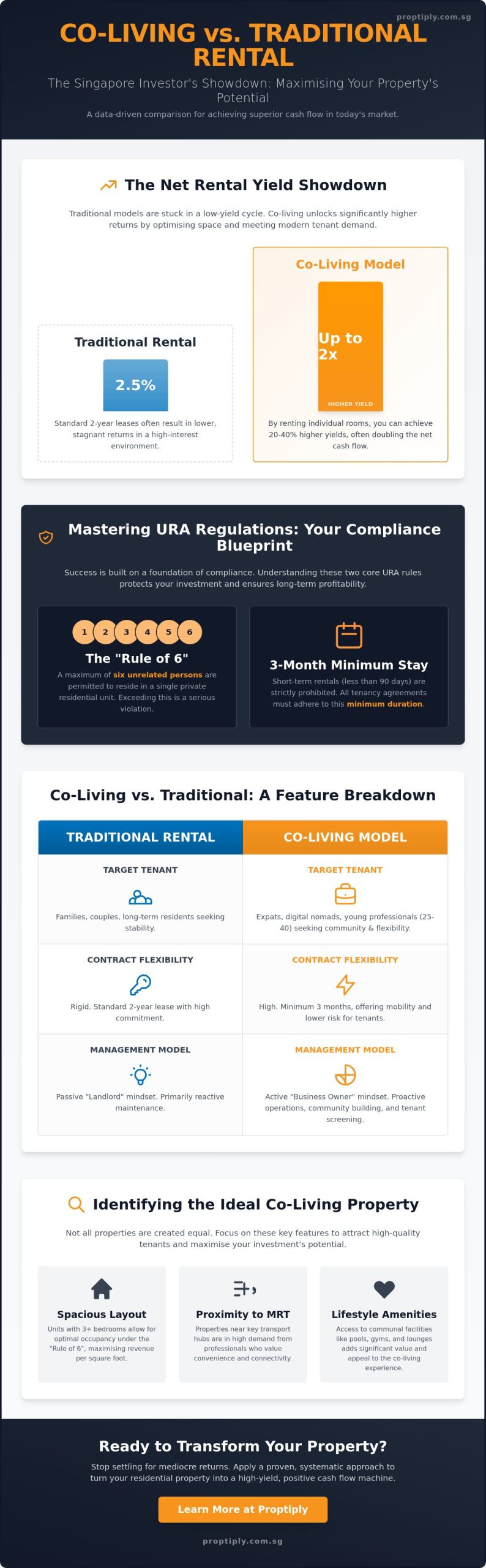
The “Rule of 6” is your first hurdle. You cannot house more than six unrelated persons in a single private residential unit. This limit includes the owner if they reside on-site. Exceeding this cap turns your residential unit into an illegal dormitory, which carries heavy penalties. You also need to respect the 3-month minimum stay. Short-term rentals are strictly prohibited in private residential zones. If your tenant stays for 89 days, you’re breaking the law. Stick to the 90-day baseline to stay compliant with URA Regulations and protect your investment.
Private Property vs. HDB: Key Legal Differences
HDB flats operate under a different set of constraints. You must complete your 5-year Minimum Occupation Period (MOP) before subletting the entire flat. Even then, you must navigate the Non-Malaysian Non-Citizen Quota, which limits how many foreign tenants can live in a block. In the private sector, Management Corporation Strata Title (MCST) bylaws can’t override URA rules to ban co-living entirely. However, they can impose strict renovation and move-in hours. Your Tenancy Agreement (TA) is your primary defense. It must clearly define house rules and maintenance responsibilities to avoid disputes.
Regulatory Changes to Watch in 2026
The landscape is shifting as we approach 2026. The government introduced the “Long-stay Serviced Apartment” category in late 2023 to address the growing demand for flexible housing. These units require a minimum 3-month commitment, bridging the gap between hotels and traditional rentals. Fire safety is another critical area. If you’re partitioning rooms to maximize yield, you must comply with SCDF’s Fire Code 2023. This includes using fire-rated materials and ensuring clear escape paths for all occupants. Unlock your potential for asset progression by staying ahead of these shifts. If you want to learn the proven co living singapore blueprint, start your journey with us today.
Co-Living vs. Traditional Rental: The Investor’s Comparison
Stop settling for the measly 2% to 3% gross rental yields typical of traditional residential tenancies. In the current market, co living singapore strategies allow savvy investors to unlock significantly higher returns, often outperforming standard rentals by 20% to 40%. This performance gap exists because you’re pivoting from renting out a single unit to a single family to monetizing the property on a per-room basis. You’re effectively selling “lifestyle as a service” rather than just floor space.
This model serves as a powerful hedge against residential cooling measures. While Additional Buyer’s Stamp Duty (ABSD) might squeeze your margins on new acquisitions, the cash flow generated from a well-executed co-living setup can offset these costs. Recent data on Co-Living Investment Trends indicates that the demand from millennials and expatriates for flexible, community-centric housing remains resilient even during economic shifts. However, you must accept the trade-off. Higher yields require higher operational intensity and a larger upfront CAPEX for furnishing and partitioning. Savvy investors who want to further diversify their portfolio beyond residential assets should also explore how business park investments in Singapore can provide a complementary stream of commercial rental income.
The Math Behind the Model
Success in this niche depends on choosing the right blueprint. You can opt for the “Rent-to-Rent” (Master Lease) model, where you lease a unit from a landlord and sublet individual rooms. This requires lower capital but demands high operational efficiency. Alternatively, the “Buy-to-Co-Live” strategy focuses on asset progression and long-term capital gains. When calculating your Net Operating Income (NOI), you must factor in the “all-in” costs that traditional landlords ignore. This includes high-speed Wi-Fi, weekly cleaning services, and utility caps. A typical 3-bedroom unit converted for co living singapore may require a renovation budget of $30,000 to $50,000 to ensure the aesthetic meets the premium expectations of 2026 tenants. Before committing your renovation capital, use our detailed investor’s checklist for co living apartments in Singapore to evaluate each property against the key criteria that separate high-yield assets from costly mistakes. Understanding how to evaluate and select the right co living spaces in Singapore is essential before committing your renovation capital to any specific property type or district.
Operational Challenges for Landlords
Managing a co-living property isn’t a “set it and forget it” endeavor. You’re managing the social dynamics of 4 to 6 unrelated individuals living under one roof. Conflict resolution becomes a core part of your job description. Whether it’s a dispute over fridge space or noise levels at 11 PM, you need a system to handle friction before it leads to a vacancy.
Professional property management software is non-negotiable for tracking rent payments and maintenance requests across multiple tenancies. If you’re ready to move beyond basic landlording and start building a high-yield portfolio, you need to master the specialized tactics used by the pros. Check out our latest real estate investment advice to learn how to minimize vacancy risks and maximize your positive cash flow in the 2026 landscape.
Identifying the Ideal Co-Living Property in Singapore
Success in co living singapore isn’t about luck. It’s about data-driven selection. You need properties that command high demand even during market shifts. Location is your primary filter. A property located more than a 10-minute walk from an MRT station is a liability. Focus on units within 500 meters of major interchanges or stations on the North-East or Downtown lines to ensure a constant stream of high-quality tenants. Proximity to transport is the single most reliable predictor of occupancy rates in 2026.
Property types dictate your entry cost and yield. Shophouses offer an unbeatable “cool factor” and heritage appeal, attracting premium rents from expats who value character. 4-bedroom condos are the strategic choice for most investors. They provide the necessary square footage to reconfigure layouts for maximum room count without compromising common areas. For those looking at HDB options, jumbo flats remain rare gems. These allow for spacious communal living, provided you strictly adhere to HDB’s occupancy caps of six unrelated persons.
Targeting District 9, 10, and the Rest of Central Region (RCR) creates a “Work-Live-Play” ecosystem. Tenants in these areas are often willing to pay a 20% premium to live near lifestyle hubs and offices. When evaluating floor plans, look for “dead space” like overly large balconies or oversized utility rooms. These areas can often be repurposed to create an extra study or bedroom, significantly boosting your gross rental income while maintaining a liveable environment for all residents. Applying a structured approach to this evaluation process is critical; our 2026 strategy guide for co living apartments in Singapore walks you through each due diligence step so you can identify the highest-potential units with confidence.
Top Hotspots for Co-Living in 2026
Lavender and Jalan Besar have evolved into the lifestyle hubs of 2026. Their mix of industrial grit and boutique cafes draws the Gen Z and Millennial creative class. Geylang remains a powerhouse for yields. With its proximity to Paya Lebar Quarter and the CBD, it offers a lower entry point with high rental velocity. Meanwhile, One-North and Buona Vista are non-negotiable for targeting the tech crowd. Professionals working at Grab or A*STAR prioritize proximity to work, making these districts recession-proof anchors for your portfolio. Investors targeting these high-tech corridors may also find it valuable to understand the 2026 market outlook for Singapore business parks, as these commercial hubs directly influence tenant demand in surrounding residential areas.
Due Diligence Checklist for Owners
Don’t sign a Sales and Purchase agreement without checking the URA Master Plan. Look for upcoming MRT extensions or commercial hubs that will spike capital appreciation. You also need to factor in high-occupancy maintenance. With five tenants sharing a space, wear and tear happens 300% faster than in traditional family rentals. Budget for durable furnishings and regular air-con servicing to protect your margins. Mastering these fundamentals is the first step toward building a real estate estate in Singapore that generates consistent passive income.
Ready to stop guessing and start investing like a professional? Attend our next property masterclass to see how we identify high-yield units before they hit the mass market.
Mastering the Co-Living Model for Financial Freedom
Most beginners dive into co living singapore investments with plenty of excitement but zero strategy. This lack of preparation leads to “expensive mistakes” that can derail your financial goals before they even start. Two of the biggest pitfalls are poor tenant screening and illegal partitioning. If you ignore URA guidelines or fail to vet the individuals staying in your unit, you risk heavy fines and property damage. Success in this niche isn’t about luck; it’s about moving from a “landlord” mindset to a “business owner” mindset. A landlord waits for things to break, while a business owner builds systems to ensure they don’t.
Scaling your portfolio becomes a logical, repeatable sequence once you master the first unit. A single successful co-living space provides the positive cash flow needed to fund your next security deposit or renovation project. This creates a powerful snowball effect for your wealth. At Proptiply, we don’t share abstract theories from a textbook. We are practitioners who actually own and manage the spaces we talk about. We share real-world data and “boots-on-the-ground” insights that generalist property seminars simply can’t provide.
- Systematic Screening: Use a rigorous 5-point checklist to ensure your tenants are reliable and respectful.
- Legal Compliance: Master the specific URA occupancy cap rules to keep your investment safe from authorities.
- Operational Excellence: Implement automated cleaning and maintenance schedules to keep your property in top condition.
Avoiding the “Solar Cowboy” Trap in Property Management
DIY management is the fastest route to burnout. Trying to handle every tenant dispute or maintenance issue yourself makes you a “Solar Cowboy” who is always working but never growing. You need a community-led learning environment and mentorship to avoid these common pitfalls. Asset progression in the Singaporean context is only possible when you stop trading your time for money and start using a proven framework to manage your properties. This shift allows you to focus on finding new deals rather than fixing leaks at 2 AM. Singaporean investors looking to fund professional property education should also explore how to use their SkillsFuture credits for property investment courses to offset the cost of structured co-living and real estate training before the 2026 rules shift.
Take the Next Step: Join the Movement
The path to a high-yield portfolio is already paved for you. Our Co-Living Bootcamp provides the specific blueprint for success in the 2026 market, breaking down complex regulations into actionable steps. We’ve watched our students go from zero properties to managing multiple units that generate significant monthly passive income. Don’t let another year pass by just watching the market from the sidelines. Take action now and learn how to Master the Co-Living Bootcamp: Your 2026 Blueprint for a secure financial future.
Master Your Path to Property Success in 2026
The landscape of co living singapore is shifting rapidly. Success in this market requires more than just owning a property; it demands a deep understanding of the 2024 URA occupancy regulations and the 3-month minimum stay requirement. Traditional rental models often fail to provide the same resilience as specialized high-yield niches. You now have the foundational knowledge to distinguish between a standard room rental and a strategic asset that generates consistent positive cash flow. Founders Jelene Lum and Ervin Ang have spent years refining these exact strategies within the co-living and industrial sectors. They’ve moved past theoretical advice to provide a proven framework that helps you avoid the common, expensive mistakes that sideline most amateur investors. By applying these “boots-on-the-ground” tactics, you can transition from a passive observer to a confident market participant. It’s time to take control of your asset progression and secure the financial freedom you’ve been working toward. Stop guessing and start following a blueprint that actually works in the local context. Investors who want to reduce their out-of-pocket education costs can discover how to leverage their SkillsFuture Level-Up credits to fund accredited property investment training and accelerate their journey into the co-living market.
Unlock high-yield returns: Join our Co-Living Bootcamp today!
You’ve got the ambition to succeed, and we’re here to provide the expert mentorship to get you there. Let’s build your legacy together.
Frequently Asked Questions
Is co-living legal in Singapore for private residential properties?
Yes, co-living is legal in private residential properties provided you follow Urban Redevelopment Authority (URA) guidelines. You must ensure the rental period stays at 3 consecutive months or longer to avoid illegal short-term stay penalties. Short-term rentals like Airbnb remain prohibited in Singapore’s private housing sector. Follow these rules strictly to protect your investment and avoid the $5,000 fine associated with illegal transient occupancy.
What is the maximum number of tenants allowed in a co-living apartment?
The maximum occupancy is 6 unrelated persons per property, regardless of the unit size. This URA cap applies to all private residential units to prevent overcrowding and maintain the living environment. If you exceed this limit, you risk enforcement action and heavy penalties from the authorities. Always verify your occupant count to maintain a compliant co living singapore setup that secures your long-term passive income.
Can I do co-living in an HDB flat?
Yes, you can operate a co-living model in HDB flats, but you must comply with strict subletting regulations. Owners must fulfill the 5-year Minimum Occupation Period (MOP) before renting out the entire flat. For 3-bedroom flats or larger, the maximum occupancy is capped at 6 persons. You must register all tenants via the HDB portal and pay the $20 application fee for each approval you seek.
How much more can I earn from co-living compared to traditional rental?
Investors generally achieve a 20% to 40% higher gross rental yield through co-living compared to traditional whole-unit leasing. By subdividing a property into individual rooms, you maximize the dollar-per-square-foot value. A condo unit that fetches $5,000 as a whole rental might generate $7,000 when managed as a co-living space. This strategy creates the positive cash flow needed to accelerate your asset progression journey.
What is the minimum rental period for co-living in Singapore?
The minimum rental period is 3 consecutive months for private residential properties and 6 months for HDB flats. Stays shorter than these durations are classified as illegal short-term accommodation by the URA and HDB. Stick to these legal timeframes to build a sustainable and professional co living singapore business. This compliance ensures you avoid the risk of heavy fines or having your rental rights revoked by the government.
Do I need a special license to run a co-living business in SG?
You don’t need a specific co-living license, but you must adhere to URA residential guidelines and SCDF fire safety codes. Any internal partitions you install must not block fire escape routes or natural ventilation. If you operate in a “Residential with Commercial at 1st Storey” zone, you must apply for a Change of Use from URA. This application involves a $535 processing fee and requires official approval before you start.
Who pays for the utilities and Wi-Fi in a co-living setup?
The landlord or co-living operator typically covers utilities, Wi-Fi, and cleaning fees as part of an all-inclusive rent package. This model is a core selling point that attracts premium tenants who value convenience and fixed monthly costs. You should factor these overheads into your monthly budget. Most successful investors set a utility cap in the tenancy agreement to prevent wastage and protect their profit margins from unexpected usage spikes.
What happens if tenants in a co-living space don’t get along?
Operators manage tenant conflicts through a combination of pre-signed house rules and active mediation strategies. Most professional co-living managers intervene within 24 hours of a reported dispute to resolve the issue. If the situation remains unresolved after mediation, the operator may exercise the right to relocate a tenant to another unit. Clear communication and a robust tenancy agreement prevent minor friction from turning into expensive vacancies or legal headaches.