What if the 20% Additional Buyer’s Stamp Duty (ABSD) isn’t a barrier, but actually a filter that separates the average saver from the sophisticated investor? Most Singaporeans stop at one HDB or condo because they fear the tax man, yet a small group of savvy owners is quietly building a massive real estate estate by playing a different game. You likely feel the sting of a stagnant single-property income while inflation eats your savings. It’s frustrating to watch your hard-earned capital sit trapped in equity when it should be working for you.
You deserve a clear path to financial freedom that doesn’t rely on a 9-to-5 grind. This guide reveals our proven frameworks to strategically scale a multi-property portfolio in Singapore’s unique market. You’ll learn how to master asset progression and use high-yield niches like co-living or industrial spaces to legally bypass ABSD. We’re breaking down the exact roadmap to generate passive income that replaces your monthly salary, giving you the security you’ve been working for. Stop guessing and start applying a systematic approach to wealth creation.
Key Takeaways
- Redefine your property goals by learning how to transition from owning a single home to managing a high-performing real estate estate that generates sustainable wealth.
- Discover how to bypass the heavy costs of ABSD by diversifying into commercial assets like shophouses and offices to maximize your passive income.
- Master the “Right Entry, Right Exit” framework to systematically scale your portfolio through strategic asset progression and high-yield property selection.
- Navigate the complex 2026 tax landscape with expert insights on cooling measures and stamp duties to protect your investment margins.
- Unlock the Proptiply blueprint to gain a “boots-on-the-ground” advantage and avoid the expensive mistakes that trap most novice investors.
Beyond the Dictionary: What “Estate” Means for Singaporean Investors
Stop thinking of an estate as just a sprawling bungalow in Bukit Timah or something you only deal with in a lawyer’s office during probate. In the 2026 Singapore market, building an estate means constructing a diversified, resilient portfolio of assets designed to generate wealth while you sleep. The old “buy and hold” residential strategy is hitting a ceiling. With ABSD rates for second residential properties sitting at 20% for citizens since the April 2023 cooling measures, the traditional path to wealth has narrowed. You can’t simply rely on the capital appreciation of a single HDB or condo to fund your retirement anymore.
You must distinguish between a legal estate and an investment estate. While the legal version focuses on inheritance and death, the investment version focuses on life, cash flow, and financial agility. Moving from a homebuyer mindset to an investor mindset requires you to stop viewing property through the lens of “dream homes” and start evaluating it as a financial instrument. This shift is the first step toward true asset progression. It’s about moving away from emotional attachments and focusing on the numbers that drive positive cash flow.
The Evolution of the Singapore Property Dream
The journey for most locals begins with Public housing in Singapore, which remains the bedrock of national wealth. However, the modern Singaporean dream has moved beyond basic HDB ownership and the “5 Cs” of the past. Today, land scarcity dictates every dollar of value. Because the government tightly controls land supply, your success depends on your ability to read the URA Master Plan. This blueprint determines where new MRT lines, commercial hubs, and industrial zones will appear, directly impacting your property’s future valuation. If you aren’t aligning your portfolio with these state-led developments, you’re essentially gambling with your future.
Why Building an Estate is Key to Financial Freedom
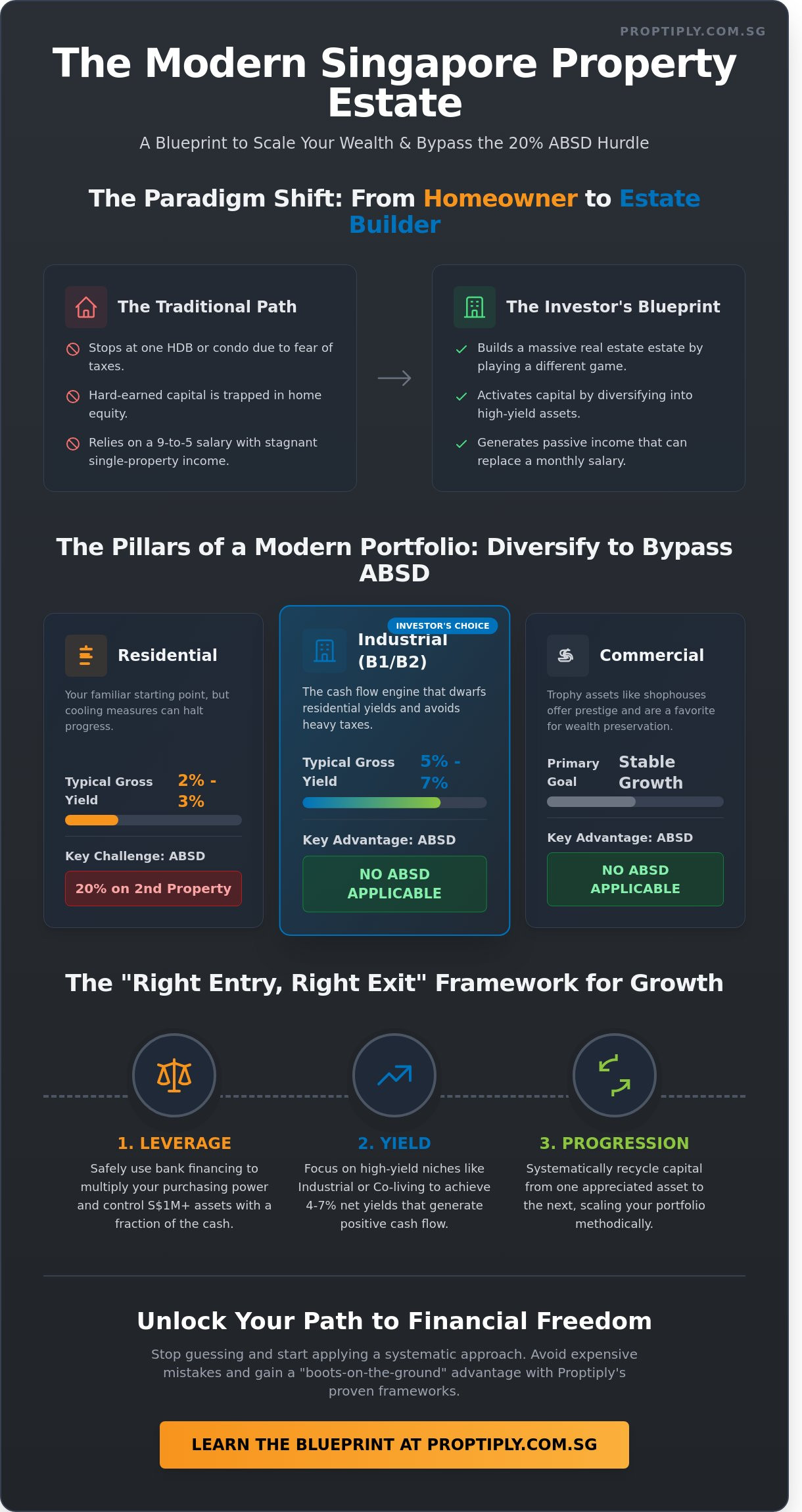
Escaping the rat race requires a systematic approach to rental yield and capital growth. We don’t just look for properties; we look for “undervalued gems” in high-yield niches like co-living or industrial spaces. These sectors often bypass the heavy cooling measures that cripple residential investors. By mastering the power of leverage within the Singapore banking system, you can control S$1 million assets with a fraction of that amount in cash. This is how you accelerate wealth. A real estate estate is a collection of income-producing assets that provide long-term security. Unlock this mindset, and you’ll find that financial freedom isn’t a distant dream, but a logical outcome of a proven framework.
- Leverage: Use bank financing to multiply your purchasing power safely.
- Yield: Focus on co-living or industrial units to achieve 4% to 6% net yields.
- Progression: Recycle your capital from one asset to the next as valuations rise.
Don’t let technical jargon or market complexity intimidate you. Every seasoned investor started with their first unit. The difference between those who struggle and those who succeed is the willingness to follow a disciplined blueprint rather than chasing market hype.
The Pillars of a Modern Singapore Real Estate Portfolio
Building a resilient property estate requires a strategic mix of assets that balance capital growth with immediate cash flow. You can’t rely solely on one property type if you want to achieve true financial freedom. Most Singaporeans start with residential units, but cooling measures like the 20% Additional Buyer’s Stamp Duty (ABSD) for a second property can halt your progress. Smart investors pivot. They look at commercial and industrial assets to bypass these hurdles. Industrial properties, specifically B1 and B2 units, offer gross yields between 5% and 7%, which dwarfs the 2% to 3% typically seen in the residential sector. Shophouses provide a unique “trophy asset” status with no ABSD, making them a favorite for wealth preservation.
Residential vs. Commercial: Which Should You Start With?
Your entry point depends on your available capital and long-term goals. Residential properties offer a familiar starting point, but the Loan-to-Value (LTV) limit of 75% for your first loan tightens on subsequent purchases. Many savvy couples use a decoupling strategy, where one party transfers their share to the other, to “free up” a name for a second residential purchase without hitting the ABSD wall. Before you commit, study the official IRAS stamp duty regulations to calculate your exact entry cost. Individual investors often find a sweet spot in strata-titled offices or retail units priced between S$1.2 million and S$2.5 million. These commercial assets allow you to scale your portfolio without the heavy tax burden of the residential market.
The Rise of Co-Living as an Estate Component
Co-living isn’t just a trend; it’s a high-yield strategy that transforms low-performing residential units into cash cows. By reconfiguring a standard three-bedroom apartment into a five-room co-living space, you can effectively double your rental income. This model serves the 500,000+ Employment Pass and S-Pass holders in Singapore who prioritize community and flexible lease terms. Success in this niche requires a standardized operational framework. You need to manage high turnover and utility costs without losing your sanity. Focus on targeting digital nomads and local millennials who are increasingly seeking independent living spaces. This makes co-living a vital estate component for those focused on monthly positive cash flow. Before diving in, explore the ultimate guide to co living singapore trends, rules, and investment potential in 2026 to understand the latest URA regulations and district-level yield data. If you want to master these high-yield strategies, learn how Proptiply mentors investors to scale through proven, real-world frameworks.
Strategic Asset Progression: How to Grow Your Property Estate
Building a massive property estate isn’t a result of luck; it’s the outcome of a systematic blueprint. You must adopt the “Right Entry, Right Exit” framework to scale effectively. This means you don’t just buy a house because you like the view. You buy an asset with a clear, data-driven exit strategy already in place. Use the quadrant analysis framework for scaling property portfolios in 2026 to categorize properties into high yield or high capital gain. High-yield units provide the immediate passive income needed to service loans, while high-growth properties build your long-term wealth. Monitoring Singapore’s private property price trends through official URA data allows you to identify the peak of the property cycle. Knowing when to flip a stagnant asset and when to hold a winner is what separates the amateurs from the pros.
Many successful investors utilize the “Sell One, Buy Two” strategy to accelerate their holdings. By unlocking the capital appreciation from a single appreciated property, you can potentially fund the down payments for two smaller, high-performing units. This move doubles your rental nodes and diversifies your risk across different locations. It’s a proven method to expand your footprint without over-extending your personal cash reserves, provided you keep a close eye on your leverage ratios. As your portfolio grows, understanding whether to self-manage or engage professional property management in Singapore becomes a critical decision that directly impacts your net returns and time freedom.
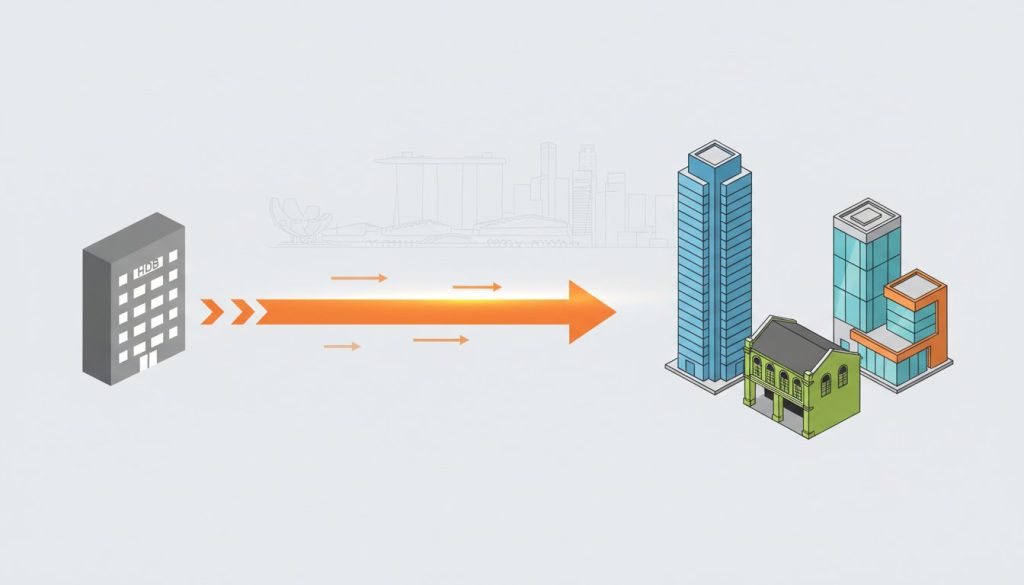
The Roadmap from HDB to Multiple Private Properties
Your journey often begins with an HDB flat. You must wait out the 5-year Minimum Occupation Period (MOP) before you can legally acquire private residential property. Use this time to build your “war chest” and study the market. Calculate your safe entry price by ensuring your Total Debt Servicing Ratio (TDSR) stays within the current 55% limit. You want to avoid being asset-rich but cash-poor. Mastering the timing of your first private acquisition is the most critical step in Building a Multi-Property Portfolio in Singapore. Focus on properties near upcoming MRT stations or regional hubs where demand remains resilient even during market corrections. For example, understanding how new infrastructure like TEL Stage 4 is reshaping the 2026 property investment landscape along Singapore’s East Coast can help you identify high-growth corridors before prices fully adjust. Investors seeking a repeatable model for evaluating suburban condos should also study the Midwood condo investor’s blueprint for Singapore property in 2026, which breaks down the exact entry-price mechanics and rental yield calculations that turned a Hillview project into a suburban success story. Buyers who secured flats during the October 2024 BTO launch should pay close attention to how the new classification system and extended MOP timelines affect their asset progression roadmap before making any private property moves.
Diversifying into Industrial and Commercial Sectors
Don’t limit your estate to residential units alone. Savvy investors often look at undervalued industrial parks or business park units in Singapore where gross yields can exceed 5% or 6%. When looking at these sectors, the 60-year versus 99-year versus Freehold debate is vital. A 60-year leasehold industrial unit can offer incredible cash flow if you enter at the right price point, even if the capital gain is slower than a freehold unit.
Risk management is different here. You must vet non-residential tenants based on their business stability and industry growth. Look for B1 industrial spaces that cater to high-growth sectors like e-commerce, logistics, and technology. This diversification is a strategic move to bypass residential cooling measures like the Additional Buyer’s Stamp Duty (ABSD), allowing your portfolio to grow even when residential regulations tighten. Focus on the numbers, follow the framework, and stay disciplined with your acquisition criteria.
Navigating the Hurdles: ABSD, SSD, and Cooling Measures
Looking toward 2026, the Singapore tax landscape remains a fortress designed to curb speculation and ensure housing remains affordable. To build a resilient real estate estate, you must master the rules of the game before you place your first bet. The 2023 cooling measures pushed Additional Buyer’s Stamp Duty (ABSD) for Singapore Citizens to 20% on their second property and 30% on their third. These numbers aren’t just statistics; they’re significant capital drains that can stall your progression if you don’t plan your entries with precision.
Your borrowing power is equally dictated by the Total Debt Servicing Ratio (TDSR), currently capped at 55%. This means your total monthly debt obligations, including car loans and credit cards, cannot exceed 55% of your gross monthly income. When interest rates hover between 3.5% and 4.5%, your margin for error shrinks. You need a clear blueprint to navigate these constraints without hitting a financial ceiling. Many investors overlook how the Singapore automotive market in 2026 silently erodes their TDSR capacity, as high COE premiums and car loan installments directly reduce the borrowing power available for property acquisitions.
Strategies to Legally Minimize ABSD
Strategic investors use legal frameworks to keep their capital working for them rather than losing it to taxes. Decoupling is a common tactic where one spouse transfers their share of a co-owned property to the other, freeing up one name to purchase a second property as a first-timer. While this involves legal fees and potentially Seller’s Stamp Duty (SSD) if done within three years of purchase, the savings on a S$1.5 million property can exceed S$300,000.
Another route is the use of a Trust for a child. This requires a 100% cash outlay as banks don’t grant loans for properties held in trust for minors. You’ll also need to pay a 65% ABSD upfront, though you can apply for a remission if the trust is structured correctly. If these residential hurdles feel too high, look toward the commercial sector. Commercial properties do not incur ABSD for Singapore Citizens and PRs. This allows you to scale your estate portfolio without the heavy tax burden associated with residential apartments.
Managing Cash Flow in a High-Interest Environment
Positive cash flow is the lifeblood of a growing portfolio. Don’t just look at gross rental yields; calculate your net position after property taxes, management fees, and maintenance costs. Stress-test your portfolio by simulating a scenario where interest rates hit 5%. If your rental income can’t cover the mortgage at that level, you’re holding a liability, not an asset.
- Build a War Chest: Set aside at least six to twelve months of mortgage installments and conservancy fees to handle unexpected vacancies.
- Focus on High-Yield Niches: Explore co living singapore opportunities or industrial spaces where yields often outperform traditional residential rentals.
- Monitor SSD Timelines: Avoid selling within the first three years to dodge the 12%, 8%, or 4% tax on the sale price.
Success in the Singapore market isn’t about luck; it’s about the systematic application of a tested framework. If you want to stop guessing and start growing, join our next property wealth masterclass to learn the exact steps we use to build cash-flow-positive portfolios.
Master Your Estate with Proptiply’s Proven Frameworks
Education is the most important investment you’ll make before signing an Option to Purchase. Many Singaporeans leap into the market based on hearsay or “gut feelings,” only to realize they’ve locked their capital into a stagnant asset for years. Building a high-performing real estate estate requires a blueprint, not a gamble. At Proptiply, we bridge the gap between academic theory and the harsh realities of the local market. We don’t just lecture; we provide “boots-on-the-ground” mentorship from practitioners who are actively closing deals and managing portfolios today.
The Proptiply difference lies in our commitment to real-world application. You won’t just learn about property types; you’ll master the mechanics of positive cash flow and asset progression. Our mentors share the exact “insider secrets” they use to navigate ABSD regulations and cooling measures. By joining our community, you gain access to a network of like-minded investors who share insights, verify data, and even collaborate on deals. This collective intelligence acts as a protective shield, helping you avoid the expensive mistakes that sideline most beginners. Before committing to any training program, use our i quadrant and property investment courses evaluation checklist to ensure you’re choosing a program that delivers real-world results over motivational rhetoric. Singaporeans looking to reduce their out-of-pocket education costs should also explore how to use SkillsFuture credits for property investment courses to offset professional real estate training fees before the 2026 rules shift.
Residential vs. Commercial Bootcamps
Your investment path depends on your current capital and financial goals. If you want to maximize your residential footprint or explore the lucrative co-living niche, our Residential Property Investment Bootcamp is the ideal starting point. This program focuses on the Residential Acceleration Program (RAP) framework, showing you how to flip the script on traditional home ownership. For those with more significant capital or those looking to bypass certain residential restrictions, our Commercial and Industrial Property (CAIP) program dives into high-yield industrial spaces.
- 1-on-1 Property Portfolio Consultation: Every student receives a personalized session to deconstruct their current financial standing.
- Capital Allocation: Learn exactly how much S$ you need to safely enter different market segments.
- Asset Progression: We help you map out a 5-to-10-year plan to scale your holdings systematically.
Start Your Journey to Financial Freedom Today
Waiting for the “perfect” market timing is a trap that keeps many Singaporeans stuck in a single HDB for decades. Market cycles are inevitable; the key is having a framework that works in any climate. Our students have built impressive portfolios starting from zero or a single property by following a disciplined, data-driven approach. They don’t wait for luck; they create opportunities by applying proven investment methodologies.
Don’t let another year pass while your capital sits idle or underperforms. Whether you’re aiming for your first investment property or looking to diversify into industrial units, expert guidance is the shortcut to success. Master your financial destiny and join a community that prioritizes results over rhetoric. Unlock your potential with our expert guidance and take the first definitive step toward the life you’ve always envisioned. Your journey to a robust estate begins with a single, informed decision.
Start Building Your Multi-Million Dollar Property Legacy
Building a resilient property estate in Singapore requires more than just capital; it demands a disciplined, systematic framework. You now understand how strategic asset progression allows you to scale your portfolio despite cooling measures like ABSD. You’ve seen why high-yield niches like industrial property and co-living are the ultimate tools for generating consistent, positive cash flow in today’s market. Since 2016, Proptiply has leveraged over 10 years of market experience to help investors bypass abstract theory and focus on real-world results. We provide the insider knowledge you need to avoid expensive mistakes and secure your financial freedom. It’s time to stop guessing and start executing with a proven blueprint. Our personalized 1-on-1 consultations ensure your roadmap is as unique as your financial goals. Join a community of practitioners who are actively shaping the local market. You have the tools to turn your aspirations into a tangible portfolio. Take charge of your financial future today.
Unlock Your Property Wealth: Join Our Next Investment Bootcamp
Frequently Asked Questions
What is the definition of a real estate estate in Singapore?
A real estate estate in Singapore refers to a diversified portfolio of property assets strategically acquired to generate passive income and long-term capital appreciation. It’s not just owning one home; it’s about building a system of residential, commercial, or industrial properties that work for you. Unlock your financial freedom by moving beyond a single roof and mastering asset progression to grow your wealth systematically.
Can I build a property estate if I only own an HDB flat?
You can start building a property estate while owning an HDB flat, provided you’ve met your five-year Minimum Occupation Period (MOP). Once the MOP is cleared, you’re free to leverage your savings or home equity to invest in private residential or industrial properties. Many savvy investors use this transition to secure their first high-yield co-living space, creating a secondary stream of positive cash flow while keeping their HDB as a primary residence.
How much capital do I need to start investing in commercial property?
You typically need a minimum of S$200,000 to S$300,000 in liquid capital to begin investing in smaller commercial or industrial units. Unlike residential properties, commercial purchases require a 20% to 30% down payment in cash because you can’t use CPF for the initial 5% booking fee or the 9% GST. Master these numbers early to ensure you maintain a healthy safety buffer for your portfolio.
Is it better to buy one luxury condo or two smaller units for my estate?
Buying two smaller units is often the superior strategy for building a resilient estate because it diversifies your rental risk and maximizes your total rental yield. Two units allow you to target different tenant segments, such as co-living professionals or young families, ensuring that a single vacancy doesn’t stop your entire cash flow. This approach also offers better exit flexibility, as selling a S$1.2 million unit is generally faster than finding a buyer for a S$3.5 million luxury property.
What are the main risks of building a property portfolio in Singapore?
The primary risks include interest rate fluctuations, policy changes like Additional Buyer’s Stamp Duty (ABSD), and extended vacancy periods. In 2023, the ABSD for Singapore citizens buying a second residential property rose to 20%, which impacts your entry cost. Avoid expensive mistakes by conducting deep due diligence on location and tenant demand. Use a proven framework to calculate your “worst-case scenario” so your portfolio remains profitable even during market downturns.
Does Proptiply provide financial advice or property brokerage services?
Proptiply doesn’t provide financial advice or property brokerage services. We’re an education and community platform that shares a tested blueprint for property investment. Our mission is to empower you with the technical knowledge and insider secrets needed to evaluate deals independently. We act as your pragmatic guide, teaching you how to spot high-yield opportunities in co-living and industrial spaces without relying on third-party sales talk.
How does the URA Master Plan affect my long-term estate value?
The URA Master Plan directly dictates your property’s future value by outlining upcoming infrastructure developments and rezoning initiatives over a 10 to 15 year horizon. For instance, the development of the Jurong Lake District transformed nearby property prices as the area evolved into a second Central Business District. Study these blueprints to identify “first-mover” advantages. Investing in areas designated for high-growth ensures your portfolio benefits from government-led urban rejuvenation. Investors targeting high-tech commercial clusters should also review the 2026 market outlook for business parks in Singapore to identify emerging opportunities aligned with URA’s long-term planning intentions.
Can I use my CPF to buy commercial or industrial properties?
You can’t use your CPF Ordinary Account savings to purchase industrial or commercial properties in Singapore. These investments must be funded through cash and bank loans. This regulation is why many investors focus on industrial units as their second or third acquisition, keeping their CPF for residential upgrades. Understanding this funding structure is vital for managing your liquidity and ensuring you don’t overextend your cash reserves during the acquisition phase. Investors who want to reduce their upfront education costs can learn how to maximise SkillsFuture credits for property investment training to fund professional courses without drawing down on the cash reserves needed for acquisitions.