
What if your next property purchase didn’t require you to pay a 20% ABSD tax that wipes out your first three years of potential gains? You’ve probably noticed that traditional real estate investment advice often fails to account for the impact of the April 2023 cooling measures that have left many Singaporeans feeling stuck in their first homes. It’s frustrating to watch your savings sit idle while you fear making an expensive mistake in a market where a single wrong move can cost you S$100,000 or more in stamp duties and lost opportunity. We understand that hesitation because the stakes in Singapore have never been higher.
You don’t have to settle for measly 2% rental yields or wait decades for capital appreciation. We’ve developed a systematic blueprint to help you master asset progression and unlock high-yield niches like co-living and industrial spaces. This 2026 guide provides the exact roadmap you need to secure positive cash flow and build a resilient portfolio. We’ll break down the specific frameworks that professional investors use to identify undervalued gems and turn them into passive income machines. It’s time to stop dreaming of wealth and start applying a tested methodology that makes financial freedom attainable.
Key Takeaways
- Master the shift from homeownership to high-yield investing by balancing capital growth with sustainable cash flow in the 2026 Singapore market.
- Learn the Residential Acceleration framework to identify undervalued units where entry price and exit strategy outweigh location for maximum returns.
- Unlock the co-living revolution to achieve the highest possible residential yields by transforming standard units into high-demand shared spaces.
- Scale your portfolio faster by leveraging industrial properties as a “hidden gem” to completely avoid ABSD and diversify your asset base.
- Get professional real estate investment advice to avoid expensive beginner mistakes and overcome the analysis paralysis stalling your financial freedom.
Foundations of Real Estate Investment Advice in Singapore
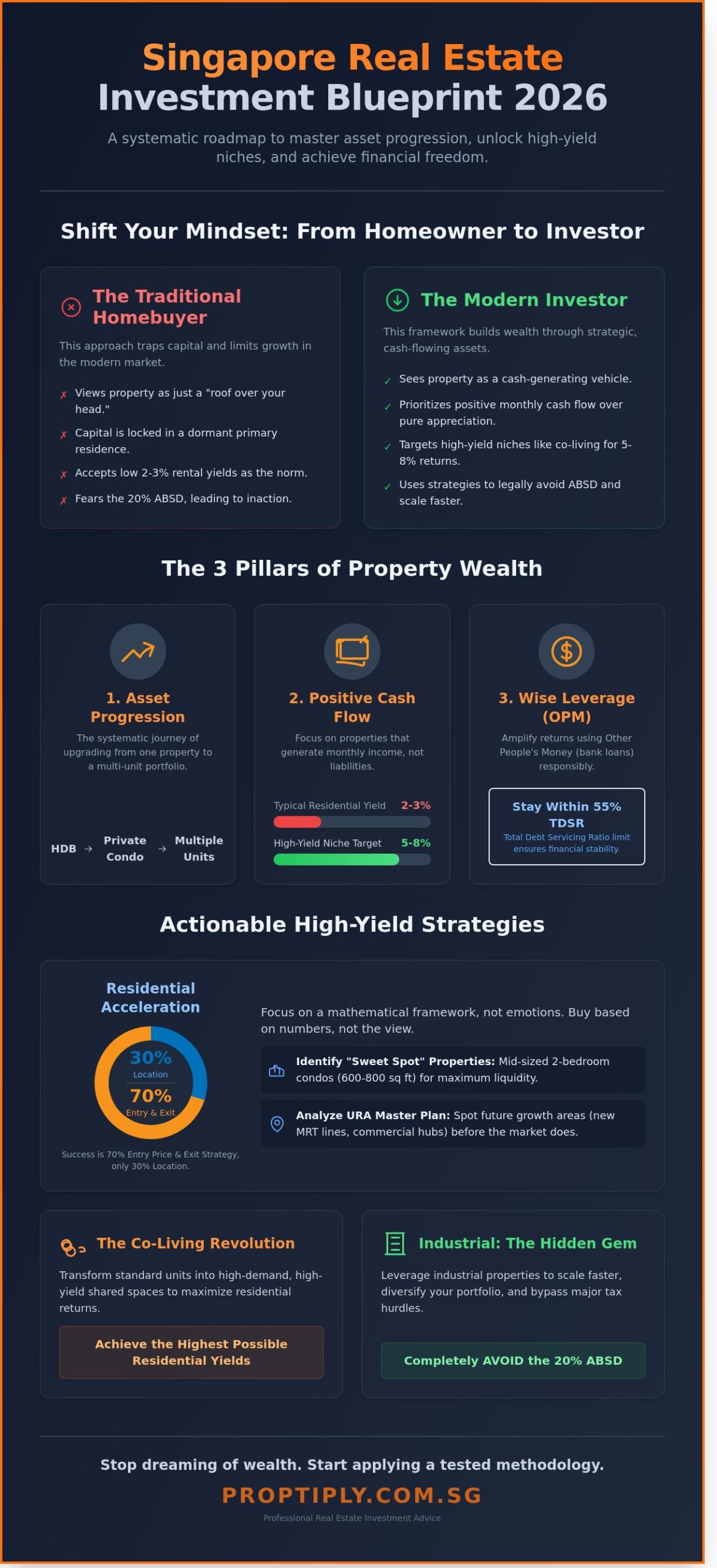
Stop viewing your home as just a roof over your head. In the 2026 Singapore market, your primary residence is often a dormant asset that locks up your capital. Real estate remains the most reliable hedge against inflation because land is our most limited resource. While many people chase capital growth, seasoned investors prioritize cash flow. You need a strategy that generates monthly income to offset rising costs. This shift from a “homebuyer” mindset to an “investor” mindset is what separates those stuck in the rat race from those building a real estate estate that provides true wealth. Relying on a single HDB flat for your retirement isn’t a plan; it’s a risk.
The property markets in Singapore have evolved beyond simple “buy and hold” tactics. To succeed today, you must master the mechanics of the market. This begins with sound real estate investment advice that focuses on data rather than emotions. You aren’t just buying a building; you’re acquiring a cash-generating vehicle. If your property doesn’t pay you every month, it’s a liability, not an investment.
The Core Pillars of Property Wealth
Success in Singapore property requires a disciplined framework. First, embrace Asset Progression. This is the systematic journey of upgrading from an HDB to a private condo, and eventually into multiple units. Second, focus on Positive Cash Flow. We look for niches like co-living or industrial spaces that yield 5% to 8% annually, far exceeding the typical 2% to 3% residential yield. Third, use Leverage wisely. By using Other People’s Money (OPM) through bank loans while staying within the 55% Total Debt Servicing Ratio (TDSR) limit, you amplify your returns without overextending your finances.
HDB vs. Private Property as an Entry Point
- Analyze the Data: Use the HDB Resale Portal to track price trends. In 2024, resale prices rose for the 18th consecutive quarter, proving that entry-level assets still hold value if you pick the right location.
- The Decoupling Strategy: Avoid the 20% Additional Buyer’s Stamp Duty (ABSD) on your second property. By “selling” your share to your spouse, you free up one name to purchase an investment unit without the heavy tax penalty.
- Identify Potential: Don’t gamble on “En Bloc” rumors. Look for properties with a high land-to-built-up ratio and aging facilities that make redevelopment a logical choice for developers.
Effective real estate investment advice focuses on taking action based on proven blueprints. Don’t wait for the “perfect” time to enter the market. Instead, understand the numbers, secure your financing, and start your progression journey today. The goal is financial freedom, and property is the most stable bridge to get you there. If you’re tired of feeling like you’re running on a treadmill with no end in sight, our guide on escaping the rat race in Singapore through property investment provides the exact blueprint to transition from trading hours for income to building scalable wealth.
Residential Acceleration: Building a Scalable Portfolio
Stop chasing “hot” locations blindly. Our Residential Acceleration Program focuses on a mathematical framework to identify undervalued units before the rest of the market catches on. Most beginners mistakenly believe location is the only factor that matters. In reality, location accounts for only 30% of your success. The remaining 70% hinges on your entry price and exit strategy. If you buy at the peak, even a prime unit near an MRT station becomes a financial burden. We teach you to buy based on the numbers, not the view.
Analyze the URA Master Plan to spot upcoming transformations with precision. The 2019 Master Plan’s focus on the Greater Southern Waterfront and the Jurong Lake District created clear demand drivers that savvy investors exploited for gains. Look for areas where the government plans new MRT lines or commercial hubs within the next 5 to 10 years. These infrastructure injections are the primary catalysts for capital growth in a land-scarce city like Singapore.
Focus on “Sweet Spot” properties to maximize your liquidity. Mid-sized condos, typically 2-bedroom units between 600 and 800 square feet, often outperform luxury penthouses in the long run. These units attract a much wider pool of both tenants and future buyers. This high demand ensures you aren’t stuck with an illiquid asset when it’s time to harvest your gains. This systematic approach is the foundation of the real estate investment advice we share with our community.
Strategic Selection Criteria
Compare the Core Central Region (CCR) with the Outside Central Region (OCR). While CCR properties offer prestige, OCR districts frequently provide higher rental yields, often exceeding 3.5% compared to the 2% seen in prime districts. For investors focused on the luxury market in prime District 9, you can learn more about premium residential options in sought-after riverside locations. Always define your exit strategy before you sign the Option to Purchase (OTP). If you’re a non-citizen, check the Singapore foreign ownership regulations to understand your eligibility for specific property types. Use professional consultants to find off-market deals that never hit public portals.
Navigating Financial Constraints
Mastering the numbers is non-negotiable for scaling. The current Total Debt Servicing Ratio (TDSR) framework limits your monthly debt obligations to 55% of your gross income. By 2026, lenders will likely maintain strict stress-test interest rates to ensure market resilience. If you’re eyeing a second property, remember your maximum Loan-to-Value (LTV) drops from 75% to just 25% if your first loan is still outstanding. This requires a disciplined capital blueprint to ensure you don’t overextend. Our goal is to provide real estate investment advice that protects your downside while capturing the upside.
Every Singapore investor must maintain a liquid cash reserve equivalent to 12 months of mortgage installments to withstand unexpected vacancies or interest rate hikes.
The Co-Living Revolution: Maximising Yields in 2026
Co-living isn’t just a housing trend; it’s a structural shift in the Singapore rental market. By 2026, the demand for flexible, community-centric living will reach its peak as traditional rental models struggle to keep pace with modern lifestyles. This strategy involves reconfiguring a standard residential unit into multiple high-value, private suites. You aren’t just a landlord; you’re a space optimizer. This model represents the highest-yielding residential strategy today because it solves the affordability crisis for tenants while tripling the income potential for owners. If you’re seeking real estate investment advice that prioritizes immediate cash flow, co-living is your primary vehicle for success.
The business model relies on transforming underutilized space. A standard three-bedroom condo that might rent for S$5,500 as a whole unit can generate upwards of S$8,500 when managed as individual suites. This shift is fueled by Gen Z professionals and digital nomads who prioritize convenience and social connection over long-term ownership. They want plug-and-play homes with utilities, high-speed Wi-Fi, and weekly cleaning included in a single monthly fee. Proptiply’s proven framework focuses on this “asset-light” approach, allowing you to unlock massive returns without needing to own the entire building. To understand the full scope of trends, regulations, and district-level opportunities shaping this niche, explore our comprehensive guide to co living Singapore investment strategies for 2026.
Operational Strategies for Success
Success begins with property identification. Focus on units located within 500 meters of an MRT station, specifically in the Rest of Central Region (RCR) like Tiong Bahru or Geylang. Large floor plates are essential for creating comfortable, partitioned living spaces that don’t feel cramped. Before you commit, you must understand Singapore’s property ownership regulations and URA guidelines, which currently cap occupancy at six unrelated persons for private residential properties. Use digital platforms to manage your portfolio. Apps that handle automated rent collection and maintenance ticketing reduce your operational overhead by 40% compared to manual management. A robust Tenancy Agreement is your best defense, clearly outlining house rules to prevent roommate disputes and protect your investment.
Profitability Analysis
The numbers don’t lie. Traditional rental yields in Singapore’s prime districts typically hover between 2% and 3%. In contrast, a well-executed co-living unit can achieve gross yields of 6% to 9%. While the returns are higher, you must manage the risks of increased wear and tear and higher tenant turnover. We mitigate these factors by setting aside a sinking fund of 5% of monthly revenue for repairs and using a systematic screening process to ensure tenant compatibility. This is the real estate investment advice the pros use to stay ahead. To master the granular details of room sizing and pricing psychology, our Co-Living Bootcamp offers the exact blueprint we use to scale our own portfolios. Don’t leave your wealth to chance; follow a tested methodology that prioritizes positive cash flow from day one.
Commercial and Industrial Property: The Sophisticated Investor’s Edge
Stop following the crowd into the overcrowded residential market. While most beginners struggle with cooling measures, savvy investors look toward the industrial sector to bypass the most aggressive tax hurdles. The biggest advantage is the 0% Additional Buyer’s Stamp Duty (ABSD) on industrial and commercial assets. If you’re a Singaporean buying a second residential property, you’d face a 20% tax hit; on a S$2 million property, that’s S$400,000 gone before you even collect your first rent check. Industrial property keeps that capital in your pocket, allowing for faster portfolio scaling.
When seeking real estate investment advice, you must understand the distinction between B1 and B2 industrial zones. B1 properties are for “clean” and light industries like software development or telecommunications. B2 properties cater to heavier industries like carpentry or vehicle repair. B2 units often command higher yields because they have specialized features that businesses can’t easily find elsewhere. Our CAIP (Commercial and Industrial Program) approach focuses on these high-yield assets by targeting units with specific technical specs that create “sticky” tenants who are less likely to move.
Remember that non-residential purchases involve a 9% Goods and Services Tax (GST) as of 2024. You can often claim this back if you’re GST-registered, but it requires careful cash flow planning. Property tax for industrial units is also a flat 10% of the Annual Value, which is often simpler to calculate than the progressive residential scales.
Industrial Investment Framework
The 60-year versus 30-year leasehold debate is where the real money is made. JTC data shows that 30-year leasehold units typically offer higher gross rental yields, often hitting 6% or more, because the entry price is lower. In contrast, 60-year leases offer better capital preservation for long-term holds. Look for “User Specification” demand markers like floor loading capacity of 12.5kN/m2 or higher and ceiling heights above 6 meters. Industrial property acts as a superior inflation hedge because industrial leases often include step-up clauses that align rental income with rising operating costs and market shifts.
Commercial Real Estate Nuances
Commercial investing isn’t just about office buildings. Singapore has roughly 6,500 conservation shophouses, making them extremely rare “trophy” assets with massive capital appreciation potential. However, the entry price is high, often starting above S$5 million. Offices are more accessible but require you to monitor the URA Master Plan closely. The 2019 Master Plan’s focus on decentralization means business hubs in Jurong Lake District and Punggol Digital District are the new frontiers for growth. Professional real estate investment advice often highlights the stability of commercial tenants; look for “Anchor Tenants” like established law firms or medical clinics that sign multi-year leases and invest heavily in their own fit-outs.
Don’t let technical jargon stop you from building a high-yield portfolio. You can master industrial property investment and secure your financial future by following our proven, step-by-step framework today.
Avoiding Expensive Mistakes: Professional Advice and Next Steps
Success in the Singapore market isn’t about luck; it’s about avoiding the pitfalls that drain your capital. Most beginners lose money before they even sign an Option to Purchase (OTP). You need sound real estate investment advice to navigate the current cooling measures and high interest rate environment effectively.
The top five mistakes we see daily include:
- Over-leveraging: Ignoring the 55% Total Debt Servicing Ratio (TDSR) and failing to maintain a 12-month mortgage cash buffer.
- Emotional Attachment: Buying a unit because it has a “nice view” rather than focusing on the 4% to 6% net rental yield required for sustainability.
- Ignoring ABSD Impact: Failing to structure ownership correctly to manage the 20% Additional Buyer’s Stamp Duty for a second property.
- Poor Niche Selection: Sticking only to residential units when industrial properties or co-living spaces often offer superior cash flow.
- Underestimating Hidden Costs: Forgetting that property tax, maintenance fees, and agent commissions can eat up to 15% of your gross annual income.
Analysis paralysis is your biggest wealth killer. While you wait for a “market crash” that hasn’t happened in decades, the Property Price Index continues its steady climb. Waiting just 18 months can mean paying S$80,000 more for the exact same asset. Don’t let fear freeze your progress. Action, backed by data, is the only way to build a portfolio.
Your Investment Roadmap
Stop wandering and start following a proven blueprint. Your journey begins with a rigorous financial health check to determine your actual borrowing capacity. Next, you must select your niche. While residential is familiar, industrial B1 units or co-living setups often provide the positive cash flow beginners crave. Finally, commit to continuous education. If you want to offset the cost of professional property investment courses using government grants, discover how to use your SkillsFuture credits for property investment education in 2026 before the rules shift. If you want to enhance your professional toolkit in digital marketing or sales to scale your business, check out ClickAcademy Asia. Proptiply’s specialized bootcamps move you from theory to real-world execution by showing you how to crunch numbers like a seasoned pro.
A traditional sales agent wants a transaction. A property consultant builds a legacy. A 1-on-1 Property Portfolio Consultation can save you six figures by identifying structural flaws in your plan before you commit your hard-earned S$200,000 down payment. It’s the difference between buying a liability and acquiring a performing asset.
Final Expert Tips for 2026
As we move toward 2026, watch the interest rate cycles closely. Timing your refinancing can save you thousands in interest payments over the loan tenure. Don’t invest in a vacuum. Join a community of like-minded investors to share deals and legal insights. This collective knowledge is the ultimate shortcut to wealth. Unlock your bespoke investment roadmap with a 1-on-1 consultation to secure your financial future today.
Take Control of Your Singapore Property Portfolio Today
The 2026 Singapore property market belongs to those who act on precision data rather than speculation. You now understand how to leverage co-living yields and industrial assets to build a resilient, scalable portfolio. These aren’t just theories; they’re the same strategies practitioners Jelene Lum and Ervin Ang use to manage their own successful portfolios. Accessing professional real estate investment advice is the bridge between simply owning a house and owning a wealth-generating asset that provides genuine security.
Since 2016, Proptiply has analyzed over a decade of market data to refine these high-yield frameworks specifically for the local SG context. We focus on helping you avoid expensive mistakes by applying a proven blueprint that has already transformed hundreds of student portfolios. It’s time to stop watching from the sidelines and start building your legacy with confidence. You have the tools and the knowledge; now it’s time to put them into practice.
Join our Residential Acceleration Program to master the SG property market and unlock the path to consistent passive income. Your journey toward financial freedom is waiting for you to take the first step.
Frequently Asked Questions
Is property still a good investment in Singapore in 2026?
Yes, property remains a resilient asset class in 2026 due to Singapore’s limited land supply and robust economic fundamentals. The Ministry of National Development increased the private housing supply to 5,050 units in the first half of 2024 to meet growing demand. This disciplined land release ensures your capital appreciation stays steady. You’ll find that real estate investment advice often highlights Singapore’s political stability as a primary driver for long-term wealth preservation.
How much capital do I need to start investing in Singapore property?
You need at least S$50,000 to S$100,000 in liquid capital to start your journey in high-yield niches like industrial property or co-living. For a S$1.5 million private condo, you’ll need a 25% downpayment, where 5% must be in cash, totaling S$75,000. Our framework focuses on maximizing your leverage and cash flow. Start small with industrial units where the entry price is often significantly lower than residential units.
How can I avoid paying ABSD on my second property?
You can legally avoid Additional Buyer’s Stamp Duty (ABSD) by investing in commercial or industrial properties, which attract 0% ABSD regardless of how many units you own. Another common strategy is decoupling for residential properties, where one spouse transfers their share to the other. Since the April 2023 cooling measures raised ABSD for second-property Singapore citizens to 20%, these alternative routes are essential for protecting your ROI and accelerating your asset progression.
What is the difference between B1 and B2 industrial properties?
B1 industrial properties are for clean and light industries like software development that don’t require more than a 50m nuisance buffer. B2 properties are for heavier industries that may cause noise or pollution, requiring a buffer over 50m from residential areas. We typically recommend B1 units for beginners because they’re easier to manage and attract a wider pool of corporate tenants. Understanding these URA classifications is vital for any sound real estate investment advice.
Can I use my CPF for commercial property investment?
You cannot use your CPF Ordinary Account funds to purchase pure commercial or industrial properties. These must be funded through cash and bank loans. However, you can use CPF for residential properties or the residential component of a mixed-use development. This cash-only requirement for commercial units is actually a blessing. It acts as a barrier to entry that keeps the market less crowded and preserves higher rental yields for disciplined investors.
Why should I choose co-living over traditional residential rental?
Co-living offers 20% to 30% higher gross rental yields compared to traditional whole-unit rentals. By renting out individual rooms and providing value-added services like housekeeping and WiFi, you turn a standard residential unit into a high-performance cash cow. It’s a proven way to achieve positive cash flow in a high-interest-rate environment. You aren’t just a landlord; you’re a space provider solving the housing needs of young professionals in Singapore.
What is the “Residential Acceleration Program” by Proptiply?
The Residential Acceleration Program is our signature blueprint that teaches you how to master the co-living market without necessarily owning the property. We share our rent-to-rent secrets so you can generate monthly passive income with minimal capital outlay. You’ll learn our 5-step framework for identifying undervalued units and managing tenants effectively. It’s designed to help you avoid expensive mistakes and jumpstart your journey toward financial freedom through real-world application.
How does the URA Master Plan affect my investment choices?
The URA Master Plan is your crystal ball for identifying high-growth regions like the Greater Southern Waterfront or the Jurong Lake District. It outlines land use for the next 10 to 15 years, showing you exactly where new MRT lines and commercial hubs will appear. Investing in areas slated for transformation ensures higher capital gains. We always cross-reference the 2019 Master Plan data to ensure our students buy into locations with guaranteed future demand.