Buying into the East Coast right now could be your biggest financial mistake, or your most lucrative move, depending entirely on whether you’re following the crowd or the data. You likely feel the pressure of rising entry prices in District 15 and 16, worrying that the window to profit from tel stage 4 has already slammed shut. It’s common to feel overwhelmed by the URA Master Plan for Bayshore or fear that you’re overpaying for a unit just because it’s near a new station. We’ve been through these market cycles before, and we know that the real opportunities often hide in plain sight while others are distracted by the headlines.
This guide will show you exactly how to identify undervalued condos near key stations that are still positioned for capital appreciation by 2026. We’ll break down the shifts in rental demand for co-living spaces and provide a proven framework to validate your asset progression strategy. You’ll discover how to master the East Coast investment landscape and secure the passive income you need for long-term financial freedom. We’re sharing the insider knowledge you need to make a confident, disciplined move in Singapore’s most exciting property corridor.
Key Takeaways
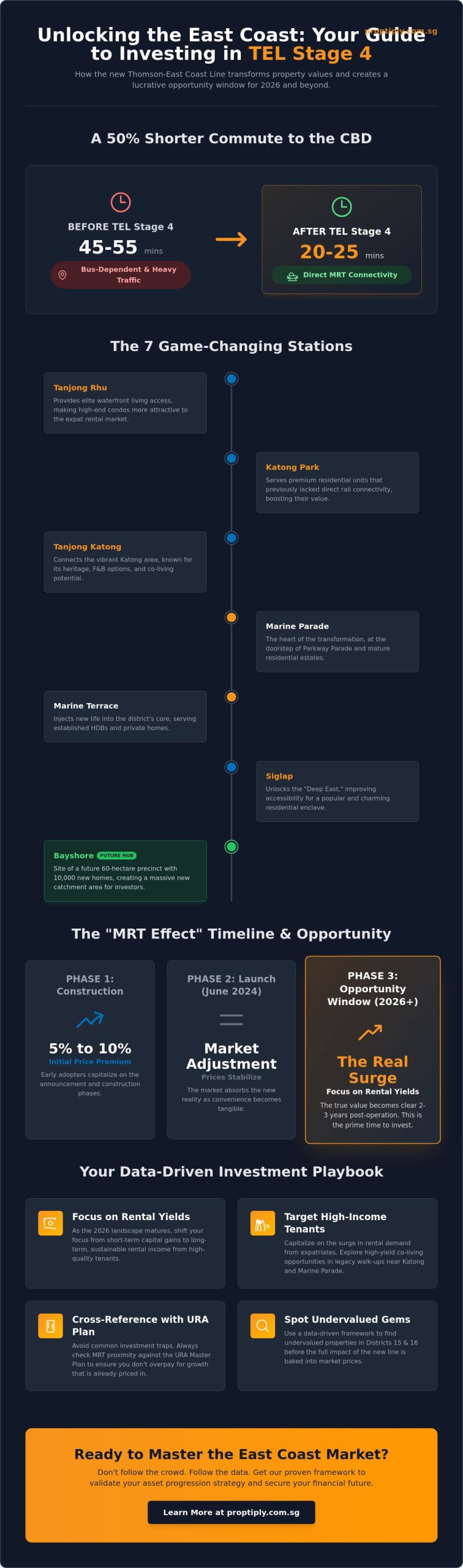
- Understand how the seven new stations from Tanjong Rhu to Bayshore slash travel times to the CBD by 50%, instantly boosting the desirability of East Coast residences.
- Analyze the “MRT effect” on property values and why the completion of tel stage 4 in 2026 presents a more lucrative capital appreciation window than previous rail expansions.
- Capitalize on the surge in rental demand from high-income expatriates by exploring high-yield co-living opportunities in legacy walk-up apartments near Katong.
- Avoid common investment traps by learning how to cross-reference MRT proximity with the URA Master Plan to ensure you don’t overpay for anticipated growth.
- Master a proven, data-driven framework to spot undervalued gems in Districts 15 and 16 before the full impact of the new line is priced into the market.
What is TEL Stage 4 and How Has It Transformed the East Coast?
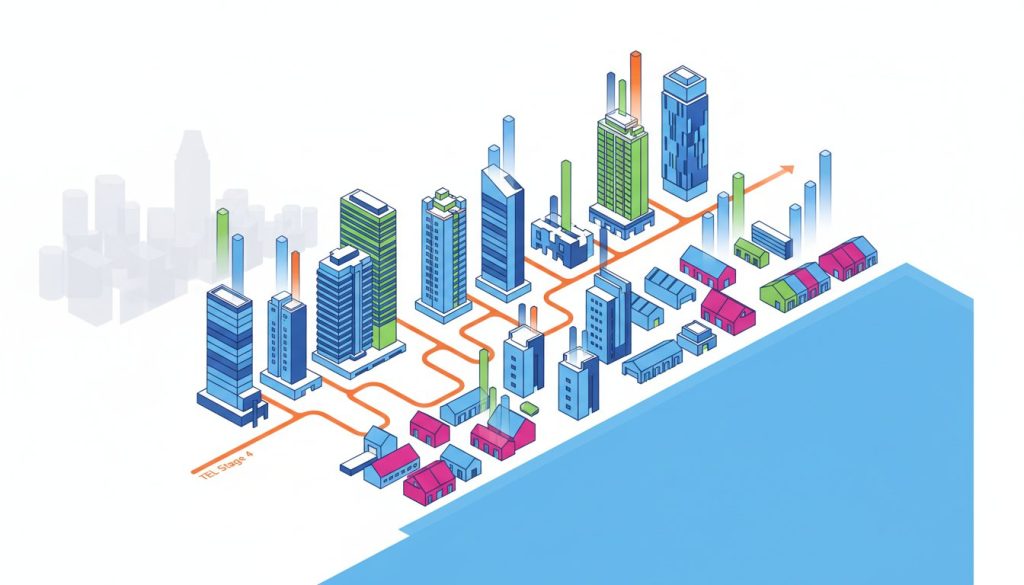
The East Coast has long been regarded as Singapore’s “Gold Coast,” yet it historically suffered from a significant infrastructure gap: a lack of direct MRT access. That changed on June 23, 2024. The official launch of the Thomson-East Coast Line (TEL) Stage 4 has fundamentally rewritten the investment playbook for District 15. This 10.8km stretch isn’t just a new line on the map. It’s a massive connectivity breakthrough that ends the era of “bus-dependent” living for thousands of residents.
For decades, commuting from Marine Parade to the Central Business District (CBD) required navigating heavy traffic on the ECP or relying on bus services that could take 45 to 55 minutes during peak hours. Now, that same journey is slashed by 50%, taking only about 20 to 25 minutes. This drastic reduction in travel time changes the math for rental yields and property valuations. We’ve moved from a “nice-to-have” location to a “must-have” precinct for high-earning professionals who demand both lifestyle and efficiency. If you want to master asset progression, understanding the impact of tel stage 4 is your first step.
The 7 Key Stations of the Thomson-East Coast Line Stage 4
- Tanjong Rhu and Katong Park: These stations provide elite waterfront living access. They serve high-end condominiums that previously lacked rail connectivity, making these premium units far more attractive to the expat rental market.
- Marine Parade and Marine Terrace: This is the heart of the East Coast transformation. These stations sit at the doorstep of major commercial hubs like Parkway Parade and mature residential estates, injecting fresh life into the district’s core.
- Siglap and Bayshore: These stations unlock the “Deep East.” Bayshore is particularly critical as it’s the site of a future 60-hectare precinct that will house 10,000 new homes, creating a brand-new catchment area for savvy investors.
The URA Master Plan Connectivity Goals
The tel stage 4 rollout aligns perfectly with the URA’s “20-minute town” concept. The goal is simple: residents should reach their nearest neighborhood center within 20 minutes using public transport or active mobility. This rail expansion makes that a reality for the East. It also sets the stage for the future. The line will eventually integrate with the Founders’ Memorial station and the Stage 5 extension toward Sungei Bedok, where it will link with the Downtown Line.
The long-term vision for the East Coast Parkway (ECP) corridor involves more than just trains. We’re looking at a future where road space is reclaimed for green corridors and cycling paths. This shift toward a “car-lite” society increases the premium on properties within a 500-meter radius of these new stations. Don’t wait for the prices to fully bake in this reality. The blueprint for growth is already visible for those who know where to look.
Analyzing the “MRT Effect” on Property Values in 2026
The “MRT effect” isn’t a myth. It’s a proven catalyst for asset progression that savvy investors use to build wealth. Since the opening of the tel stage 4 stations in June 2024, the East Coast has transitioned from a “bus-only” lifestyle hub into a high-connectivity powerhouse. Historically, properties near new lines see a 5% to 10% price premium during the construction phase. However, the real surge often happens two to three years post-operation as the convenience becomes a daily reality for tenants and homeowners.
The impact on the East Coast is more pronounced than the TEL’s northern stretch. In the North, the line added capacity to an already connected region. In the East, it unlocked “MRT-starved” enclaves like Marine Parade and Tanjong Rhu. You can see the shift in HDB resale prices. In Marine Parade, 4-room flats that previously struggled with age-related depreciation are now fetching record prices because the commute to Shenton Way has dropped from 45 minutes to under 20.
If you want to master the art of spotting undervalued units, you must look at the shift from capital gains to rental yields. While capital appreciation was the primary play between 2021 and 2024, the 2026 landscape is all about yield. With the official TEL Stage 4 project details confirming seamless transfers to the Circle Line, rental demand from CBD professionals has spiked.
District 15 vs. District 16: Price Gap Analysis
The premium for living within a 10-minute walk of a tel stage 4 station is currently hovering around 15% to 20%. Katong has led the charge with aggressive capital gains over the last 24 months, but Siglap remains a “lagging” opportunity. Our data shows that certain older freehold walk-ups in Siglap haven’t fully priced in the TEL effect yet. These properties are trading at a significant discount compared to new launches in Meyer Road, representing a strategic entry point for those seeking “safe entry” prices. Investors looking to apply a similar entry-price discipline in other MRT-proximate projects can study the Midwood condo investment blueprint, which breaks down how suburban condos near rail stations can deliver outsized returns when bought at the right price point.
The Bayshore Precinct: A New Investment Frontier
Bayshore is the crown jewel of the 2026 investment landscape. The government’s plan to inject 10,000 new HDB flats and 2,500 private homes will transform this precinct into a vibrant residential town.
- Commercial Demand: The “Bayshore Main Street” will drive demand for shop houses and commercial spaces.
- Price Ceilings: Expect new launches in this precinct to set new benchmarks, likely crossing the S$2,800 psf mark by late 2026.
- Infrastructure: The car-lite town design ensures that properties closest to the MRT will hold the highest value retention.
Rental Demand Shifts: Co-Living and Professional Tenants
Stop viewing the East Coast as just a weekend lifestyle destination. The completion of tel stage 4 has fundamentally transformed the district into a high-octane commuter hub. High-income expatriates who previously insisted on living in District 9 or 10 are now pivoting to the East. They want the seaside breeze without sacrificing a 20-minute commute to Shenton Way. This shift is driving a surge in demand for premium rentals near stations like Marine Parade and Tanjong Katong.
Investors must understand the current yield dynamics. While property prices in the East have climbed, leading to some rental yield compression in luxury new launches, absolute rental figures remain robust. The work-from-home trend hasn’t disappeared; it’s evolved. Tenants now seek larger floor plates or unique “character” homes that offer a distinct separation between work and rest. Proximity to a TEL station is no longer a luxury. It’s a non-negotiable requirement for the modern professional tenant.
Co-Living Strategies Along the TEL Corridor
Marine Parade is rapidly becoming a hotspot for digital nomads and young professionals. You can unlock significant value by targetting legacy walk-up apartments in the Katong area. These older assets often feature generous square footage that is perfect for co-living reconfigurations. By applying a proven framework to maximize room count while maintaining high design standards, you can achieve a higher rental yield compared to traditional whole-unit rentals. Managing operational costs in these older developments requires a disciplined approach to maintenance and utility partitioning. You can master these tactics by studying the co-living investment potential available in the current market.
Commercial and Industrial Spillovers
The impact of tel stage 4 extends far beyond residential units. Improved connectivity to Changi Business Park and Paya Lebar has turned the East Coast into a strategic midpoint for corporate tenants. Shophouses and retail units within a 500-meter radius of Marine Parade MRT have seen a dramatic shift in footfall patterns. Since the 2024 opening, weekend crowds have surged by an estimated 15% to 25% in some pockets. This creates a compelling investment case for commercial assets that cater to the increased density of high-spending residents. Look for units with F&B licenses or those that can be converted into boutique wellness studios. These niches offer defensive qualities and consistent cash flow in a volatile economy.
- Target Audience: Fintech and legal professionals working in the CBD.
- Asset Choice: Older walk-ups or 3-bedroom condos with efficient layouts.
- Key Metric: Focus on “rent per square foot” optimization through co-living.
- Exit Strategy: Capitalize on the scarcity of freehold land in District 15.
Common Pitfalls When Investing Near TEL Stage 4
Don’t let the excitement of the new tel stage 4 stations cloud your judgment. Many retail investors rush into the East Coast market thinking any property within a 500-meter radius of a station is a guaranteed goldmine. This is a dangerous assumption. You’ll often find that “MRT proximity” is already priced into the developer’s launch price or the seller’s asking price, sometimes by as much as 15% to 20% above the actual valuation. If you overpay at the entry point, your capital appreciation is effectively capped before you even collect your first rental check.
Successful investing requires looking past the shiny new station signs. You must account for the “noise and congestion” factor. Properties located directly adjacent to major bus interchanges or station entrances often suffer from heavy foot traffic and ambient noise. This can actually lower the desirability for high-quality tenants who prioritize privacy. Not every project near the line will appreciate at the same rate. Factors like the age of the development, the total number of units, and the specific unit floor plan play a massive role in your eventual exit strategy.
- Master Plan Neglect: Failing to check the URA Master Plan for upcoming land sales that could block your “unblocked” sea view.
- Timing Blunders: Ignoring how the April 2023 cooling measures, which raised ABSD for second-property buyers to 20%, impact your total cost of acquisition.
- Holding Power: Underestimating the 3-year Seller’s Stamp Duty (SSD) window which can eat your profits if you’re forced to sell early.
Asset Progression and the ABSD Factor
You can’t master asset progression without mastering the math. To calculate your real ROI, you must subtract the Buyer’s Stamp Duty (BSD) and the Additional Buyer’s Stamp Duty (ABSD) from your projected gains. For many savvy couples, decoupling is the secret weapon to avoid that 20% ABSD hit on a second investment property. We’ve seen cases where investors failed because they entered the market at the peak of a cycle without a clear exit plan, only to be hit by a liquidity crunch when interest rates spiked. Always ensure your tel stage 4 investment maintains a positive cash flow even if interest rates hover around 4%. Investors who want to scale beyond a single property should also explore the quadrant framework for scaling property portfolios in Singapore, which provides a structured approach to diversifying across asset classes while managing ABSD exposure.
Identifying “Ghost” Amenities and Future Construction
Look beyond what’s built today. Check the plot ratios in the surrounding area; a jump from a 1.4 to a 2.8 plot ratio signifies massive future density and potential construction noise for years. The upcoming Cross Island Line (CRL) interchange at Sungei Bedok will be a massive catalyst, but it also means years of hoardings and dust. You also need to scout for aging developments nearby with high en-bloc potential. While a collective sale sounds good, a neighboring site undergoing 48 months of piling works will decimate your rental yield in the short term. For buyers who are currently in an HDB and planning their upgrade path, understanding how the october bto 2024 launch reshaped asset progression timelines is critical context before you commit to any private property purchase. Use a proven framework to vet these risks before you sign the Option to Purchase.
Ready to avoid these expensive mistakes and build a high-yield portfolio? Join our next masterclass to learn the exact blueprint we use to identify undervalued gems in the East Coast.
Mastering the East Coast Market with Proptiply
The full activation of tel stage 4 represents more than just a commute upgrade. It marks a fundamental shift in East Coast property valuations. You can’t rely on guesswork or “gut feelings” to capture this growth. You need a proven framework. Most retail investors buy based on emotion or marketing hype. We use rigorous, data-driven analysis to spot undervalued gems before the 2026 surge. Our methodology focuses on identifying properties where the entry price allows for a safety margin, ensuring your capital stays protected while you wait for the “TEL effect” to peak.
Building a scalable portfolio requires a shift in mindset. You’re not just buying a house; you’re acquiring a cash-generating asset. Proptiply’s bootcamps are designed to strip away the complexity of the Singapore market. We provide the tools to evaluate rental yields and capital appreciation potential with surgical precision. If you want to capitalize on the 2026 market, you must act while the infrastructure is still maturing. The window for maximum gains closes the moment the first passenger taps their EZ-Link card at Marine Parade station.
The Residential Acceleration Program
Success in the local market requires a systematic approach. Our program reveals the insider secrets of building a real estate estate in Singapore by focusing on high-potential residential units along the TEL corridor. We teach you how to filter out the noise and identify properties with the right “X-factor” for capital growth. Our community-led mentorship is your safety net. It helps you avoid expensive S$100,000 mistakes that solo investors often make when they overpay for “freehold” status without looking at the underlying data.
Personalized Portfolio Consultation
Generic advice fails in a specialized market like District 15. The nuances of a specific street or the distance to a tel stage 4 exit can impact your ROI by 10% or more. Book a 1-on-1 session to map your specific asset progression journey. We offer bespoke real estate investment advice that aligns with your long-term wealth goals. Whether you’re looking to transition from an HDB to multiple private properties or explore co-living strategies, we provide the blueprint to make it happen.
Your next steps are clear. The 2026 landscape is being shaped right now. To stay ahead, you should:
- Analyze historical price gaps between East Coast properties and the Rest of Central Region (RCR) average.
- Attend a Proptiply sharing session to understand the mechanics of positive cash flow.
- Review your current loan eligibility to ensure you’re ready to strike when a deal appears.
- Join our community of practitioners who are actively buying in the current market.
Don’t be a spectator to the East Coast’s transformation. Master the framework, use the data, and build the future you deserve. The 2026 market won’t wait for the hesitant. It rewards the prepared.
Secure Your East Coast Legacy Before 2026
The 2026 completion of the Thomson-East Coast Line represents a pivotal shift for Singapore’s property market. You’ve learned how the “MRT Effect” historically accelerates capital appreciation and why the influx of professional tenants is driving demand for specialized co-living spaces. Success in the tel stage 4 landscape isn’t about luck; it’s about applying a disciplined framework to identify high-yield opportunities while avoiding the common pitfalls that trap many amateur investors.
Don’t navigate this complex market alone. Proptiply has trained over 1,000 students in Singapore property strategies, focusing specifically on high-yield co-living and industrial niches that deliver results. Led by active practitioners Jelene Lum and Ervin Ang, we share the exact blueprints we use to build our own portfolios. It’s time to stop theorizing and start taking decisive action toward your financial freedom.
Join our Residential Property Investment Bootcamp to master the TEL Stage 4 trend!
Your path to a secure, cash-flowing portfolio in the East Coast is ready for you to unlock. We’ll see you at the bootcamp.
Frequently Asked Questions
What are the 7 stations in TEL Stage 4?
TEL Stage 4 consists of seven key stations: Tanjong Rhu, Katong Park, Tanjong Katong, Marine Parade, Marine Terrace, Siglap, and Bayshore. These stations officially opened on June 23, 2024, providing direct rail access to the East Coast region. You can now travel from Bayshore to the city center in under 30 minutes. This connectivity transforms the East Coast from a bus-dependent area into a high-accessibility corridor.
How much have property prices increased since TEL Stage 4 opened?
Property prices in District 15 saw a capital appreciation of approximately 15% to 20% in the five years leading up to the 2024 launch of tel stage 4. Recent URA data shows that median prices for non-landed private homes in the Rest of Central Region reached roughly S$2,500 per square foot by 2026. This growth reflects the market’s pricing in the MRT effect as accessibility improves for residents.
Is it still a good time to buy property near Marine Parade MRT in 2026?
Buying near Marine Parade MRT in 2026 remains a strategic move for long-term asset progression. While the initial announcement pop has passed, the actual utility of the line sustains high rental demand from professionals working in the CBD. Focus on freehold properties or those with rejuvenation potential. You’ll avoid the construction risk while benefiting from a mature neighborhood that now boasts top-tier connectivity.
How does TEL Stage 4 affect rental yields in the East Coast?
Rental yields in the East Coast have seen a positive shift, currently averaging between 3.2% and 3.8% for well-located units. Tenants are willing to pay a premium of 10% to 15% for homes within a 500-meter radius of the new stations. Use our proven framework to identify undervalued units that offer high cash flow potential. The reduced commute time to Shenton Way makes these properties highly attractive to the expat demographic.
What is the Bayshore Master Plan and how does it relate to TEL4?
The Bayshore Master Plan is a 60-hectare residential precinct designed to house about 10,000 new homes, including 7,000 HDB flats. It directly integrates with the Bayshore and Bedok South stations on the tel stage 4 line. This development creates a first-mover advantage for investors. The plan emphasizes car-lite living and green corridors, ensuring the area remains a high-value lifestyle destination for decades.
Will TEL Stage 4 impact HDB resale prices in Bedok?
HDB resale prices in Bedok South have increased by 8% to 12% since the line’s completion. Flats that were previously 15 minutes away from an MRT station by bus are now within walking distance of the TEL. This shift has pushed several 5-room flats in the area toward the S$900,000 mark. It’s a classic example of how infrastructure unlocks value in older estates.
How does the Thomson-East Coast Line connect to the CBD?
The Thomson-East Coast Line provides a direct, seamless connection to the CBD via stations like Shenton Way, Maxwell, and Great World. Commuters from Marine Parade can reach the heart of the financial district in approximately 20 minutes without any line changes. This eliminates the need for the crowded East-West Line transfers at Paya Lebar or Raffles Place. It’s a game-changer for those seeking a work-live-play balance.
Are there any commercial investment opportunities near the new stations?
Commercial opportunities are thriving, particularly for street-level retail units and shophouses in the Katong and Marine Parade areas. Increased footfall from the MRT stations has driven up commercial rents by 5% to 7% annually. Look into co-living conversions or boutique office spaces that cater to the growing work-from-near-home trend. These assets provide a stable hedge against inflation while offering robust positive cash flow.