
What if the most resilient asset in your 2026 portfolio isn’t a luxury condo or a standard warehouse, but a specialized business park unit? You likely feel that premium commercial real estate is reserved for institutional giants, or find yourself confused by the thin line separating B1 industrial zoning from high-spec spaces. It’s a common pain point for many Singaporean investors who want to scale but fear the high barrier to entry or the technicalities of the URA Master Plan 2025.
Companies must engage in high-technology, R&D, or knowledge-intensive activities to rent space in a business park. This includes software development, data processing, and regional headquarters operations that don’t involve heavy manufacturing. JTC Corporation and URA strictly enforce these guidelines to ensure the ecosystem remains a hub for innovation. If you are planning to establish a qualifying entity, you can find out more about Singapore Company Incorporation to ensure your business is structured correctly from the start. Always check if your business activity aligns with the URA’s list of approved categories before signing a lease. Following this proven framework prevents you from making expensive mistakes with your tenancy applications.
We’re here to share the insider knowledge you need to master these nuances and unlock the potential of this high-tech asset class. This guide serves as your proven blueprint for identifying high-growth clusters like the Jurong Innovation District and Changi Business Park. We’ll show you exactly how to integrate these properties into a diversified portfolio, whether you choose the path of REITs or direct acquisition. It’s time to stop guessing and start applying a systematic framework to secure your passive income and avoid expensive mistakes.
Key Takeaways
- Master the URA guidelines for high-technology and R&D activities to ensure your investments meet the strict “knowledge-intensive” requirements.
- Understand the critical differences in rental premiums and capital appreciation potential when comparing a business park to traditional industrial spaces.
- Identify the most suitable entry point for your capital—whether through REITs or direct acquisition—using our proven risk-reward framework.
- Navigate Singapore’s high-growth clusters like One-North and IBP to align your asset progression with the URA’s decentralization strategy.
- Future-proof your property portfolio by leveraging the 2025 Master Plan’s shift toward regional hubs and polycentric development.
Understanding the Business Park Concept in Singapore
A business park isn’t just a cluster of offices; it’s a specialized land use zone designated by the Urban Redevelopment Authority (URA) specifically for non-pollutive, high-technology, and R&D activities. To secure a spot here, companies must prove they engage in “high value-added” and “knowledge-intensive” work. This isn’t for your average trading firm or back-end administrative office. We’re talking about software development, biotechnology, and high-end engineering. Business Parks serve as the critical infrastructure for Singapore’s Industry 4.0, providing the high-spec environment needed for a digital-first economy to thrive.
You can spot these precincts by their distinct physical characteristics. Unlike the gritty industrial estates of the past, these hubs offer campus-like settings with lush greenery and superior building specifications. They feature floor-to-ceiling windows, high floor loading capacities, and advanced telecommunications infrastructure. These premium environments attract “blue-chip” tenants, including MNCs, tech giants, and pharmaceutical research firms that require sophisticated ecosystems to drive innovation.
BP vs. BP-White: Decoding the Zoning
Smart investors pay close attention to the “White” component in zoning. While a standard business park zone focuses on core industrial activities, a BP-White site allows a percentage of the floor area to be used for retail, F&B, or even childcare facilities. This flexibility is a massive advantage. It increases the Gross Plot Ratio (GPR) and boosts the overall asset value by transforming the development into a self-contained lifestyle hub. For an investor, this translates to higher rental yields and better tenant retention rates because employees enjoy the convenience of on-site amenities.
The Evolution of Singapore’s Business Park Landscape
The journey began with the launch of the Singapore Science Park in 1980, marking our shift toward a technology-driven economy. Since then, JTC Corporation has played a pivotal role in master-planning specialized zones that cluster similar industries together. From the early days of basic industrial estates, we’ve moved into integrated hubs like One-North and Changi Business Park. These areas are designed to foster collaboration between private firms and public research institutes. By understanding this evolution, you can see how the government’s systematic approach creates a stable, high-demand environment for property investment.
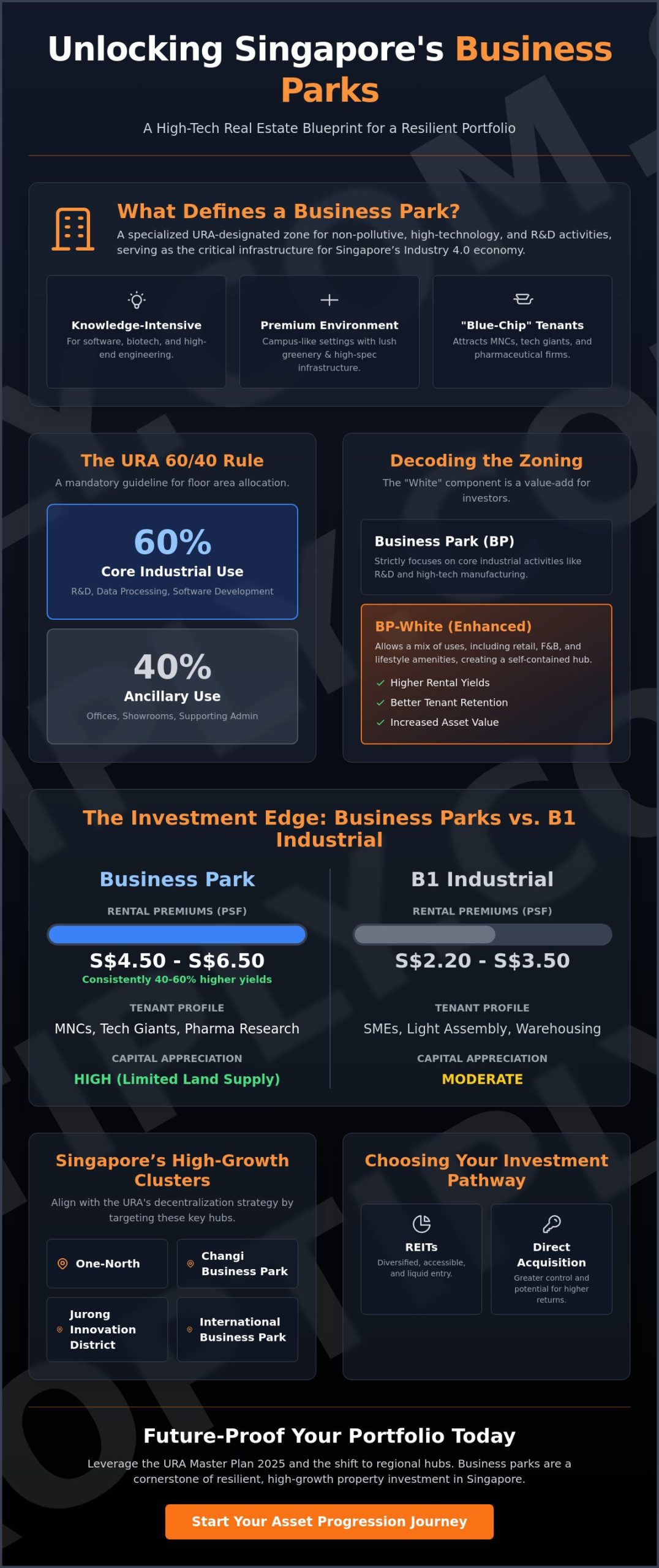
To succeed in this niche, you need to master the regulatory framework that governs these spaces. The URA mandates a “60/40 rule,” where at least 60% of the total floor area must be dedicated to core industrial activities like R&D or data processing. The remaining 40% can be used for ancillary offices or showrooms. Following this blueprint ensures you stay compliant while maximizing your property’s potential for positive cash flow. Don’t let the technical jargon intimidate you; once you grasp these zoning fundamentals, you’ll unlock a powerful asset class that offers both stability and growth.
Strategic Differences: Business Parks vs. Industrial Parks
You need to understand that not all industrial spaces are created equal. Distinguishing between a standard B1 industrial property unit and a business park asset is the first step to mastering this asset class. The Urban Redevelopment Authority (URA) applies the 60/40 rule to both, requiring 60% of the floor area for core industrial activities. However, the definition of “activity” differs significantly. While a B1 space might house light assembly or generic warehousing, business parks are strictly reserved for high-technology, R&D, and knowledge-intensive industries. This regulatory barrier creates an exclusive environment that protects your investment from market oversaturation.
Investors often see a massive gap in rental performance. Prime business park spaces in clusters like one-north or Changi Business Park frequently command rents between S$4.50 and S$6.50 per square foot. Compare this to standard B1 industrial units, which typically hover between S$2.20 and S$3.50 per square foot. You aren’t just buying floor space; you’re buying into a corporate ecosystem. Tech giants and pharmaceutical MNCs choose these locations because they prioritize corporate image and talent retention over raw cost. If you want to unlock higher rental yields, you must target the specs these tenants demand.
- Rental Premiums: BP assets consistently outperform B1 units by 40% to 60% in monthly rental income.
- Capital Appreciation: Limited supply of BP land ensures better long-term value retention compared to generic industrial zones.
- Amenity Factor: Modern business parks offer lifestyle hubs, high-end F&B, and lush greenery that standard factories simply don’t provide.
Technical Specifications and Building Requirements
High-specification buildings are the blueprint for success in this sector. Modern business park developments feature floor loadings of 5.0kN/sqm to 7.5kN/sqm and clear ceiling heights of at least 4.0 meters. These technical thresholds allow for the installation of specialized infrastructure like cleanrooms, specialized exhaust systems, and reinforced labs. If a building lacks the power provision for high-intensity computing or R&D equipment, it won’t attract the top-tier tenants that drive your passive income.
Tenant Profiles and Lease Structures
The stability of your cash flow depends on who pays the rent. Business parks attract Fortune 500 companies and regional headquarters that sign long-term leases of five to ten years. These MNCs invest millions into their fit-outs, making them “sticky” tenants with very low turnover rates. In contrast, standard industrial areas often see SMEs on shorter two-year cycles. To see how these zones compare across the island, check out our Singapore industrial area roundup for a full breakdown of localized performance data. This specialized focus is what allows seasoned investors to build a secure, recession-resistant portfolio.
The Investment Landscape: How to Participate in the BP Sector
Securing a foothold in the business park sector requires a tactical approach and a clear understanding of the entry points. You’ve got three main paths to choose from: S-REITs, stratified units, or the direct acquisition of entire buildings. While institutional heavyweights like CapitaLand and Mapletree own the majority of the landscape, there are still ways for savvy individual investors to claim their share of the pie. You just need the right blueprint to navigate the high barriers to entry that define this asset class.
Risk and reward in this sector are closely tied to the global tech and R&D cycles. Tech clusters offer incredible growth potential, but they also carry higher volatility compared to traditional industrial spaces. If a major multinational shifts its R&D hub, occupancy can fluctuate. By 2026, the barrier to entry for individual investors remains significant because most BP assets are priced well above the S$50 million mark. This makes the sector a playground for institutional players, though it doesn’t mean you’re locked out. It simply means you must be more calculated in how you participate.
Investing via Singapore REITs (S-REITs)
S-REITs are the most accessible gateway for retail investors looking to unlock the potential of the business park market. CapitaLand Ascendas REIT (CLAR) and Mapletree Industrial Trust are the dominant forces here, holding prime assets in locations like One-North and Changi Business Park. You get the benefit of professional management and high liquidity without the stress of facility maintenance or tenant negotiations. For the 2026 outlook, investors should target dividend yields of 5.3% to 5.9% for REITs with heavy business park concentrations, reflecting stabilized interest rates and steady rental growth in high-spec clusters. This is a proven strategy for building passive income with a lower capital requirement.
Direct Ownership: Stratified Business Park Units
If you prefer direct control over your assets, stratified units are a rare but rewarding opportunity. These units are hard to find because most BP-zoned land is held by JTC or large developers under single-title deeds. When you find a stratified unit, you must perform rigorous due diligence on the remaining leasehold tenure. A 30-year lease requires a much more aggressive capital recovery plan than a 60-year lease. Don’t forget that commercial property acquisitions in Singapore attract 9% GST, which you’ll need to factor into your initial capital outlay. Financing typically allows for an 80% Loan-to-Value ratio for corporate entities, but you’ll need a solid business case to secure the best rates. Mastering these technicalities is the difference between a mediocre investment and a high-yield success story. Investors looking to reduce their education costs can also explore using SkillsFuture credits to fund professional property investment training before committing capital to this complex asset class.
Key Clusters: Navigating Singapore’s Business Park Map
Singapore’s business park landscape isn’t a monolith. It’s a series of specialized ecosystems designed to attract specific industries. You need to understand these micro-markets to spot where the highest yields are hiding. One-North stands as the undisputed champion of this model. Spanning 200 hectares, it’s a high-tech cluster where Biopolis, Fusionopolis, and Mediapolis converge. Rental demand here remains fierce because it’s the primary home for R&D, Infocomm, and Media giants. If you want an asset that benefits from a concentrated talent pool, this is your baseline.
International Business Park (IBP) offers a different strategic play. It serves as the gateway to the Jurong Lake District, Singapore’s upcoming second CBD. While some buildings in IBP are older, the area’s integration into the wider Western region’s transformation provides a significant safety net for capital preservation. Meanwhile, Science Parks 1 and 2 are shedding their “legacy” labels. CapitaLand’s S$883 million revitalization project at Science Park 1 is a clear signal. They’re transforming these spaces into campus-style environments that appeal to modern life sciences and deep-tech firms. Don’t overlook these older hubs; their modernization is creating fresh entry points for savvy investors.
The Rise of the Jurong Innovation District
The “Western Gateway” is no longer a future concept. It’s happening now. The Jurong Innovation District (JID) is a 600-hectare powerhouse dedicated to advanced manufacturing and robotics. Accessibility is the big story here. With the Jurong Region Line (JRL) expected to be fully operational by 2029, and the TEL Stage 4 already improving connectivity, the “distance” barrier is vanishing. JID creates a massive synergy with the Tuas Mega Port. This isn’t just about office space; it’s about being part of a supply chain ecosystem that will dominate the next decade of Singapore’s industrial growth.
Eastern Promise: Changi and Punggol Digital District
Changi Business Park (CBP) has solidified its reputation as the “Canary Wharf of the East.” It’s a financial back-office powerhouse, hosting names like DBS and Standard Chartered. Its proximity to the airport makes it a natural fit for aviation logistics and cybersecurity firms. However, the real excitement in the East is shifting toward the Punggol Digital District (PDD). As Singapore’s first “Enterprise District,” PDD integrates JTC’s business spaces with the Singapore Institute of Technology (SIT). This creates a plug-and-play environment for fintech and AI startups. For those seeking the latest real estate investment advice, PDD represents the new blueprint for high-productivity land use. It’s where the next generation of tech tenants will congregate.
Future-Proofing Your Portfolio: URA Master Plan 2025 and Beyond
The URA Master Plan 2025 isn’t just a government roadmap; it’s your investment blueprint for the next decade. Singapore is aggressively pushing a “Polycentric” development strategy to bring jobs closer to homes. This decentralization move transforms regional hubs like Jurong Lake District and the Punggol Digital District into economic powerhouses. When you invest in a business park located within these strategic clusters, you’re aligning your capital with national growth. These hubs reduce the strain on the Central Business District while creating localized demand for high-spec office and industrial spaces.
Recent cooling measures have fundamentally shifted the investment landscape. While residential investors face a staggering 60% Additional Buyer’s Stamp Duty (ABSD) for foreign buyers, the commercial sector remains a sanctuary. You don’t pay ABSD on commercial or industrial assets. This regulatory environment has redirected massive capital flows toward the business park segment. Smart investors are moving away from low-yield residential units and pivoting toward assets that offer stable, long-term rental income from corporate tenants. Proptiply’s CAIP framework helps you navigate this shift by identifying undervalued commercial assets that others overlook due to a lack of technical knowledge.
Sustainability and Green Mark Certifications
ESG compliance is no longer optional for MNCs. Global corporations now prioritize leasing space in buildings with BCA Green Mark Platinum or Super Low Energy certifications. This creates a “Green Premium” where eco-friendly buildings command rents 5% to 10% higher than their traditional counterparts. Energy efficiency directly impacts your long-term valuation by lowering operating costs and attracting higher-quality tenants. If you’re looking at older assets, take advantage of government incentives like the Green Mark Incentive Scheme (GMIS) for retrofitting. Upgrading an older building’s efficiency is a proven way to force appreciation and “future-proof” your yield against rising energy costs.
Next Steps: Mastering Commercial and Industrial Investment
Execution is the bridge between a dream and a portfolio that generates passive income. Most people hesitate because they fear making “expensive mistakes” in a technical market. You need education before you deploy capital. Our Commercial and Industrial Program (CAIP) provides the insider knowledge you need to analyze floor loadings, power requirements, and zoning laws with confidence. We don’t just teach theory; we share the exact blueprint we use to build our own portfolios. If you’re looking to offset the cost of professional property education, find out how to maximise your SkillsFuture credits for property investment courses before the 2026 rules shift. Stop guessing and start following a system that works.
- Identify high-growth clusters before they peak.
- Master the technical due diligence for industrial assets.
- Unlock positive cash flow through strategic asset progression.
Don’t let another market cycle pass you by while you’re sitting on the sidelines. It’s time to take control of your financial destiny. Schedule a 1-on-1 Property Portfolio Consultation to map your BP strategy and discover how to secure your piece of the Singapore growth story.
Secure Your Stake in Singapore’s 2026 Industrial Evolution
The window to capitalize on the business park sector is narrowing as the URA Master Plan 2025 begins to reshape our local landscape. You’ve seen how these high-spec spaces differ from traditional industrial assets by attracting tech and R&D giants that drive resilient rental yields. Success in this niche isn’t about luck; it’s about applying a systematic approach to asset progression and identifying clusters with the highest growth potential. These strategic moves ensure your capital works harder in an increasingly competitive environment.
Don’t let market complexity hold you back from building a multi-property portfolio. Founded by seasoned investors Jelene Lum and Ervin Ang, Proptiply provides a proven framework designed specifically for the Singapore market. We focus on high-yield industrial and commercial niches that most retail investors overlook. It’s time to stop guessing and start following a blueprint that delivers real-world results. Our methodology is built on years of active investing and successful exits.
Master the secrets of commercial property at our next CAIP bootcamp. Take the first step toward your financial freedom today. You have the potential to master this market and secure your legacy through disciplined action.
Frequently Asked Questions
What is the difference between a business park and a science park in Singapore?
A business park caters to high-tech and knowledge-based industries like software development or back-room financial operations. In contrast, a science park is a specialized hub strictly for research and development (R&D) and high-technology innovation. While both fall under the same zoning in the URA Master Plan, science parks like Science Park 1 and 2 require companies to engage in deeper R&D activities to qualify for tenancy. You’ll find more lifestyle amenities in a modern business park compared to the laboratory-focused environment of a science park.
Can an individual investor buy a unit in a business park directly?
You generally can’t buy a single unit in a business park directly because most developments are owned by institutional investors or Real Estate Investment Trusts (REITs) like CapitaLand Ascendas REIT. Most assets are held under a single title to maintain high-quality tenant mixes and professional management. To gain exposure, individual investors usually buy shares in industrial REITs or look for rare strata-titled industrial properties that offer similar high-yield potential in nearby B1 industrial zones. This is a key part of a smart asset progression strategy.
What are the qualifying activities for a company to rent space in a business park?
Companies must engage in high-technology, R&D, or knowledge-intensive activities to rent space in a business park. This includes software development, data processing, and regional headquarters operations that don’t involve heavy manufacturing. JTC Corporation and URA strictly enforce these guidelines to ensure the ecosystem remains a hub for innovation. Always check if your business activity aligns with the URA’s list of approved categories before signing a lease. Following this proven framework prevents you from making expensive mistakes with your tenancy applications.
How does the 60/40 rule apply to business park developments?
The 60/40 rule dictates that at least 60% of the total floor area must be used for core industrial activities like R&D or data logging. The remaining 40% can be used for ancillary purposes such as administrative offices, meeting rooms, or showrooms. Mastering this ratio is vital for compliance and maintaining your lease. If a company uses more than 40% of its space for pure office work, it risks facing enforcement actions from JTC. This rule ensures that industrial land isn’t converted into pure office space.
Is GST applicable when purchasing a business park property in Singapore?
Yes, you must pay GST when purchasing a business park property because it’s classified as non-residential. As of January 1, 2024, the GST rate is 9%. If you’re buying through a GST-registered company, you can typically claim this back as input tax. This is a crucial step in your financial blueprint to ensure you don’t lose out on significant capital at the start of your investment journey. Always consult with a tax professional to ensure your structure allows for these claims.
What is the typical lease duration for business park land in Singapore?
Most modern business park land in Singapore is leased for 30 years. While older developments might have 60-year or 99-year leases, the government shifted toward shorter 30-year tenures in 2012 to ensure land use remains flexible. Shorter leases mean you must be more disciplined with your calculations to ensure positive cash flow. Always verify the remaining lease term on the JTC portal before committing your capital to any industrial asset. This transparency is vital for protecting your investment returns.
How does the URA Master Plan 2025 affect existing business park valuations?
The URA Master Plan 2025 emphasizes decentralization, which boosts valuations for business parks located in regional centers like Jurong Lake District and Tampines. By increasing plot ratios and improving connectivity through the Cross Island Line, the government is driving more demand toward these hubs. Investors who position themselves early in these growth corridors can unlock significant capital appreciation as these regional centers mature. It’s about following a logical path to wealth by aligning with national development goals.
Why do business parks usually have better amenities than traditional industrial estates?
Business parks offer superior amenities like high-end F&B outlets, childcare centers, and lush green spaces to attract a white-collar workforce. Traditional industrial estates focus on logistics and manufacturing efficiency, often lacking the lifestyle balance found in hubs like Changi Business Park. These premium features allow landlords to command higher rents and attract stable, multinational tenants. This makes them a lucrative niche for those who follow a disciplined investment methodology. Better amenities translate directly into higher tenant retention and stronger rental yields.