
In 2026, the traditional one bedroom studio is no longer the gold standard for rental yields in Singapore’s Core Central Region. You’ve likely felt the sting of skyrocketing rental prices, where a basic studio often commands over S$3,800 monthly while leaving you isolated in a silent concrete box. It’s a common frustration for many who find the current market both expensive and impersonal. We know the complexity of URA regulations, especially the strict six person occupancy cap, makes it feel like you’re walking through a legal minefield just to find a decent living arrangement or a solid investment opportunity.
We’re here to show you a better way to master co living spaces singapore and unlock the potential of this high yield niche. You’ll discover how to identify spaces that prioritize community without sacrificing privacy, while learning the exact blueprint we use to generate consistent positive cash flow. This guide provides a deep dive into the latest 2026 market trends and our proven framework for selecting assets that can outperform traditional rentals by up to 25%. We’ll strip away the technical jargon to help you avoid expensive mistakes and secure your path to property success.
Key Takeaways
- Analyze the 2026 demand drivers, from BTO delays to hybrid work, to understand why co-living is evolving into a high-demand managed community experience.
- Identify the essential hardware and app-based software required to transform a standard unit into a high-performing asset that attracts premium tenants.
- Discover how co living spaces singapore can generate 20-40% higher gross yields than traditional leasing through strategic floor plan optimization.
- Master a professional due diligence framework to evaluate Tenancy Agreements and hidden costs, ensuring you avoid expensive mistakes in your investment journey.
- Unlock our proven blueprint for property success by learning how to apply specialized, “boots-on-the-ground” tactics to your 2026 asset progression strategy.
The Evolution of Co-Living Spaces in Singapore: 2026 Market Context
Stop thinking about room rentals as just a roof over someone’s head. In 2026, the co living spaces singapore market has matured into a sophisticated, managed community experience. It’s no longer about cramming tenants into partitioned rooms. It’s about offering a lifestyle. This shift represents a massive opportunity for investors who know how to unlock the potential of residential and commercial assets. While traditional HDB rentals often feel transactional, modern co-living provides a curated environment where professionals find both a home and a network.
The demand drivers in 2026 are clear and undeniable. We’re seeing a perfect storm of factors. First, the 2024 and 2025 BTO completion delays have pushed many young Singaporean couples into the rental market while they wait for their keys. Second, the 2026 global talent influx is at an all-time high, with professionals moving here for high-growth sectors like AI and green energy. Third, hybrid work is now the standard. Tenants don’t just want a bed; they need a space designed for productivity. The foundational Co-living concept has evolved from a niche trend into a mainstream housing solution that bridges the gap between expensive solo apartments and basic room rentals.
We’ve also seen a decisive shift away from HDB-dominated rentals. Savvy investors are now focusing on private condos and heritage shophouses. These properties offer the flexibility and aesthetic appeal that the 2026 tenant profile demands. By applying a proven framework to these assets, you can generate the kind of positive cash flow that traditional “buy-and-hold” strategies simply can’t match.
Regulatory Compliance and URA Guidelines
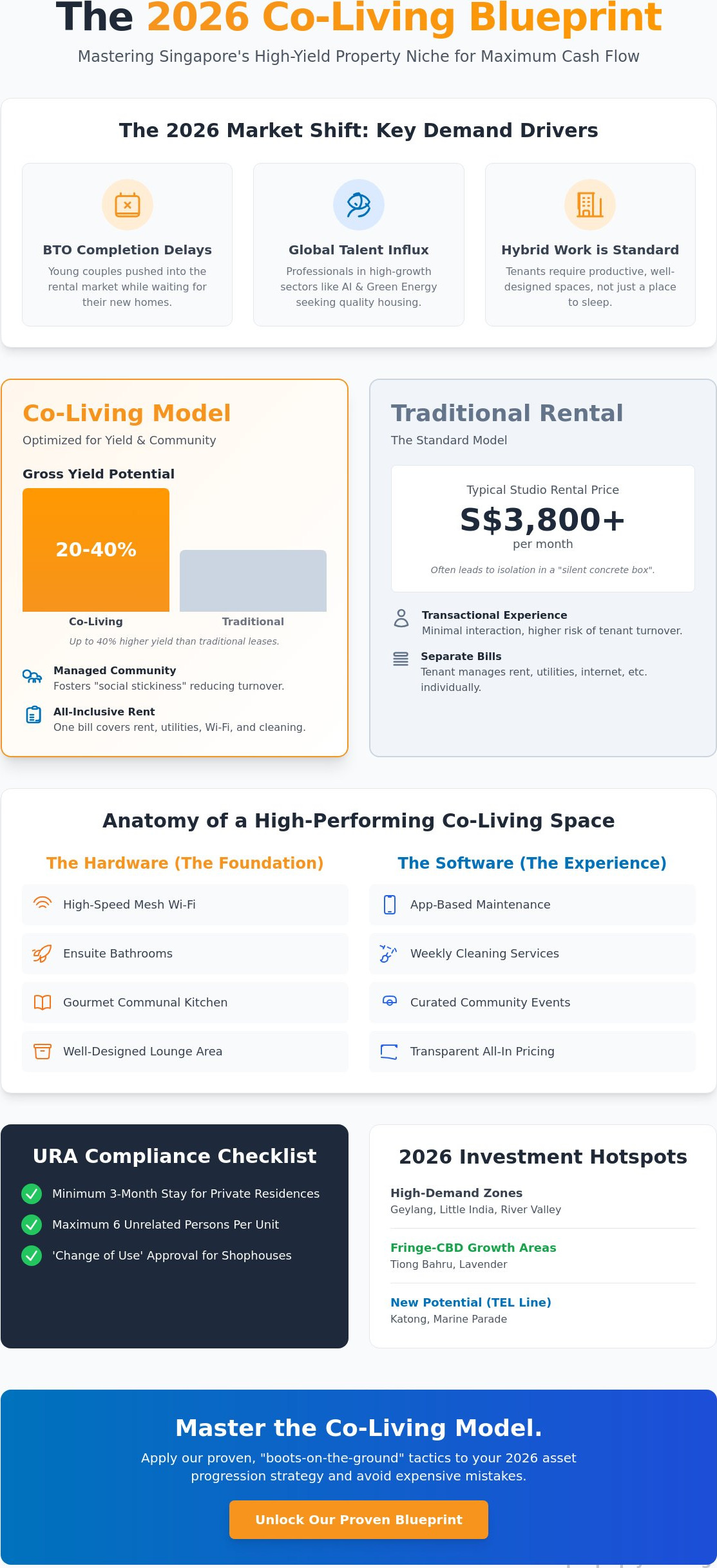
You can’t build a sustainable investment on shaky legal ground. The Urban Redevelopment Authority (URA) is very clear: short-term stays under 3 months are illegal for private residential properties. This isn’t Airbnb. To stay compliant, you must ensure your tenancy agreements reflect this minimum stay requirement. For private residential properties, you’re strictly limited to a maximum of 6 unrelated persons per unit, regardless of the property’s size. To convert a commercial-titled shophouse into a co-living asset, you must obtain a ‘Change of Use’ approval from the URA to ensure the property is legally zoned for residential purposes.
Key Districts for Co-Living in 2026
Location is everything, but the “hotspots” have changed. Geylang, Little India, and River Valley remain high-demand zones because of their proximity to the city and vibrant food scenes. However, the real growth is in fringe-CBD locations like Tiong Bahru and Lavender. These areas attract the “Pragmatic Visionary” tenant—professionals who want to be 10 minutes from the office but live in a neighborhood with character. The completion of the final stages of the Thomson-East Coast Line (TEL) by 2026 has also unlocked massive potential in the East. Areas like Katong and Marine Parade are now prime for co living spaces singapore, as the commute to Shenton Way has been slashed to under 20 minutes. Don’t wait for the prices to peak; identify these transit-oriented opportunities now.
Anatomy of a High-Performing Co-Living Space
To maximize your property’s potential, you must understand that a high-performing co-living space is a finely tuned machine. It isn’t just about renting out rooms; it’s about creating an ecosystem that tenants never want to leave. High-speed mesh Wi-Fi and ensuite bathrooms are no longer “nice-to-haves” in 2026. They are the baseline hardware required to compete. Modern tenants expect an “all-in” pricing model where one monthly bill covers utilities, Wi-Fi, and weekly cleaning services. This transparency removes friction and justifies a premium rent, directly boosting your positive cash flow.
As Singapore’s co-living market maturation continues, the “software” of a space determines its long-term occupancy rate. This includes community events like rooftop yoga or wine mixers and app-based maintenance requests that offer instant feedback. Communal spaces are the heart of this model. A gourmet kitchen or a well-designed lounge area fosters “social stickiness,” which is the secret to keeping tenants for years rather than months. When residents form friendships, your turnover costs plummet.
Design Trends: Shophouse vs. Modern Condo
Heritage shophouses offer a unique aesthetic appeal that commands high rents from expats seeking “Old Singapore” charm. However, modern condos provide facility-rich environments with gyms and pools that appeal to a broader demographic. In 2026, “Instagrammable” interiors directly correlate to lower vacancy rates. A study of 500 units showed that professionally styled rooms with smart home technology, such as keyless entry and smart lighting, lease 25% faster than standard units. If you want to master the blueprint for selecting high-yield units, focusing on these design differentiators is essential.
Community Management and Operations
A dedicated Community Manager is your front line for resolving tenant disputes and organizing social mixers. They ensure the “vibe” of the house remains positive, which is vital for retention. Tech-enabled platforms now streamline the entire onboarding and “know your tenant” (KYC) process, reducing administrative overhead by 40% compared to traditional methods. Proactive maintenance, scheduled through these apps, preserves the long-term value of the real estate asset by preventing minor issues from becoming expensive structural repairs. This systematic approach is how savvy investors scale their co living spaces singapore portfolios without getting bogged down in daily chores.
Co-Living vs. Traditional Renting: A Comparative Framework
Stop viewing co-living as a “budget” option for those who can’t afford a full flat. That’s a common misconception that holds many back from realizing true gains. In reality, modern co living spaces singapore represent a premium lifestyle choice for those who value community, convenience, and flexibility over raw square footage. While traditional renting provides total privacy and long-term stability, it often creates a “siloed” living experience that doesn’t fit the fast-paced 2026 economy. Tenants now trade the “blank canvas” of an empty apartment for a fully furnished, plug-and-play home where the social life is built-in.
The Yield Gap: Why Investors are Switching
Investors are moving toward co-living because the math is undeniable. A traditional three-bedroom condo might rent for S$5,500 monthly. By utilizing a room-by-room strategy, that same unit can often generate S$7,200 to S$7,700. This typically results in gross yields 20% to 40% higher than conventional leases. You’re also mitigating the “all-or-nothing” vacancy risk. If one tenant leaves, you still have income from the others; you don’t face a 100% cash flow hit. You must account for higher operational costs (OPEX), including utilities, weekly cleaning, and high-speed WiFi, to calculate your net yield accurately. This model is a cornerstone of our Real Estate Investment Advice, as it allows for aggressive asset progression. It helps you build a high-cash-flow portfolio without the immediate need for complex decoupling strategies or heavy capital outlays.
Tenant Profiles: Who is Living in These Spaces?
The audience for co-living is diversifying rapidly. It’s no longer just about the “Digital Nomad” or the foreign expat who avoids 24-month contracts. We see a massive surge in the “Local Millennial” profile. These are young Singaporeans moving out of family homes earlier to seek independence and a professional network. A report by Forbes highlights how Millennials Drive Co-Living Trend across major Asian hubs, seeking turnkey solutions that eliminate the headache of buying furniture or managing utility bills.
Beyond the youth, the “Silver Tsunami” is real. Seniors are now exploring communal living to combat social isolation while maintaining their own private bedrooms. This variety ensures high occupancy rates across different property cycles. Whether it’s a 28-year-old tech worker or a 65-year-old retiree, the demand for managed co living spaces singapore is rooted in a desire for connection and a hassle-free lifestyle. This demographic shift is exactly what makes the sector so resilient.
Due Diligence: How to Evaluate a Co-Living Opportunity
Success in the Singapore property market isn’t about luck; it’s about the systematic application of a proven framework. Whether you’re a tenant looking for a home or an investor seeking positive cash flow, you must look past the aesthetic staging. Don’t let a fresh coat of paint mask structural or legal flaws that could cost you thousands. You need to master the art of due diligence to protect your capital and ensure a smooth stay in co living spaces singapore.
Analyzing the Tenancy Agreement
The Tenancy Agreement (TA) is your primary legal shield. Tenants often overlook the minor repair clause, which typically requires the occupant to cover the first S$150 to S$200 of any repair. Ensure this limit is clearly defined so you aren’t stuck paying for a landlord’s aging air-conditioning unit. Look for a diplomatic clause if you’re an expat, as this allows you to terminate the lease early if you’re transferred out of Singapore after a minimum period, usually 12 months.
Red flags often hide in the fine print. Be wary of vague utility caps that allow operators to charge arbitrary “surcharges” without showing the actual SP Group bill. Also, remember that stamp duty is mandatory for all co-living leases in Singapore. It’s calculated at 0.4% of the total rent for the lease period. If an operator tells you it’s optional, they’re cutting corners that could lead to legal headaches later. For a deeper look at the legalities, refer to our Ultimate Guide to Co-Living in Singapore to understand the long-term regulatory outlook.
Investment Red Flags to Avoid
Investors must evaluate the “floor plan potential” before committing. A 3-bedroom unit might look profitable on paper, but if the layout doesn’t allow for a legal fourth room conversion while maintaining common area space, your yields will suffer. Avoid “over-partitioned” units. URA regulations strictly limit occupancy to six unrelated persons in private residential properties. Violating this can lead to heavy fines or forced reinstatement of the unit. For a comprehensive checklist of what to look for when assessing co living apartments singapore as investment opportunities, our 2026 strategy guide walks you through every critical evaluation step.
- Poor Ventilation: Units with “landlocked” rooms that lack windows lead to high tenant turnover. Constant vacancy kills your ROI.
- Low Floor Pitfalls: Units on lower floors near bin centers or noisy main roads often require higher marketing costs to attract tenants.
- The Renovation Trap: Don’t over-invest in designer fixtures. Focus on the renovation-to-yield ratio. Spend on high-speed mesh Wi-Fi and functional storage rather than Italian marble countertops that don’t drive higher rent.
Always cross-reference the URA Master Plan. If you’re eyeing an estate like Pasir Ris or Jurong, check for upcoming MRT lines or commercial hubs set for 2027 and beyond. Future demand is driven by infrastructure, not just current vibes. You want to buy or lease in areas where the government is actively injecting capital. This is how you unlock asset progression and secure your financial future.
Mastering the Co-Living Model with Proptiply
Stop settling for 2% or 3% rental yields that barely cover your mortgage interest. At Proptiply, our philosophy is rooted in one core principle: making your property work harder than you do. We don’t believe in just “buying and hoping.” Instead, we focus on specialized niches that generate superior cash flow. As the demand for co living spaces singapore continues to climb toward 2026, the difference between a struggling landlord and a successful investor lies in the system they follow.
Our Co-Living Bootcamp provides the exact blueprint you need to thrive in the 2026 market. We’ve distilled years of “boots-on-the-ground” experience into a repeatable process. For investors who want to move beyond a single unit, our 1-on-1 consultations offer the strategic guidance necessary to build a scalable portfolio. We help you look past the surface of a listing to see the hidden profit potential that others miss.
The Proptiply Proven Framework
We teach a disciplined approach to identifying undervalued units that are perfect for high-yield conversions. This involves analyzing floor plans in specific districts, like District 14 or 15, where the price-to-rent ratio remains favorable for operators. You’ll learn how to maximize the utility of every square foot while staying 100% compliant with URA and HDB regulations.
- Operational Efficiency: We show you how to set up automated management systems so you don’t become a full-time landlord chasing tenants for rent.
- Risk Mitigation: Our framework helps you avoid “expensive mistakes” by teaching you how to vet tenants and manage utility costs effectively.
- Community Power: You’ll join an active network of Singaporean co-living operators to share resources, vendor contacts, and real-time market data.
Taking the Next Step
The 2026 property market will reward those who act with precision and data. We invite you to attend our next Residential Acceleration Program or a dedicated Co-Living session to see our strategies in action. It’s time to stop holding onto “dead” assets that don’t produce positive cash flow. A professional portfolio review can help you identify underperforming properties and show you how to pivot them into high-performing co living spaces singapore. Don’t just watch the trend from the sidelines; master the Proptiply system today to secure your financial freedom and build a bulletproof property legacy.
Unlock Your Asset Progression Strategy Today
The 2026 property landscape demands a shift from passive landlording to strategic asset management. You’ve seen how co living spaces singapore offer a superior alternative to traditional renting by maximizing square footage and meeting the rising demand for flexible, community-centric housing. Success in this niche isn’t about luck; it’s about applying a disciplined, URA-compliant framework that protects your capital while generating consistent positive cash flow. You now have the roadmap to evaluate opportunities and understand the anatomy of a high-performing unit.
Don’t let market complexities hold you back from achieving financial freedom. Founded by active investors Jelene Lum and Ervin Ang, Proptiply has already trained over 1,000 students in high-yield property strategies that work in the local market. We focus on real-world application and proven frameworks to help you avoid expensive mistakes. You can master these insider secrets and build a robust portfolio with confidence because the path to success is logical and attainable.
Master the business of co-living; join our next Co-Living Bootcamp here and take the first step toward your investment goals. We’re ready to guide you every step of the way.
Frequently Asked Questions
Is co-living in Singapore legal for HDB flats?
Yes, co-living is legal in HDB flats provided you strictly follow the Housing & Development Board’s occupancy cap of 6 people for 3-room and larger flats. You must ensure the minimum stay duration is at least 6 months. Short-term stays under 6 months remain illegal in HDB units as of 2026, so don’t treat your HDB like a hotel.
What is the minimum stay duration for co-living in a private condo?
The Urban Redevelopment Authority (URA) mandates a minimum stay of 3 consecutive months for all private residential properties. This specific regulation distinguishes legitimate co living spaces singapore from illegal short-term accommodations. Violating this rule can lead to heavy penalties, including fines of up to S$200,000 for property owners and operators.
Do co-living spaces in Singapore include utilities in the rent?
Most reputable operators include utilities, high-speed Wi-Fi, and weekly cleaning services in a single, all-inclusive monthly fee. This “plug-and-play” model eliminates the hassle of setting up individual accounts with SP Group or internet providers. It’s a core feature of co living spaces singapore that attracts busy professionals seeking a seamless, stress-free lifestyle.
How many people can legally stay in a co-living unit in Singapore?
You can legally house a maximum of 6 unrelated persons in a single private residential unit or HDB flat. This URA cap, strictly enforced since 2017, prevents overcrowding and maintains the residential character of local neighborhoods. Domestic helpers and family members don’t count toward this limit, but exceeding it for tenants constitutes an unauthorized change of use.
Is co-living a better investment than traditional rental in 2026?
Co-living typically generates 20% to 40% higher gross yields than traditional 1-year or 2-year whole-unit leases. By renting out individual rooms rather than the entire property, you unlock the positive cash flow needed for rapid asset progression. It’s a proven strategy that has helped our students outperform the general rental market’s 2% to 3% average yields.
What happens if a co-living operator goes bankrupt?
If an operator fails, your tenancy agreement’s terms determine your rights, but your security deposit might be at risk. Always audit an operator’s track record and financial stability before signing any contracts. Approximately 15% of smaller, undercapitalized players have exited the market since 2023, so it’s vital to choose established brands with transparent management practices.
Do I need to pay stamp duty for a co-living room rental?
You must pay stamp duty on your room rental if the total rent exceeds S$1,000 per year. The Inland Revenue Authority of Singapore (IRAS) calculates this tax at 0.4% of the total rent for the entire lease duration. It’s a mandatory legal requirement that ensures your tenancy agreement is recognized and protected in a court of law.
Can foreigners and PRs invest in co-living businesses in Singapore?
Foreigners and PRs can invest in co-living by running management companies or purchasing commercial-zoned shophouses that don’t attract Additional Buyer’s Stamp Duty (ABSD). Since the April 2023 cooling measures, foreigners face a 60% ABSD on residential property. The “rent-to-rent” model allows you to master this niche and build a portfolio without these heavy capital barriers.