
What if the secret to achieving a 6% rental yield in Singapore’s 2026 market isn’t the property you buy, but the professional property management system you use to run it? Most investors treat their units as passive assets, yet they find themselves trapped by high tenant turnover and the rising costs of maintenance. It’s frustrating to watch your positive cash flow get eaten away by complex MCST rules or unexpected URA compliance issues. You’ve likely felt the pressure of a competitive market where simply listing on a portal isn’t enough to secure quality tenants anymore.
I’ve navigated these waters and I’ll show you how to master the proven frameworks that turn these headaches into a scalable empire. This guide provides the blueprint to automate your tenant systems and keep your yields high even as operational costs rise. We’ll explore the roadmap to move from a single unit to a multi-asset portfolio while staying fully compliant with local regulations. Here is how you can unlock consistent passive income and avoid expensive mistakes in the year ahead.
Key Takeaways
- Distinguish between basic facilities maintenance and strategic asset management to ensure your Singapore portfolio generates consistent, long-term growth.
- Analyze the trade-offs between DIY landlording and professional property management to determine which fee structure best protects your time and passive income.
- Master the four pillars of yield optimization to transform your property into a high-performance asset before the first tenant even signs the lease.
- Unlock the operational blueprints required to successfully manage high-yield niches like co-living and industrial spaces for maximum cash flow.
- Apply asset progression frameworks to scale your investment journey from a single unit into a diversified, wealth-generating real estate empire.
What is Property Management in the Singapore 2026 Context?
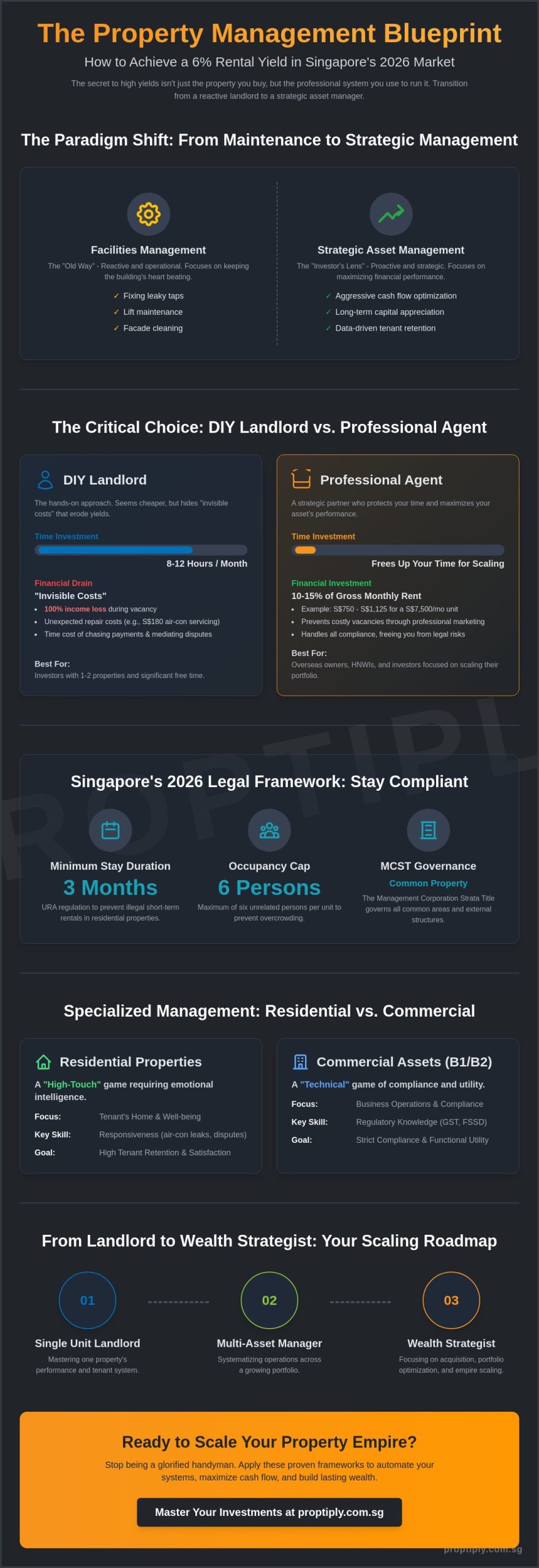
Stop thinking of property management as just a service for collecting rent and fixing leaky taps. In the 2026 Singapore market, effective property management has evolved into a high-stakes discipline of strategic oversight. It’s the systematic process of preserving your real estate asset’s physical condition while aggressively optimizing cash flow. To master this, you must understand the divide between Facilities Management and Asset Management. Facilities Management keeps the building’s heart beating through lift maintenance and facade cleaning. Asset Management is the “investor’s lens” that focuses on capital appreciation, tenant retention, and yield expansion. Understanding What is Property Management at a global level helps, but applying it to our local 2026 landscape requires a much sharper focus on efficiency and data-driven decisions.
The 2026 rental market remains tight; however, tenants have become more discerning. They demand seamless digital experiences and well-maintained spaces. For individual landlords, professional standards aren’t optional anymore. If you don’t treat your unit like a business, your vacancy rates will climb. You need a proven framework to ensure your property stands out in a sea of new condo completions and industrial B1 clusters.
The Legal Framework: MCST and URA Regulations
In Singapore, most private residential and industrial properties fall under the Management Corporation Strata Title (MCST) system. The MCST governs the common areas, but your individual rights are strictly bounded by URA guidelines. As of 2026, the URA maintains a minimum stay duration of three consecutive months for residential properties to prevent illegal short-term rentals. Additionally, the occupancy cap remains fixed at six unrelated persons per unit to prevent overcrowding. Under the Building Maintenance and Strata Management Act, the Managing Agent is a firm or individual appointed by the MCST to exercise the powers and perform the duties of the corporation in managing the common property. You must align your internal house rules with these statutory requirements to avoid heavy fines or legal entanglements.
Residential vs. Commercial Management Needs
Residential management is “high-touch” and requires emotional intelligence. You’re dealing with people’s homes, so responsiveness to air-con leaks or neighbor disputes is vital for tenant retention. Conversely, managing commercial assets like industrial B1 or B2 spaces is a technical game. You’ll need to navigate Goods and Services Tax (GST) registration for rent collection and strictly adhere to Fire Safety and Shelter Department (FSSD) regulations for unit partitions. Before you even sign a Tenancy Agreement, obtaining professional real estate investment advice is a mandatory prerequisite to ensure your chosen management strategy matches your financial goals. Commercial tenants value compliance and utility over aesthetics; don’t make the expensive mistake of treating an industrial workshop like a luxury condo.
Managing Agent vs. DIY Landlord: A Strategic Comparison
Deciding whether to hire a professional for property management or handle everything yourself is a pivotal choice for your 2026 portfolio strategy. In Singapore, most managing agents charge between 10% and 15% of your monthly gross rent, though some offer flat fees for high-volume portfolios. For a co-living unit generating S$7,500 in monthly revenue, that is a S$750 to S$1,125 monthly expense. While DIY seems cheaper on paper, it hides “invisible costs” that quietly erode your yields. You’ll likely spend 8 to 12 hours a month on administrative tasks, including chasing late payments, coordinating S$180 air-con servicing, or mediating minor tenant disputes. If your vacancy stretches to 30 days because you’re too busy to host viewings, you lose 100% of that month’s income. For investors with more than two properties, DIY becomes a lethal bottleneck. You can’t scale your wealth or hunt for new deals if you’re stuck acting as a glorified handyman for your existing assets.
When to Outsource to a Managing Agent
Outsourcing is the right move for overseas owners, high-net-worth individuals, or those managing complex industrial assets. Always vet your agent rigorously before handing over the keys. Ensure they hold accreditation from the Singapore Institute of Surveyors and Valuers (SISV) or the Association of Property and Facility Managers (APFM). These professionals must operate within the framework of the Building Maintenance and Strata Management Act, which ensures legal compliance and structural integrity. Be wary of “lazy management” where agents take the path of least resistance. This often looks like hiring the first S$400 contractor they find for a simple S$100 repair just to close a maintenance ticket quickly. This laziness drains your cash flow over time.
The Middle Path: Mastering Management Systems
Proptiply advocates for a middle path: learn the systems first so you can manage the manager. Don’t just outsource your financial future blindly. When you master the blueprint of property management, you gain the confidence to spot inflated quotes or identify when a vacancy is taking too long to fill. You’ll understand the exact workflows required to keep a unit profitable. You can even use SkillsFuture credits for property investment courses to fund this specialized education, reducing your out-of-pocket costs while building a high-value skill set. This approach puts you back in the driver’s seat and ensures your third-party providers stay sharp. If you want to see how these systems apply to your current holdings, take a moment to audit your portfolio performance and identify where your time is being wasted.
The 4 Pillars of High-Yield Property Management
Stop thinking of property management as a series of chores. It is a strategic engine for yield optimization. In 2026, the difference between a passive landlord and a proactive investor is measured in thousands of dollars of lost cash flow. Successful management begins long before the first rental deposit hits your account. It requires a systematic approach that treats your asset like a high-performance business. To truly master High-Yield Property Management, you must transition from reactive troubleshooting to a preventative mindset that protects your bottom line.
Rigorous Tenant Screening and Selection
The “Proptiply Way” prioritizes quality over speed. A “nightmare” tenant can wipe out a year of profits in weeks. You must verify FIN and Work Permit statuses through the ICA and MOM portals to comply with Singapore’s strict immigration laws. Avoid guessing your rental price. Use real-time URA Caveat data to see actual transacted prices in your specific condo block. Setting the price S$50 below market often attracts a wider pool of high-quality applicants, allowing you to pick the most stable profile rather than settling for whoever pays the most.
Proactive Maintenance and Asset Preservation
Preventative schedules are always cheaper than reactive repairs. A S$150 air-con servicing prevents a S$2,000 compressor failure. In Singapore condo living, you must distinguish between the Management Fund, used for daily operations like security, and the Sinking Fund, reserved for major capital expenses like repainting. Build a reliable vendor list for plumbing and electrical works before you need them. Digital tools in 2026 now allow you to track every repair via cloud-based logs, ensuring your asset remains in “Show Gallery” condition for future resale.
Tenant Retention and Relationship Management
The cost of vacancy is your biggest yield killer. If your unit sits empty for one month, a S$100 rent hike takes nearly three years to break even. Keeping a good tenant is almost always more profitable than finding a new one. Establish clear communication protocols using dedicated WhatsApp groups for formal notices. Initiate the “Option to Renew” (OTR) process exactly 90 days before the lease expires. This gives you a three-month buffer to market the unit if they decide to move, ensuring your property management strategy maintains a 0% vacancy rate.
- Digital Rent Collection: Use automated PayNow triggers to eliminate manual tracking.
- Legal Compliance: Ensure all Tenancy Agreements (TA) are e-stamped via IRAS within 14 days.
- Inventory Standards: Use high-resolution video walkthroughs for move-in inspections to prevent deposit disputes.
Specialized Management: Co-Living and Industrial Assets
Standard residential management won’t cut it if you want to scale your portfolio in 2026. Traditional methods focus on finding one tenant every two years and fixing a leaky tap occasionally. High-yield niches like co-living and industrial spaces require a much more aggressive, hands-on property management strategy. You aren’t just a landlord here; you’re an operator. This shift in mindset is what separates average investors from those achieving double-digit returns. These specialized sectors are the high-yield frontier for Singaporeans looking to escape the limitations of cooling measures on private residential homes.
The Co-Living Management Blueprint
Co-living is about managing people and community dynamics, not just physical walls. You must master the “community” aspect to prevent high turnover. This involves mediating disputes between housemates over common area cleanliness or fridge space. Your operational blueprint should include weekly professional cleaning and automated utility splitting to remove friction points. We recommend standardizing your room turnover process to fit a 48-hour window. This efficiency minimizes vacancy and keeps your cash flow consistent. To master these granular details, explore our co living singapore guide for deeper operational insights.
Industrial Property Management Nuances
Industrial assets offer incredible stability but demand technical expertise that most residential agents lack. You need to understand the specific needs of a “User” versus an “Investor” in business park environments. Compliance is your top priority. You must strictly adhere to JTC or HDB land use rules. For example, ensuring the 60:40 rule for ancillary vs. predominant use is vital to avoid heavy fines. Managing B1 or B2 spaces requires you to track technical specifications that directly impact rentability:
- Floor Loading: Verify if the unit supports 7.5kN/sqm for light production or up to 15kN/sqm for heavy machinery.
- Power Supply: Ensure the unit has 3-phase 60A or 100A power to support industrial equipment.
- Logistics: Confirm cargo lift weight limits and dock leveler access for 20-footer or 40-footer containers.
Get these technicalities right and you unlock a specialized asset class that delivers superior cash flow. Failure to manage these details often leads to expensive mistakes and prolonged vacancies.
Scaling Your Portfolio: From Landlord to Wealth Strategist
Stop thinking like a landlord and start acting like a CEO. Most Singaporeans get stuck after their first or second purchase because they treat property management as a side hustle rather than a scalable business. In 2026, the gap between accidental landlords and wealth strategists is widening. To cross that bridge, you need a systematic Asset Progression framework. This involves moving strategically from your initial HDB into multiple private properties or high-yield industrial spaces without over-leveraging your capital.
You can’t afford to be sentimental about your holdings. If an entry-level condo isn’t hitting your target yields or capital appreciation benchmarks, it’s time to prune. Regular portfolio reviews ensure your capital isn’t trapped in stagnant assets. We’ve seen investors unlock S$300,000 or more in latent equity just by rebalancing their holdings at the right market cycle. Scaling effectively means your property management systems must be robust enough to handle five units as easily as one.
Building Your Investment “A-Team”
Scaling isn’t a solo sport. You need an ecosystem of experts to move fast and avoid expensive mistakes. A savvy mortgage broker finds the best repricing deals to keep your interest costs low. A sharp lawyer handles the fine print of complex decoupling or trust structures. Finally, a mentor provides the roadmap based on actual market results. Proptiply serves as that mentor pillar, giving you the insider secrets that aren’t found in textbooks.
When choosing your educational path, consider the depth of training. While a general course at sgx academy provides a solid financial foundation for stocks and bonds, our specialized bootcamps focus on the granular, real-world application of co-living and industrial investment. You need boots-on-the-ground tactics that work in the specific context of Singapore’s 2026 regulatory environment.
Your Next Step to Financial Freedom
It’s time to stop simply collecting properties and start building a real estate. True wealth comes from owning a portfolio that runs on proven systems, allowing you to step back while the cash flow grows. Our Residential Acceleration Program is designed to help you master these frameworks, from sourcing undervalued units to optimizing your tenant management workflows for maximum retention.
Don’t let another year of market shifts pass you by. Take the leap from theory to reality. We invite you to move beyond reading and start executing. Book your 1-on-1 Portfolio Consultation today and let’s map out your path to a sustainable, high-yield property portfolio that delivers the freedom you deserve.
Take Control of Your Asset Progression Journey
The Singapore real estate market in 2026 leaves no room for guesswork. Success depends on a disciplined property management strategy that moves beyond simple rent collection toward maximizing every square foot of your portfolio. You’ve seen how specialized niches like co-living and industrial assets provide the high-yield buffer needed to thrive, provided you apply the right framework. Transitioning from a hands-on landlord to a strategic investor is the only way to ensure your assets continue to deliver consistent positive cash flow.
Don’t navigate these complexities alone. We’ve already mentored over 1,000 students in Singapore, helping them avoid the common pitfalls that stall most investors. Our founders, Jelene Lum and Ervin Ang, are active practitioners who share the exact “boots-on-the-ground” tactics they use daily in the co-living and industrial sectors. You can gain access to these insider secrets and start building a resilient wealth blueprint right now. Master the Art of Property Management—Join our Residential Acceleration Program today!
The path to financial security is logical and within your reach. Let’s start building your legacy together.
Frequently Asked Questions
What is the typical property management fee in Singapore for 2026?
Expect to pay between 5% and 10% of your gross monthly rent for comprehensive property management services in 2026. This fee covers tenant sourcing, rent collection, and maintenance coordination for your investment. Investing in professional management ensures your asset progression stays on track without the headache of daily operations. It’s a small price for securing passive income and protecting your high-yield units.
Do I need a license to manage my own rental properties in Singapore?
You don’t need a license from the Council for Estate Agencies (CEA) to manage your own rental properties in Singapore. However, if you manage properties for others for a fee, you must be a licensed agent or part of a licensed firm. Master the legal framework first to avoid expensive mistakes. Most DIY investors transition to professional help as their portfolio grows to 3 or more units.
What is the difference between a property manager and a managing agent?
A property manager handles your specific unit and tenant relations, while a managing agent works for the MCST to maintain the entire building’s common areas. Your property manager focuses on maximizing your individual unit’s yield and cash flow. The managing agent ensures the condo facilities, such as the gym and pool, remain in top condition for all residents under the Building Maintenance and Strata Management Act.
Can I use SkillsFuture credits for property management or investment courses?
You can use your SkillsFuture credits for various property investment and management courses offered by accredited institutions like the Singapore Institute of Surveyors and Valuers (SISV). These courses provide the blueprint you need to understand market cycles and asset valuation. Unlock your potential by using government subsidies to fund your education in high-yield niches like industrial property or residential co-living strategies. Learn exactly how to maximise your SkillsFuture credits for property investment in 2026 to ensure every dollar of your subsidy works toward building real wealth.
How does the URA occupancy cap affect co-living management in 2026?
The URA occupancy cap for private residential properties returns to 6 unrelated persons after the temporary 8-person limit expires in December 2026. This regulation is crucial for co-living operators who must design layouts that maximize space without violating the law. Stick to this proven framework to ensure your rental business remains compliant and avoids heavy fines of up to S$5,000 from the authorities.
What happens if my tenant stops paying rent and I am managing the property myself?
Issue a formal Letter of Demand immediately if your tenant misses a payment deadline by more than 7 days. If they don’t settle the arrears, you’ll need to apply for a Writ of Possession through the State Courts to recover your property. Managing this yourself is risky and time-consuming. Professional property management firms have established protocols to handle these disputes quickly and legally while protecting your cash flow.
Is it better to hire an individual property agent or a management firm?
Hire a property management firm if you want a systematic, results-driven approach that doesn’t depend on a single person’s availability. Firms provide a team-based structure and professional software to track your portfolio’s performance. Individual agents are great for one-off rentals, but a firm offers the scalability needed for serious asset progression and the long-term wealth building you’re aiming for.
How often should a property manager conduct site inspections?
Conduct a thorough site inspection at least once every 6 months to catch maintenance issues before they become expensive repairs. Quarterly visits are even better for high-turnover co-living spaces where wear and tear is more frequent. Regular checks protect your capital appreciation and show tenants that you’re a committed, professional landlord. This proactive approach is a key part of our proven management methodology.