
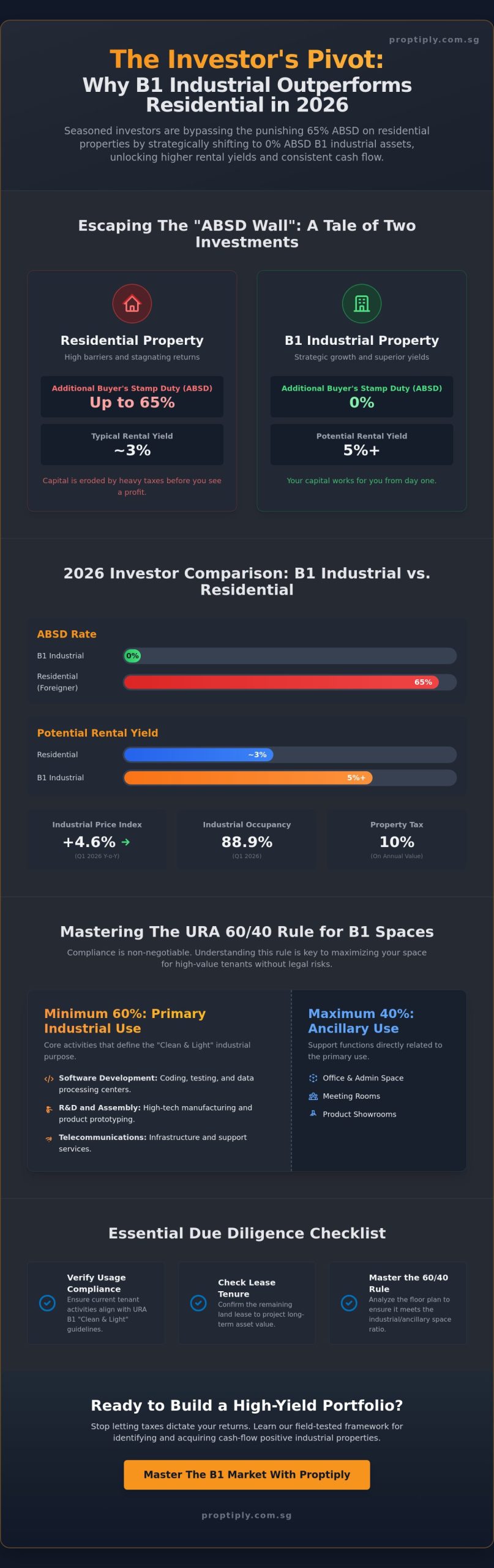
Why are seasoned investors walking away from the prestige of luxury condos to buy unassuming warehouses? The answer is simple. While residential buyers face Additional Buyer’s Stamp Duty (ABSD) rates as high as 65%, the ABSD for b1 industrial property remains a flat 0%. You’ve likely noticed your residential rental yields stagnating while industrial prices climbed 4.6% year-on-year in the first quarter of 2026. It’s frustrating to watch your capital get eaten by taxes before you even collect your first rent check. We understand that shift in the market, and we’re here to help you capitalize on it.
This guide will show you how to master the nuances of light industrial zoning so you can unlock rental yields of 5% or more. You’ll learn exactly how to navigate the URA 60/40 rule and avoid the expensive mistakes that trap unprepared investors. We’re breaking down the latest 2026 Buyer’s Stamp Duty rates and comparing B1 against B2 zones to give you a clear, actionable blueprint for your next high-yield acquisition. It’s time to stop settling for mediocre returns and start building a portfolio that actually works for you.
Key Takeaways
- Discover how to bypass the “ABSD Wall” by pivoting your capital into non-residential assets that offer significantly higher rental potential.
- Master the URA 60/40 rule to ensure your b1 investment remains fully compliant while maximizing your usable space for high-value tenants.
- Compare the technical differences between light and heavy industrial zones to target premium MNC and tech tenants who prefer modern, office-like environments.
- Learn the essential due diligence steps for verifying remaining lease tenures and current usage to protect yourself from expensive legal mistakes.
- Unlock the secret to identifying undervalued industrial gems using Proptiply’s field-tested CAIP framework for consistent positive cash flow.
Beyond Residential: Why B1 Industrial is Singapore’s Strategic Investment Pivot in 2026
The residential market has hit a ceiling. With foreign ABSD at 65% and significant levies for locals buying second homes, the “ABSD Wall” is forcing investors to rethink their strategy. You’re likely here because you want your capital to grow, not get eaten by taxes. In 2026, b1 industrial property has emerged as the premier alternative for those who want professional-grade assets without the residential tax baggage. It’s a shift from chasing speculative capital gains to securing reliable, high-yield income streams.
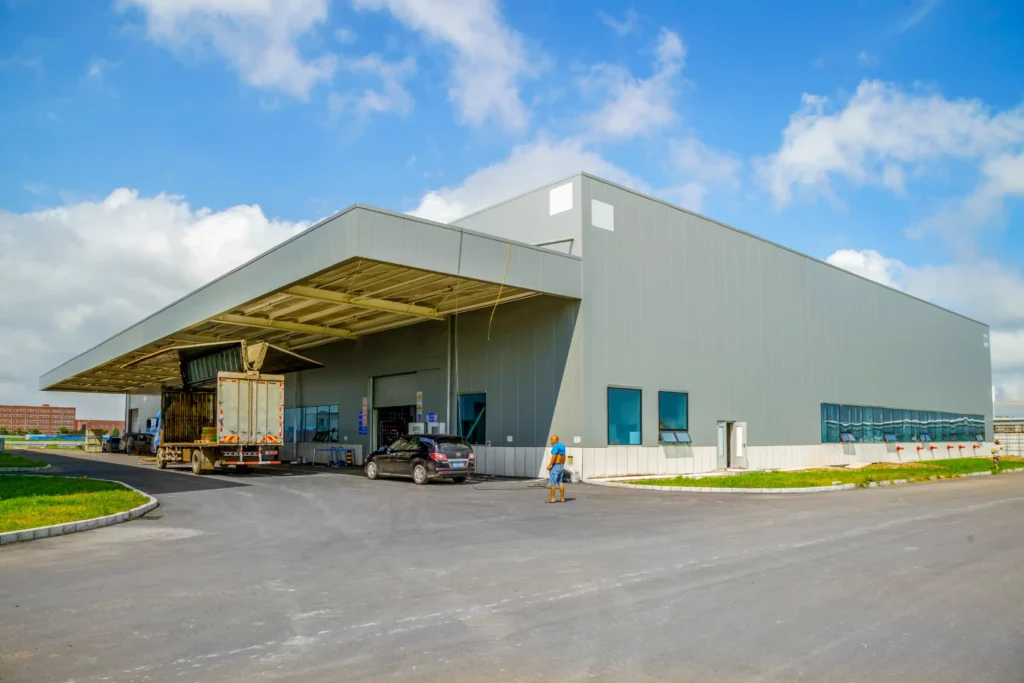
Why choose this niche? Think of it as “office-lite.” These spaces aren’t for heavy, smoky manufacturing. They are designed for clean, light industrial activities like software development, telecommunications, and R&D. This classification is a core part of Urban Planning in Singapore, where the government carefully zones land to support high-tech industries. While mass-market condos often struggle to hit 3% rental yields, B1 units frequently achieve 5% or more. In the first quarter of 2026, the industrial property price index rose 4.6% year-on-year, proving that the demand for these “clean” spaces is only accelerating. Occupancy rates hit 88.9% in the same period, signaling that businesses are actively snapping up these spaces as supply remains tight in prime industrial heartlands.
The ABSD Advantage: Keeping Your Capital Working
The most compelling reason to pivot is the 0% Additional Buyer’s Stamp Duty. Whether you’re a Singaporean citizen or a Permanent Resident, you don’t pay a cent in ABSD for industrial property. This drastically lowers your entry cost. For example, a $1.2 million B1 unit requires significantly less upfront cash than a second residential property of the same value. The 10% property tax rate on Annual Value (AV) is also predictable, making your cash flow projections much easier than in the residential sector. Essentially, B1 serves as the most accessible “safe entry point” for residential investors looking to transition into the industrial sector without taking on the risks of heavy machinery zones.
Who is the B1 Investor in 2026?
Today’s successful investors aren’t just looking for capital appreciation; they are chasing consistent, positive cash flow. We see many people in our community moving through a process of asset progression, shifting their focus from stagnant residential units to high-yield industrial spaces. They want diversification and a hedge against cooling measures. If you’re ready to make this shift, check out our Real Estate Investment Advice: The 2026 Guide to Singapore Property to see how industrial assets fit into a broader portfolio. It’s about moving from a mindset of “owning a home” to “owning a business-supporting asset.”
Decoding the URA B1 Classification: Rules, Trades, and the 60/40 Rule
Investing in industrial property isn’t just about finding four walls and a roof. It’s about understanding the legal box that the Urban Redevelopment Authority (URA) puts that property in. In Singapore, b1 industrial space is reserved for “Clean and Light” industries. This means the activities inside shouldn’t cause significant noise, vibration, or pollution. If you’re looking at a unit next to a residential estate, it’s almost certainly a B1 zone because of these strict environmental limits. Understanding these boundaries is the first step to ensuring your investment stays on the right side of the law.
You can’t just treat these units as cheap office space. The URA is very clear about what happens inside. If you lease to a tenant who runs a pure retail shop or a commercial gym, you’re looking at an “illegal change of use.” This can lead to heavy fines or orders to vacate. Stick to the permissible trades: software development, high-tech assembly, and R&D. These are the industries driving Singapore’s economy in 2026, and they are the ones looking for the professional environment that B1 properties provide. If you’re ever in doubt about a specific trade, always refer back to the Official URA B1 Guidelines to verify compliance before signing a tenancy agreement.
Mastering the 60/40 Rule for Maximum Compliance
The 60/40 rule is the most critical technical detail you need to master. URA mandates that a minimum of 60% of the gross floor area (GFA) must be dedicated to core industrial activities. This includes production, assembly, or data processing. The remaining 40% is for “ancillary” use, such as office space, showrooms, or meeting rooms that support the primary industrial function. Don’t let your tenants flip these numbers. If a tech firm uses 80% of the unit for its sales team and only 20% for its servers, they are in breach. We often teach our students to calculate this usable space upfront to avoid expensive legal headaches later. If you want to see how this compares to premium corporate spaces, read The Investor’s Guide to Business Parks in Singapore for a deeper dive into higher-spec zoning.
Allowable Trades in the 2026 Digital Economy
The modern B1 tenant looks very different than they did a decade ago. Today, the “dream tenant” is often an e-commerce giant using the space for backend logistics or a media production house with a high-tech studio. Data centres and telecommunications hubs are also prime candidates. These businesses value the “office-lite” feel of a b1 unit but need the industrial-grade power supply and floor loading that a standard commercial building doesn’t offer. By targeting these high-growth sectors, you secure a tenant base that is resilient and willing to pay for quality. If you’re ready to start spotting these high-potential units yourself, join our community of savvy investors to learn our proven selection criteria.
B1 vs. B2 vs. Residential: The Ultimate Investor Comparison
Stop treating every property investment like a residential condo purchase. To master the Singapore market, you must understand how b1 industrial property stacks up against B2 zones and the traditional residential sector. While residential units are often emotional buys, industrial assets are cold, hard business decisions. Think of B1 properties as the “Goldilocks” zone. They are clean enough to be situated near residential estates, yet they offer the commercial advantages of industrial zoning that residential units simply cannot match.
Let’s look at the tax landscape. If you buy a second residential property, your ABSD could hit 20% or even 60% depending on your residency status. In contrast, the ABSD for B1 and B2 industrial property is exactly 0%. You’ll still pay Buyer’s Stamp Duty (BSD), which scales up to 5% for the portion of the value in excess of $1.5 million as of the February 15, 2023, tax revision. However, you avoid the massive tax wall that kills residential returns. Financing also works differently. Residential LTV usually sits at 75% for your first loan. Industrial loans are often assessed based on a company’s profile or the property’s valuation, typically ranging from 60% to 80%. While the loan tenure for industrial property is shorter, usually capped at 20 to 25 years, the higher rental income often covers the mortgage more comfortably than a condo would.
Cash Flow Analysis: Yields and Rental Stability
In 2026, net yields for b1 units consistently hit the 4% to 6% range. This dwarfs the 2% to 3% yields currently seen in mass-market condos. This stability comes from tenant “stickiness.” When a tech firm spends six figures on a specialized fit-out for their server room or media studio, they don’t move out after a year. They stay for five or ten. Beware the “Leasehold Trap,” though. A 30-year lease requires a much more aggressive cash flow strategy than a 60-year or 99-year tenure. You must ensure the rental income amortizes the purchase price before the lease expires.
The “Nuisance Buffer” and Location Factors
Location is largely dictated by the “Nuisance Buffer.” B2 properties require significant distance from homes due to noise and pollution. B1 properties don’t have this restriction. This allows them to sit in prime, accessible areas like Tai Seng, Bukit Merah, or Kallang. This proximity to transport hubs and food amenities makes them far more attractive to modern, high-value tenants. To see where the best investment clusters are located, explore our Top Singapore Industrial Areas: An Investor’s Roundup for 2026. This will help you identify which districts are currently seeing the highest occupancy growth.
Due Diligence Checklist: 5 Things to Verify Before Buying B1 Property
Don’t let the excitement of a 0% ABSD deal blind you to the technical realities of the asset. Buying a b1 unit requires a level of scrutiny that goes far beyond checking for cracks in the wall. You’re buying a functional tool for a business. If that tool doesn’t meet their specific operational needs, your unit will sit empty. Start your due diligence by looking at the remaining tenure. In Singapore’s industrial market, a property with a 20-year balance is a completely different beast than one with 60 years left. Banks are often hesitant to grant full loan tenures for properties with less than 30 years remaining, which can drastically affect your exit strategy and resale value.
You also need to verify that the current tenant is actually compliant with zoning rules. It’s common to find units being used as pure offices or even illegal dormitories. If the URA conducts an inspection and finds the 60/40 rule is being ignored, you as the owner could face the consequences. Always ask for a copy of the tenant’s business activity declaration before you take over a tenancy. This protects your investment from being flagged for an “illegal change of use” shortly after you’ve committed your capital.
The GST Factor: A Hidden Cost or a Hidden Benefit?
One of the biggest shocks for new investors is the 9% GST. On a $1.5 million property, that’s an extra $135,000 you need to account for at the point of purchase. We often advise our students to buy through a GST-registered company entity so they can claim this tax back from IRAS. In 2026, the 9% GST rate represents a significant upfront cash outlay that can derail your liquidity if you haven’t structured your purchase correctly. Buying under a company name isn’t just about tax; it’s a strategic move to keep your personal borrowing capacity clean for future residential upgrades.
Technical Specs that Kill or Seal the Deal
Match the property’s physical limits to the industry’s needs. If your unit has a floor loading of only 5.0 kN/m2, you’re excluding tenants with heavy server racks or precision engineering equipment. Check the ceiling height too. Modern e-commerce tenants love “high-cube” units with at least 6 meters of clearance for vertical racking. Power supply is the final deal-breaker. A standard 60-Amp three-phase supply might be enough for a small office-lite setup, but a data-heavy tech firm will demand much more “juice” to keep their servers running. If you’re planning to scale your investments into a larger portfolio, check out The Ultimate Guide to Building a Real Estate Estate in Singapore for our proven framework on asset progression.
If you’re unsure how to read a technical spec sheet or want to see how we vet actual deals, join our next investor community session to learn our “boots-on-the-ground” due diligence process.
How to Master the B1 Market with Proptiply’s CAIP Framework
Knowledge alone won’t pay your mortgage. You’ve spent this guide learning the rules of the b1 market, from the URA 60/40 rule to the 0% ABSD advantage. Now, you need a system to turn that information into positive cash flow. Our Commercial and Industrial Program (CAIP) provides that exact bridge. We don’t just teach theory. We share the “boots-on-the-ground” secrets we use to identify undervalued gems before they ever hit the open market. This isn’t about luck. It’s about the disciplined application of a proven framework that has helped our community navigate the 4.6% price growth we’ve seen in the first quarter of 2026.
Many of our members started exactly where you are. They were tired of seeing their capital stagnate in residential units while paying heavy taxes. We’ve guided investors through the transition of selling a single, underperforming condo to build a high-yield portfolio that generates passive income month after month. By surrounding yourself with pragmatic practitioners, you avoid the “expensive mistakes” that catch beginners off guard. You’ll learn to spot the technical specs that matter and negotiate deals with the confidence of a seasoned pro. It’s about moving from a state of curiosity to a state of readiness for action.
Stop Guessing, Start Investing with Data
Success in the industrial sector requires more than just a gut feeling. Our 1-on-1 consultations are designed to help you navigate the specific dilemma of choosing between b1 and B2 zones based on your risk profile and capital. We provide the granular detail that generalist seminars miss, such as which industrial parks are currently seeing the highest demand from tech-heavy MNCs and why the 88.9% occupancy rate in Q1 2026 matters for your entry timing. Don’t leave your financial future to chance when you can access a tested methodology. Book a 1-on-1 Property Portfolio Consultation to review your industrial strategy and see how we can optimize your current holdings.
Your Blueprint for Financial Freedom
Financial freedom is not a dream. It’s a systematic result. B1 industrial property is the “Goldilocks” investment of 2026 because it offers the perfect balance of professional tenant profiles, high rental stability, and tax efficiency. By mastering this asset class, you’re not just buying property. You’re securing your future. We invite you to join a community that values transparency, results, and mutual growth. Take the first step toward a robust, ABSD-free portfolio today. Join our Commercial and Industrial Program (CAIP) to unlock industrial yields today!
Secure Your Financial Future in Singapore’s Industrial Heartlands
The 2026 market has made one thing clear; the days of relying solely on residential appreciation are over. You’ve seen how b1 industrial property offers a strategic escape from the “ABSD Wall” while delivering superior rental yields that often double those of mass-market condos. By mastering the technical specs and URA compliance rules we’ve discussed, you position yourself to capture the growth of Singapore’s digital economy. Don’t let technical jargon or fear of the unknown hold you back from these high-yield assets.
We’ve already trained over 1,000 students in specialized property niches, helping them avoid expensive mistakes and build real wealth through asset progression. Led by practitioners Jelene Lum and Ervin Ang, our community focuses on the real-world application of industrial investment strategies. It’s time to stop watching from the sidelines and start applying a proven blueprint for passive income. Master the B1 Industrial Market at our next Commercial & Industrial Program (CAIP) and take control of your investment journey today. Your path to financial freedom is a systematic process, and we’re here to guide you every step of the way.
Frequently Asked Questions
Can I use a B1 industrial property as my personal office?
You can use a portion of the unit as an office, but it must be ancillary to a core industrial activity. Under the URA 60/40 rule, at least 60% of the gross floor area must be used for industrial purposes like production, assembly, or data processing. Operating a pure commercial office without any industrial component is a breach of zoning regulations. Always ensure your business trade is registered correctly to avoid enforcement action and potential fines.
Is GST claimable when I buy a B1 industrial unit in Singapore?
GST is claimable if you purchase the property through a GST-registered company and the seller is also GST-registered. The current 2026 GST rate of 9% represents a significant upfront cost. By registering your investment vehicle for GST, you can apply for a refund of the tax paid on the purchase price. This is a common strategy we teach to help investors manage their initial cash outlay and improve their overall internal rate of return.
What is the difference between B1 and B2 industrial zoning?
The primary difference lies in the environmental impact and the “nuisance buffer” required by authorities. b1 zones are for clean and light industries that don’t produce significant noise or pollution, allowing them to be located near residential areas. B2 zones are reserved for heavy manufacturing, workshops, and industries that require at least a 50-meter buffer from housing. This distinction directly impacts your potential tenant pool and the property’s long-term capital appreciation potential.
Do I need to pay ABSD when buying a B1 industrial property?
You pay 0% Additional Buyer’s Stamp Duty (ABSD) on industrial property purchases. This applies regardless of whether you are a Singaporean citizen, a Permanent Resident, or a foreigner. While residential buyers are hit with massive tax levies for second or third properties, industrial investors only need to budget for the standard Buyer’s Stamp Duty (BSD). This tax exemption makes industrial units a powerful tool for asset progression and preserving your liquid capital.
Can I stay or live in my B1 industrial property?
No, living in an industrial property is strictly prohibited and illegal under URA regulations. These units are zoned for business and production activities, not residential use. Using the space as a home or even a temporary residence can lead to heavy fines and the immediate termination of your fire insurance. If you want to achieve residential-style returns with industrial benefits, consider exploring co-living strategies in approved residential zones instead.
What happens if my tenant is not doing an “allowable trade” in a B1 unit?
You as the owner are ultimately responsible for ensuring your tenant complies with URA zoning. If a tenant operates an unapproved trade, such as a retail boutique or a pure accounting firm, the authorities can issue a fine or a “Notice to Quit.” This results in unexpected vacancy and potential legal costs. Always vet your tenant’s business registration and industrial activity declaration before signing the lease to protect your b1 investment from regulatory trouble.
Is it better to buy B1 property under a personal name or a company?
Buying under a company name is usually the preferred route for savvy investors. This structure allows you to register for GST to claim back the 9% tax and keeps the industrial loan separate from your personal Total Debt Servicing Ratio (TDSR). It protects your borrowing capacity for future residential upgrades. However, you should consult a tax professional to ensure the company setup aligns with your specific long-term exit strategy and corporate tax obligations.
What are the typical maintenance fees for B1 industrial buildings?
Maintenance fees are typically lower than residential condos because they don’t include expensive “lifestyle” amenities like swimming pools or clubhouses. These fees are calculated based on the share value of your unit and cover essential services like lift maintenance, 24-hour security, and common area cleaning. In 2026, most modern industrial buildings maintain competitive rates that are easily covered by the robust rental yields this asset class generates.