The 60% ABSD hike in April 2023 has officially turned the residential market into a yield trap for serious investors. You probably feel that your capital is being squeezed by cooling measures, and you’re looking for a way to grow your portfolio without giving half your profits to the taxman. Mastering the right singapore industrial area is the strategic pivot you need to unlock consistent passive income and secure your financial future. It’s common to feel overwhelmed by the complexity of JTC regulations, but staying on the sidelines only leads to missed opportunities in high-growth clusters.
This roundup provides the exact blueprint you need to dominate the industrial landscape for 2026. You’ll learn the critical differences between B1 and B2 zones and identify four specific “hot” zones where capital appreciation is still attainable. We’ll share our proven framework for selecting units, helping you avoid sunset industries while focusing on sectors that offer robust, long-term returns. By the end of this article, you’ll have the insider knowledge to stop guessing and start investing with the confidence of a seasoned professional.
Key Takeaways
- Leverage the 0% ABSD advantage for individual investors to secure significantly higher rental yields compared to traditional residential properties.
- Identify high-growth clusters within a singapore industrial area, focusing on the strategic powerhouses of Jurong, Tuas, and the Changi aviation gateway.
- Master the technical distinctions between B1 and B2 industrial zones to attract high-quality tenants and maximize your portfolio’s occupancy rates.
- Evaluate infrastructure impact using our investor’s checklist, prioritizing proximity to the TEL Stage 4 and Cross Island Line for long-term capital preservation.
- Unlock the CAIP Blueprint to move beyond theory and pinpoint “hidden gem” properties that generate consistent positive cash flow.
Why Investors are Flocking to Singapore Industrial Areas in 2026
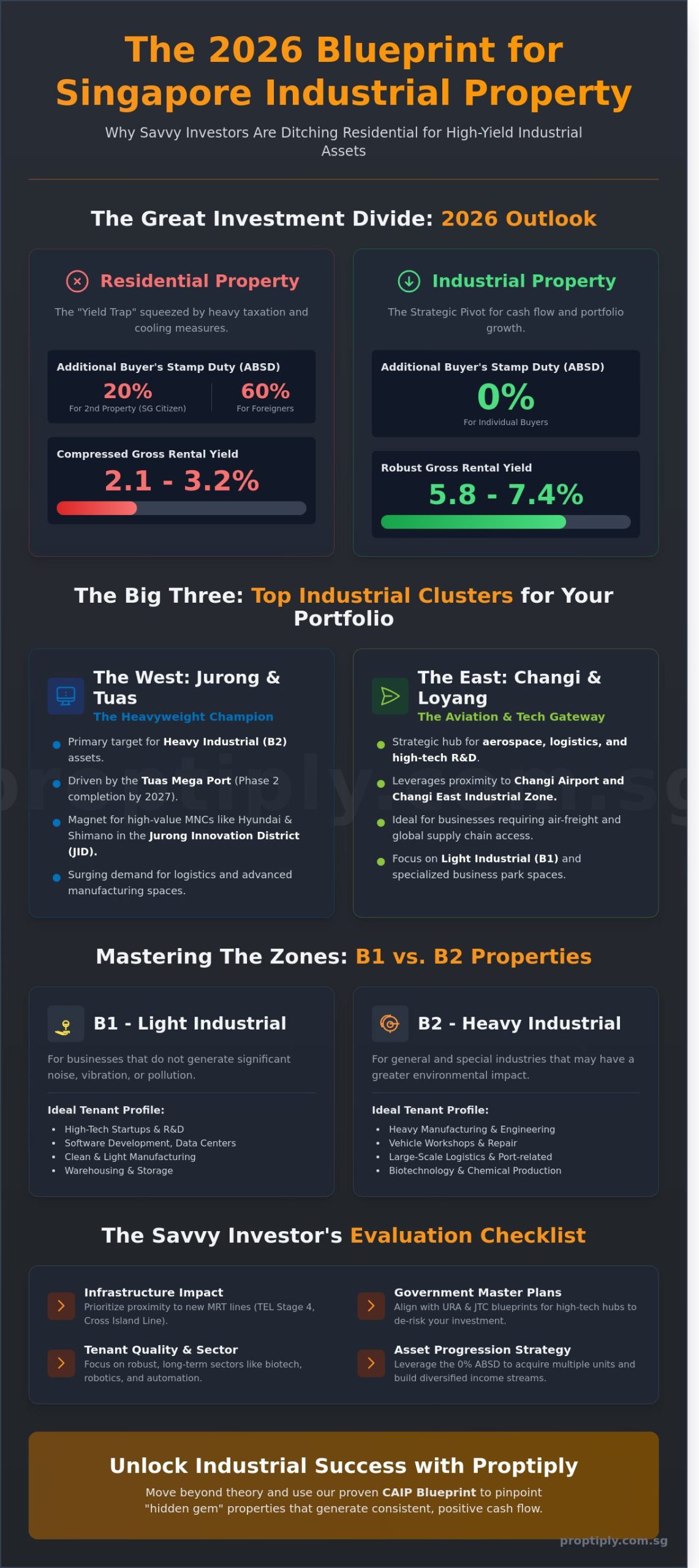
Stop chasing low-yield residential units that drain your capital through heavy taxation. In 2026, savvy investors have pivoted their focus toward the industrial sector to secure their financial future. The residential market remains weighed down by high Additional Buyer’s Stamp Duty (ABSD) rates, which can reach 20% for a Singaporean’s second property and a staggering 60% for foreigners. Industrial property offers a clear escape route because individual buyers still enjoy 0% ABSD. This tax exemption allows you to scale your portfolio rapidly without losing six-figure sums to the taxman before you even collect your first rent check.
Investing in a singapore industrial area is no longer just about warehouses; it’s about capturing the “yield play” that residential property simply cannot match. While residential rental returns have compressed to a range of 2.1% to 3.2%, well-selected industrial assets are consistently delivering gross yields between 5.8% and 7.4%. Industrial property is the ultimate strategic asset for cash-flow-focused investors who prioritize monthly passive income over speculative capital gains.
The “No ABSD” Advantage
The math is simple: saving 20% on taxes means you have more liquidity to acquire your next asset. This lack of ABSD for individuals makes industrial units the perfect vehicle for asset progression. You can acquire multiple B1 or B2 units to build a diversified stream of income while residential investors are stuck waiting years to save for their next tax-heavy purchase. When you compare the 5-7% industrial yields against the rising costs of borrowing, the spread remains much healthier than the razor-thin margins found in the condo market. It’s the most efficient way to build a “war chest” for future investments.
Government Master Plans as Investment Blueprints
You aren’t just buying four walls; you’re buying into Singapore’s economic future. The URA Master Plan 2025 has designated specific regions to become high-tech manufacturing hubs, ensuring that “sunset” industries are replaced by high-value tenants in biotech and robotics. JTC Corporation’s strict zoning ensures that supply remains regulated, which protects your rental rates from being diluted by sudden oversupply.
By studying Singapore’s top industrial clusters, you can align your portfolio with national infrastructure projects like the Tuas Mega Port or the Changi East industrial zone. This alignment provides a built-in exit strategy. When the government spends billions on a singapore industrial area, they’re essentially de-risking your investment. Your tenant demand is backed by Industry 4.0 initiatives that prioritize automation and data exchange, making your property a vital node in the global supply chain. This stability is the foundation of a disciplined, results-driven investment framework.
The Big Three: Top Industrial Clusters for Your Portfolio
Successful asset progression requires you to look beyond the surface of a building. You must understand the heartbeat of the singapore industrial area you choose. Location dictates your tenant profile, rental yield, and long term capital appreciation. Smart investors don’t just buy units; they buy into ecosystems that the government is actively developing. Recent market analysis for 2026 suggests that while growth may be uneven, specific clusters backed by national strategic initiatives will remain resilient. Whether you’re targeting heavy manufacturing or high-tech startups, these three clusters form the blueprint for a robust industrial portfolio.
The West: Jurong and Tuas Mega Port
The West is the undisputed heavyweight champion of industrial Singapore. If you want heavy industrial (B2) assets, this is your primary target. The Tuas Mega Port is the massive engine driving this region. With Phase 2 of the port scheduled for completion by 2027, warehouse demand is already surging as logistics firms scramble for proximity. Don’t overlook the Jurong Innovation District (JID) either. It’s a magnet for high-paying MNC tenants like Hyundai and Shimano. These companies bring high-value jobs and a need for specialized advanced manufacturing spaces. Investing here means tapping into a massive, government-backed transformation that ensures your property remains relevant for decades.
The East: Changi Business Park and Loyang
The East offers a sophisticated blend of aviation and technology. Changi Business Park serves as the “CBD of the East,” catering specifically to B1 white-collar industrial use. It’s where global banks and tech firms house their back-end operations. You’ll find a powerful synergy here between Changi Airport and the surrounding semiconductor clusters. When evaluating this singapore industrial area, pay attention to land tenure. Freehold industrial sites in the East often command a significant premium over JTC leaseholds because they’re rare. This scarcity, combined with the growth of the electronics sector, makes the East a reliable choice for investors seeking stability and “blue-chip” tenant profiles.
The City Fringe: Kallang, Tai Seng, and Geylang
Proximity is profit. The city fringe clusters like Kallang and Tai Seng are the “Last Mile” logistics heroes. Being just a 10-minute drive from the Central Business District allows tenants to slash delivery times. Tai Seng has evolved into a lifestyle-industrial hybrid hub, where chic F&B outlets sit right next to high-spec B1 spaces. This attracts the “creative class” tenants who want refurbished, modern workspaces that don’t feel like traditional factories. If you’re looking to master your industrial property investment strategy, targeting these gentrifying city-fringe assets can unlock higher-than-average rental premiums from tech and media startups.
While the big three dominate the headlines, keep an eye on the North. The Sungei Kadut and Woodlands area is transforming into an “Eco-District.” It’s becoming the future hub for food security and high-tech timber manufacturing, offering a specialized niche for investors who want to get in early on the next wave of sustainable industrial growth.
B1 vs. B2 Industrial Property: Which Should You Buy?
To master the singapore industrial area market, you must first distinguish between Light (B1) and General (B2) industrial zones. The Urban Redevelopment Authority (URA) categorizes these based on the environmental impact of the business activities. B1 units are for “clean” industries that don’t create noise or smoke nuisance, while B2 units house heavier operations. This distinction isn’t just technical; it dictates your tenant pool, your regulatory responsibilities, and your long-term yield.
Every savvy investor must master the 60/40 rule. URA regulations mandate that at least 60% of the gross floor area must be used for core industrial activities like manufacturing, production, or data processing. The remaining 40% can be used for ancillary purposes like offices, showrooms, or meeting rooms. If your tenant uses 50% of the space for a call center, you’re in breach of the law. This regulation ensures industrial land remains affordable for actual businesses rather than becoming a backdoor for cheap office space. Ignoring this rule can lead to heavy fines and “expensive mistakes” during URA inspections.
B1: The Investor’s Gateway
B1 properties are often the most palatable entry point for beginners transitioning from residential investments. These units often look and feel like modern offices, making them easier to manage and maintain. You’ll attract tech startups, media agencies, and e-commerce fulfillment centers. Proximity to MRT stations is your biggest lever for success here; if a B1 unit is a 5-minute walk from a major transport node, your vacancy risk drops significantly. Watch out for the “pseudo-office” trap. Some developers build B1 units with glass facades and fancy lobbies to mimic Grade A offices, but if the supply in that specific singapore industrial area is too high, you’ll face stiff competition and stagnant rents. Stick to the fundamentals of location and accessibility. For a deeper understanding of how B1 industrial property compares to other asset classes in Singapore’s 2026 market, reviewing the latest investor’s comparison guide can sharpen your acquisition strategy. For a deeper understanding of how high-spec B1 spaces compare to dedicated business park investments in Singapore, reviewing the 2026 market outlook can sharpen your acquisition strategy.
B2: High Yields and Heavy Lifting
B2 properties are where the heavy lifting happens. These spaces cater to sectors like car workshops, carpentry, and heavy machinery. Many of these businesses are strategically located in Singapore’s advanced manufacturing hubs where the infrastructure supports large-scale operations. B2 properties often command higher yields because the requirements are so specialized. You aren’t just selling space; you’re selling utility. Look for these three critical features to ensure your asset stays in high demand:
- Floor Loading: Aim for at least 12.5 kN/m2 to support heavy equipment or high-density storage.
- Ceiling Height: Minimum 6 meters to allow for vertical racking or mezzanine levels.
- Logistics: Direct 40-foot container access to the unit or a dedicated loading bay is a massive advantage.
While B2 units face “nuisance” factors like noise, heat, and fumes, these are actually protective moats for your investment. Because B2 activities are restricted to specific zones, your tenants have fewer relocation options. This leads to higher retention rates and stable passive income from tenants who are willing to pay a premium for specialized specs that meet their operational needs.
The Investor’s Checklist for Evaluating Industrial Areas
Success in a singapore industrial area requires more than just capital. It demands a systematic framework to filter the winners from the “yield traps.” You need to look beyond the four walls of the unit and analyze the ecosystem surrounding it. Master these four pillars to ensure your asset delivers positive cash flow and long-term security. We don’t guess; we use data to drive every acquisition decision.
Connectivity and Infrastructure
Infrastructure drives tenant demand and determines your rental ceiling. The completion of TEL Stage 4 on June 23, 2024, has already shifted the gravity of eastern industrial hubs. Smart investors are now targeting units near upcoming Cross Island Line (CRL) hubs like Bright Hill or Jurong Town Hall on the Jurong Region Line. These connections slash commute times for workers, making your unit significantly more attractive to SMEs. The North-South Corridor, scheduled for phased completion starting in 2027, will reduce freight travel times by up to 30%. Don’t overlook the “lunch factor” either. Internal data shows that units within a 400-meter radius of a staff canteen or hawker center maintain 20% higher retention rates. Happy workers mean stable tenants and consistent checks in your bank account.
Decoding the Leasehold Trap
Stop chasing high yields blindly. A 30-year JTC lease often shows a tempting 8% gross yield, but the “time decay” is aggressive. You must calculate your break-even point within the first 10 to 12 years to protect your principal. In contrast, 60-year or 99-year titles offer better asset progression opportunities as they hold value longer for bank financing. Freehold industrial land is a vanishing breed. Since JTC ceased freehold land sales decades ago, these assets have become “gold dust.” They frequently trade at premiums of S$1,200 to S$1,500 per square foot, but they offer the ultimate capital preservation for your portfolio. It’s the difference between a cash cow and a legacy asset.
You must also master the JTC 30:70 rule. Only 30% of your floor area can be used for ancillary purposes like offices or showrooms. If you exceed this, you risk heavy fines or lease termination. Always verify the assignment of lease and subletting rules before signing. JTC often requires the owner to occupy at least 50% of the Gross Floor Area in specific B2 zones. Don’t get trapped in a unit you can’t legally rent out. Use our proven industrial investment blueprint to avoid these expensive mistakes and secure your financial freedom through disciplined property selection.
Unlock Industrial Success with Proptiply’s CAIP Blueprint
Identifying a high-potential singapore industrial area on a map is a great start, but it isn’t a complete investment strategy. Many retail investors fail because they treat industrial property like a residential home. They look at the facade rather than the utility. Our Commercial and Industrial Program (CAIP) bridges this gap. We help you transition from a casual buyer to a professional asset manager who understands the mechanics of wealth creation. You don’t need to guess where the next hotspot is when you have a systematic framework to follow.
The URA master plan holds secrets that only trained eyes can see. We teach you to spot “hidden gems” in a singapore industrial area before the rest of the market catches on. You’ll learn to analyze properties based on technical logistics and zoning regulations rather than just proximity to your home. This is about building a portfolio that survives market cycles and delivers consistent results. We’ve spent years refining this process so you can skip the trial-and-error phase, much like how traineticsacademy.com.sg empowers individuals and organizations through comprehensive educational programs. For those looking to further enhance their professional toolkit for the regional market, Chinese Edge offers specialized Mandarin training for business professionals.
The CAIP Advantage
We don’t do fluff. Our training focuses on the “boots-on-the-ground” details that determine your ROI. You’ll learn to analyze floor plans and technical specs like a seasoned pro. We cover the essentials that others ignore:
- Technical Due Diligence: Evaluating floor loading capacities (measured in kN/m2) and ceiling heights to ensure your unit attracts high-quality tenants.
- Positive Cash Flow: We prioritize properties that put money in your pocket every month. If the numbers don’t work, we don’t buy.
- Big Brother Mentorship: You’ll benefit from our experience. We’ve already navigated the pitfalls of JTC subletting rules and 30-year versus 60-year leasehold calculations. We help you avoid the S$50,000 mistakes that sink most beginners.
Your Path to Financial Freedom
The days of easy gains in the residential market are fading due to cooling measures and high ABSD rates. Industrial property remains one of the most effective ways for Singaporeans to achieve genuine asset progression. It’s time to stop feeling frustrated by residential limitations and start embracing industrial prosperity. You don’t have to do this alone. When you join CAIP, you enter a community of practitioners who actually own the types of assets they teach. We’re investors first and educators second.
Stop waiting for the “perfect” market conditions. The best time to build your blueprint was yesterday; the second best time is now. See the actual case studies, crunch the numbers, and decide if you’re ready to level up. Join our next CAIP Preview and see the numbers for yourself. Your journey toward a high-yield, passive income portfolio starts with a single, informed decision.
Secure Your High-Yield Industrial Future Today
The landscape for every singapore industrial area is shifting rapidly as we approach 2026. You now understand the strategic importance of the top industrial clusters and the critical differences between B1 and B2 asset classes. Success in this sector isn’t about luck; it’s about the disciplined application of a proven methodology. By using a rigorous evaluation checklist, you can identify properties that offer genuine asset progression and sustainable passive income.
Don’t navigate these complex regulations alone. The CAIP framework has already helped hundreds of local investors avoid costly errors while targeting high-yield niches. You’ll gain direct access to the insider knowledge of seasoned practitioners Jelene Lum and Ervin Ang. They’ve documented every step of their successful journey so you can replicate their results without the typical guesswork. It’s time to take control of your financial destiny and build a resilient portfolio that thrives in any market condition.
Master the Industrial Market: Join the CAIP Program Today
Your path to financial freedom is ready for you. Let’s start building your legacy together.
Frequently Asked Questions
Can individuals buy industrial property in Singapore?
Yes, you can definitely buy industrial property as an individual in Singapore. One major advantage is that you don’t have to pay Additional Buyer’s Stamp Duty (ABSD), which currently stands at 20% for a Singaporean’s second residential property. This makes it a powerful vehicle for building passive income without the heavy tax burden associated with the residential sector. You’ll only need to focus on the Buyer’s Stamp Duty and the 9% GST.
Is GST claimable for industrial property investments?
You can only claim back the 9% GST if you’re a GST-registered entity, such as a private limited company. Many savvy investors choose to incorporate a company specifically to purchase a singapore industrial area unit, allowing them to offset the tax and preserve their capital. If you buy as an individual, that 9% becomes a sunk cost; therefore, structuring your investment correctly from day one is essential for maximizing your returns.
What is the minimum downpayment for an industrial property?
Expect to put down a minimum of 20% to 25% of the purchase price in cash. Unlike residential properties where Loan-to-Value (LTV) ratios are stricter, banks typically offer a 75% to 80% loan for industrial assets. You’ll also need to budget for the Buyer’s Stamp Duty (BSD), which follows a tiered structure reaching up to 5% for the portion of the purchase price exceeding S$1.5 million.
How does the 60/40 rule affect my industrial property investment?
The 60/40 rule mandates that at least 60% of your unit’s floor area must be dedicated to core industrial activities like manufacturing or warehousing. The remaining 40% can serve as ancillary space, such as an office or showroom. Mastering this balance is vital because non-compliance can lead to enforcement actions from the Urban Redevelopment Authority (URA), potentially jeopardizing your rental income and long-term asset progression strategies.
Are industrial properties in Singapore always leasehold?
Most industrial properties are leasehold, but rare freehold units still exist in the market. While government land sales through JTC now typically feature shorter 20 or 30-year leases to ensure land productivity, older freehold developments offer better long-term value retention. Focus on the remaining lease life; a unit with 40 years left often provides a sweeter spot for high-yield rental returns compared to aging 20-year plots.
What happens when a JTC industrial lease expires?
The land and the building revert to the state without compensation once a JTC lease expires. There’s no automatic right to a lease extension, so you must plan your exit strategy or ensure your rental yield amortizes the initial investment within the lease term. Successful investors treat these as cash cow assets, extracting maximum positive cash flow well before the clock runs out on the tenure.
Which is better for a beginner: B1 or B2 industrial property?
B1 industrial units are generally better for beginners because they cater to clean and light industries like software development or e-commerce. These units are often located in a singapore industrial area closer to residential hubs, making them easier to tenant and manage. B2 units allow for heavier industrial usage and involve more complex environmental regulations, which can be a steep learning curve for those just starting their journey. For a comprehensive breakdown of how B1 industrial property stacks up against other investment options in Singapore, the 2026 investor’s comparison guide offers detailed analysis to help you make an informed first purchase.
Can I use CPF to buy industrial property in Singapore?
You cannot use your CPF savings to purchase industrial property. This is a purely cash and bank loan play, which is why it’s considered a more sophisticated investment class. Because you aren’t dipping into your retirement funds, you maintain a clear separation between your personal savings and your business assets. This discipline ensures that your industrial portfolio stands on its own merit as a generator of real, liquid wealth.