
Your HDB flat isn’t the retirement goldmine you were promised; for many Singaporeans, it’s a dormant asset that barely keeps pace with the 3.4% headline inflation rate recorded in early 2024. You’ve likely felt the mounting pressure of rising utility bills and transport costs while your salary remains tied to a volatile job market. It’s exhausting to feel like you’re running faster just to stay in the same place. We understand that frustration because we’ve been there, and we know that the traditional path of “work hard, save more” is no longer enough to secure your future.
This guide provides the exact blueprint you need to escape the rat race by transitioning from trading your limited hours for a paycheck to building a scalable property portfolio. You’ll discover how to unlock positive cash flow through high-yield niches like co-living and industrial properties that can actually cover your monthly expenses. We’re going to break down a proven asset progression strategy that moves you from uncertainty to a position of financial strength by 2026.
Key Takeaways
- Understand why the Singaporean rat race is so intense and how to shift your mindset from chasing status symbols to building sustainable wealth.
- Learn how to use bank leverage and “positive cash flow” strategies to control high-value assets with minimal upfront capital.
- Avoid the “dream home” trap by using a numbers-first approach to evaluate property, including assessing the en bloc potential of older units.
- Follow a 5-step blueprint to define your “Freedom Number” and audit your CPF and cash reserves for a strategic 2026 entry.
- Access a proven acceleration framework and expert mentorship to bypass years of trial and error in the local property market.
What is the Rat Race and Why is it So Intense in Singapore?
To truly understand What is the Rat Race, you have to look at the endless, self-defeating loop of trading your most valuable resource, time, for a paycheck that barely covers your lifestyle. In our local context, this struggle is amplified by a culture obsessed with the “5Cs” and a high cost of living that keeps even high-earning PMETs on a treadmill. Many Singaporeans are uniquely susceptible to this cycle because our financial systems, particularly CPF dependencies, encourage us to lock our wealth into illiquid assets early in life. The Singaporean rat race is a cycle of earning to service debt rather than building equity.
The psychological toll on local families is heavy. When you spend 45 hours a week in a 9-to-6 cycle just to maintain a status symbol, burnout isn’t just a risk; it’s an inevitability. You aren’t working to get ahead; you’re working to stay in place. Breaking free requires a shift in mindset from being a laborer to becoming a disciplined investor who understands how to make capital work harder than any human can.
The “HDB Trap” and the Illusion of Home Ownership
Stop treating your primary residence as your primary investment. This is the most common mistake that keeps Singaporeans stuck in the rat race for decades. A home is a liability because it takes money out of your pocket every month for mortgage payments, conservancy fees, and taxes. In contrast, a true investment property is an asset that puts money into your pocket through positive cash flow.
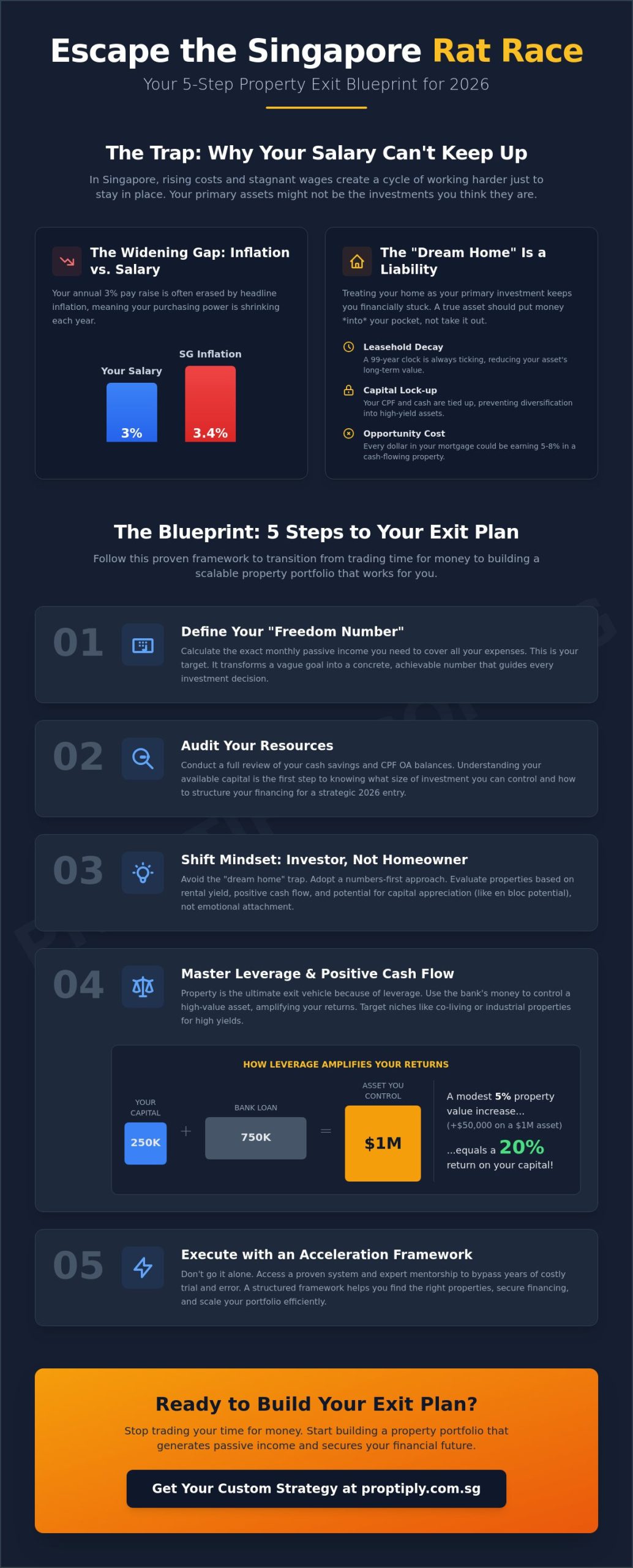
- Leasehold Decay: Most HDB flats and many private condos sit on 99-year leases. As the clock ticks down, the asset’s value will eventually face a “cliff,” making it a poor tool for long-term wealth preservation.
- Capital Lock-up: Sinking all your cash and CPF into a single residential property prevents you from diversifying into high-yield niches like co-living or industrial spaces.
- Opportunity Cost: Every dollar spent on a “dream home” mortgage is a dollar that isn’t earning 5% to 8% in a cash-flowing asset.
Inflation vs. Salary: Why Hard Work Isn’t Enough
Relying on a single source of active income is a dangerous game in 2026. While you might celebrate a 3% annual wage increment, Singapore’s core inflation often fluctuates between 3% and 5%, effectively neutralizing your hard work. If your income doesn’t grow faster than the cost of laksa and electricity, you’re actually getting poorer every year.
Traditional savings accounts are a losing game for wealth builders. With interest rates often failing to beat the real inflation rate, leaving your money in a bank is equivalent to watching your purchasing power evaporate. You cannot work your way to freedom through a salary alone. You must master the art of asset progression and transition into passive income streams that provide a safety net regardless of the job market’s volatility.
Why Property is the Ultimate “Exit Vehicle” from the Rat Race
Most Singaporeans are trapped in a cycle of trading time for money. This cycle is the rat race, and property is the most effective tool to break it. The primary reason is leverage. Unlike stocks where you usually trade with your own capital, property allows you to control a S$1,000,000 asset with a S$250,000 down payment. This 4:1 leverage means that a modest 5% increase in property value actually represents a 20% return on your initial cash outlay. You’re using the bank’s money to build your personal wealth.
Stability is another factor that sets real estate apart from volatile asset classes. While crypto can lose 30% of its value overnight, the Singapore property market remains a global hot spot for capital preservation. According to JLL CEO Christian Ulbrich, the city-state’s transparency and land scarcity ensure it stays a top choice for investors through 2026. This resilience provides a safe harbor for your real estate investment advice and long-term retirement planning. You aren’t just buying brick and mortar; you’re securing a predictable income stream backed by physical collateral.
Linear Income vs. Passive Property Income
Trading hours for dollars is a trap that keeps you stuck in the rat race. This is linear income; if you stop working, the money stops flowing. Passive property income flips this script. A well-managed co-living unit in a prime district can generate a net positive cash flow of S$1,500 to S$2,500 monthly. That’s the equivalent of a part-time salary earned while you sleep. When you reinvest these rental profits into your next unit, you trigger a snowball effect. Your first property pays for the deposit of your second, accelerating your path to financial independence without requiring more of your time.
Asset Progression: The Strategic Move Up
Strategic growth often starts with moving from an HDB to a private condominium or an industrial space. You don’t need to be a millionaire to start; you just need to understand the mechanics of decoupling. By structuring ownership correctly, couples can avoid the Additional Buyer’s Stamp Duty (ABSD) on their second property, allowing them to maximize their portfolio growth. Asset progression is about velocity, not just ownership. It’s about moving your equity from slow-growing assets into high-yield opportunities that work harder for you.
Don’t let your capital sit idle in a low-interest account. Start your journey toward freedom by learning how to master positive cash flow strategies today.
Common Mistakes That Keep Singaporeans Stuck in the Race
Most Singaporeans remain trapped in the rat race because they view property through a lens of emotion rather than cold, hard logic. They chase the “dream home” with a scenic view, overextending their Total Debt Servicing Ratio (TDSR) for a lifestyle asset that drains their bank account every month. This is a fundamental error. To build wealth, you must prioritize numbers over aesthetics. If the rental yield doesn’t comfortably cover your mortgage and maintenance, you’ve bought a liability, not an investment.
Another common pitfall is failing to analyze the hdb en bloc potential 2022 when looking at older resale flats. Many buyers see a cheap price tag but ignore the decaying lease. Without a strategic exit plan or SERS potential, that “affordable” flat becomes a declining asset that anchors you to your 9-to-5 job for decades. Stop waiting for the “perfect time” to enter the market. While you wait for a price dip that may never come, property values in prime districts continue to climb, leaving your savings eroded by inflation.
You must also reframe your relationship with debt. Fear of borrowing is often what prevents middle-class earners from scaling their portfolios. You need to distinguish between two types of leverage:
- Bad Debt: High-interest credit cards or car loans used for depreciating assets.
- Good Debt: Low-interest bank loans used to acquire income-generating properties that pay for themselves.
The ABSD Fear Paralysis
Don’t let the Additional Buyer’s Stamp Duty (ABSD) paralyze your progress. While the tax seems high, savvy investors know it’s a one-time cost that can be mathematically justified by high-yield assets. If a property generates a strong net yield, the ABSD cost is often recovered within a few years of operation. If you want to avoid these taxes entirely, look into commercial and industrial properties where ABSD does not apply. You can also structure your portfolio through legal methods like de-coupling to minimize tax hits while expanding your reach.
Poor Cash Flow Management
Being “asset rich but cash poor” is a dangerous trap in the Singapore market. You might own a S$2 million condo, but if you’re struggling to pay the monthly installments, you’re still stuck in the rat race. High-yield niches like co-living are essential for generating the positive cash flow needed to service mortgages and provide passive income. Always stress-test your portfolio against rising interest rates. As we move into 2026, ensure your investments can withstand a rate hike to 4.5% or 5% without compromising your financial security.
5 Strategic Steps to Build Your Exit Plan in 2026
Escaping the rat race in Singapore isn’t a matter of luck; it’s a matter of strategy. You can’t work your way to freedom if you’re always trading hours for dollars. To break free by 2026, you need a transition from active income to passive cash flow. It’s about building a machine that works while you sleep. Follow these five disciplined steps to build your exit blueprint.
- Step 1: Audit your financial health. Stop guessing and start measuring. Review your CPF Ordinary Account balances and liquid cash reserves. Ensure your Total Debt Servicing Ratio (TDSR) is optimized below the 55% limit so you’re ready to move when the right deal appears.
- Step 2: Define your “Freedom Number.” Calculate the exact monthly passive income needed to cover your current lifestyle and mortgage. Once your property cash flow hits this number, the 9-to-5 becomes optional.
- Step 3: Choose your niche. Match your capital to the right asset class. Residential property offers stability, but industrial spaces often provide higher yields without the sting of Additional Buyer’s Stamp Duty (ABSD). Co-living remains the fastest route for monthly cash flow.
- Step 4: Network with practitioners. Stop taking advice from people who are still stuck in the rat race themselves. Surround yourself with a community of investors who are actively buying and managing portfolios in the current market.
- Step 5: Execute with a proven framework. Avoid the “expensive mistakes” of trial and error. Use a systematic approach to analyze entry prices and exit strategies before you sign the Option to Purchase.
Leveraging the URA Master Plan for Capital Gains
Government urban planning is your investment crystal ball. By 2026, the ripple effects of the Thomson-East Coast Line (TEL) Stage 4 will be fully priced into the East Coast and Marine Parade regions. Smart investors look for the “entry price gap” in these areas. If you can secure a resale unit at S$1,900 psf while nearby new launches are crossing S$2,600 psf, you’ve built in an immediate safety margin. Focus on the Jurong Lake District as it transforms into Singapore’s second CBD, ensuring your capital gains are backed by long-term infrastructure growth.
Building a “Co-Living” Cash Flow Machine
Co-living is the most efficient way to replace a corporate salary quickly. It’s about maximizing the utility of every square foot. For example, a standard 3-bedroom unit in a central location might fetch S$4,500 in the traditional market. However, by professionally managing it as a co-living space and renting rooms individually for S$1,500 to S$2,000 each, that same unit can generate over S$7,500 in gross rent. This 2x yield jump is the secret to accelerated wealth. We focus on the operational systems, from tenant screening to maintenance, that make this a “hands-off” income stream rather than a second job.
Don’t leave your financial future to chance. Attend our upcoming property masterclass to master the proven frameworks that help Singaporeans achieve true passive income.
Mastering the Blueprint: How Proptiply Helps You Break Free
Breaking the cycle of the rat race requires more than just hard work. It demands a shift from trading time for money to making money work for you. Proptiply provides the exact roadmap to achieve this through our Residential Acceleration Program. This isn’t just another theory-based course; it’s a structured, step-by-step path designed for beginners to master the mechanics of the Singapore property market. You’ll learn how to identify undervalued units and manage your finances to maximize leverage without overextending your capital.
Success in property investment isn’t about luck. It’s about following a proven framework. Most new investors lose tens of thousands of dollars on “learning fees” because they try to DIY their way through complex regulations like ABSD and TDSR. Our mentorship model ensures you learn from practitioners who have already navigated these hurdles. To get your strategy right from day one, our 1-on-1 Property Portfolio Consultation creates a bespoke roadmap based on your specific income and goals. You’ll also join the Proptiply community, surrounding yourself with like-minded “escapees” who provide the support and networking needed to stay the course.
Real-World Results vs. Theoretical Education
Jelene Lum and Ervin Ang aren’t just educators. They’re active investors with “boots-on-the-ground” experience in the local market. While many seminars focus on abstract concepts, Proptiply dives into high-yield niches like industrial properties and co-living spaces. These segments often provide the consistent positive cash flow necessary to replace a monthly salary. Our students don’t just study spreadsheets; they analyze actual deals and visit sites to see the numbers in action. Join our next bootcamp to see how these frameworks apply to real 2026 market conditions and start building your asset base today.
Your Next Move: Stop Running, Start Investing
The 2026 property market won’t wait for those who hesitate. The rat race ends the moment you decide to own assets instead of being one. You’ve spent years working for your money, so it’s time to reverse that flow. The urgency to start your portfolio has never been higher as Singapore continues its growth as a global financial hub. Whether you’re looking to unlock your first investment or scale an existing portfolio, the first step is taking action. Book a consultation or attend our upcoming preview to finally take control of your financial destiny.
Take Control of Your Financial Future Today
Escaping the rat race in Singapore requires more than just hard work; it demands a strategic shift from trading time for money to building a portfolio of high-yield assets. You’ve seen how specialized niches like co-living and industrial spaces generate the positive cash flow needed to replace a monthly salary. By avoiding common pitfalls like over-leveraging on low-yield residential units, you can accelerate your path to early retirement. Success isn’t about guessing the next market peak. It’s about applying a disciplined, data-driven framework that works regardless of cooling measures.
Proptiply provides the exact roadmap you need to stop dreaming and start executing. Our founders are active investors who manage over 100 units right here in Singapore, and we’ve already trained more than 1,000 students to master these same strategies. We don’t teach abstract theory; we share the insider knowledge that secures your financial future through proven high-yield models.
Join the Residential Acceleration Program and start your journey to financial freedom today!
You have the blueprint and the tools are within reach. Now is the time to claim your time back and build a legacy that lasts for generations.
Frequently Asked Questions
What exactly is the “rat race” in the context of Singapore?
The rat race in Singapore describes the exhausting cycle of working a 9-to-5 job primarily to fund a high cost of living and long-term debt. It’s a state where your monthly salary is immediately consumed by mortgage payments, taxes, and daily expenses, leaving little room for personal freedom. In 2026, with core inflation remaining a factor, many find themselves working harder just to maintain their current lifestyle without building true wealth.
Can I really escape the rat race with just one investment property?
Escaping the rat race usually requires a portfolio of assets, but one high-yield property serves as the essential proof of concept. A single industrial unit or a co-living apartment that generates S$1,500 in monthly positive cash flow can cover significant household bills. This first success provides the confidence and the equity needed to execute asset progression, allowing you to eventually replace your entire salary with passive income.
How much capital do I need to start investing in Singapore property in 2026?
You generally need between S$150,000 and S$250,000 in liquid capital to secure an entry-level investment property in the current market. This amount covers the 25% down payment and Buyer’s Stamp Duty for an industrial unit priced around S$600,000. If you’re eyeing residential units, remember that the Additional Buyer’s Stamp Duty for a second property is 20% for Singapore Citizens, which significantly increases your initial cash requirement.
Is it too late to start property investing given the current cooling measures?
It’s never too late because cooling measures are designed to stabilize the market, not stop disciplined investors from profiting. While the 2023 cooling measures increased ABSD rates, they also pushed savvy investors toward the industrial and commercial sectors where these taxes don’t apply. Focus on the 55% Total Debt Servicing Ratio limit and look for undervalued assets that offer strong rental yields despite the tighter regulatory environment.
What is the best type of property for generating passive income quickly?
Industrial B1 spaces and co-living residential units offer the fastest path to high rental yields in Singapore today. A well-managed co-living apartment can achieve gross yields of 6% or higher, which is double the 2% to 3% typical of standard long-term residential rentals. These niches allow you to maximize rent per square foot by catering to the growing demand from foreign professionals who need flexible, high-quality living arrangements.
How do I balance a full-time job while building a property portfolio?
Use a systematic framework to manage your investments so they don’t become a second full-time job. Automate your rent collection and hire professional co-living operators to handle tenant issues and maintenance. By spending just 4 hours a month reviewing your portfolio’s performance, you can build wealth while maintaining your career. Successful investors focus on managing the business rather than doing the manual labor themselves.
Should I sell my HDB flat to start my investment journey?
Selling your HDB flat is a strategic move if the sale unlocks enough capital to transition into two private properties using a “sell one, buy two” strategy. This approach allows a couple to own one property for residence and another for investment without incurring ABSD. If your HDB has reached its peak valuation after the 5-year Minimum Occupation Period, recycling that equity into higher-yielding private assets is a proven way to accelerate wealth.
What is the difference between an investor and a landlord?
A landlord focuses on property maintenance and tenant complaints, while an investor focuses on ROI and positive cash flow. Investors treat their property as a business asset, using data-driven strategies to maximize returns and minimize vacancies. Landlords often get stuck in the daily grind of repairs. Investors use proven systems to ensure their money works for them, creating the financial freedom needed to leave their jobs behind.