
Why settle for a 2.5% rental yield when the 2026 market is ready to reward investors who think in rooms, not units? You’ve likely noticed that the old “buy and hold” strategy for traditional condos has hit a wall of cooling measures and razor-thin margins. It’s frustrating to watch your monthly mortgage eat your profits while you struggle to keep up with the latest URA regulatory shifts. If you want to achieve genuine financial freedom, you need to pivot toward high-yield co living apartments singapore that generate consistent, positive cash flow regardless of market volatility.
We’ve spent years refining a proven framework for asset progression, and we’re ready to share the insider knowledge you need to succeed. Since the URA maintained the six-unrelated-person occupancy cap for private properties into 2025, the demand for managed flexible housing has surged by over 15% in core central regions. This guide provides a clear blueprint for navigating these regulations and selecting high-demand locations that keep your occupancy rates high. We’ll break down the 2026 strategy for maximizing rental income per square foot so you can build a secure property portfolio with the confidence of a seasoned pro.
Key Takeaways
- Discover why shifting demographics and the rise of independent living make co living apartments singapore the most resilient asset class for the 2026 property market.
- Master a rigorous 5-point selection checklist to identify high-potential units and avoid the costly mistake of converting unsuitable residential properties.
- Navigate complex URA regulations with confidence, ensuring your investment remains fully compliant while avoiding heavy penalties associated with the “6-person rule.”
- Learn to calculate true ROI by comparing Master Lease and Owner-Operator models to maximize your net yield and monthly positive cash flow.
- Unlock a proven blueprint for market mastery that prioritizes real-world application over theory, helping you build a secure portfolio of passive income.
Why Co-living Apartments in Singapore are the 2026 Investment Frontier
Stop looking at residential real estate through an outdated lens. The game has changed. Co-living is the professionalized evolution of communal housing, designed specifically for PMEs (Professionals, Managers, and Executives) and digital nomads who demand more than just a roof over their heads. It is a curated lifestyle model that combines private living spaces with high-quality shared amenities. In the 2026 market, co living apartments singapore represent the most aggressive way to secure positive cash flow in a high-interest environment.
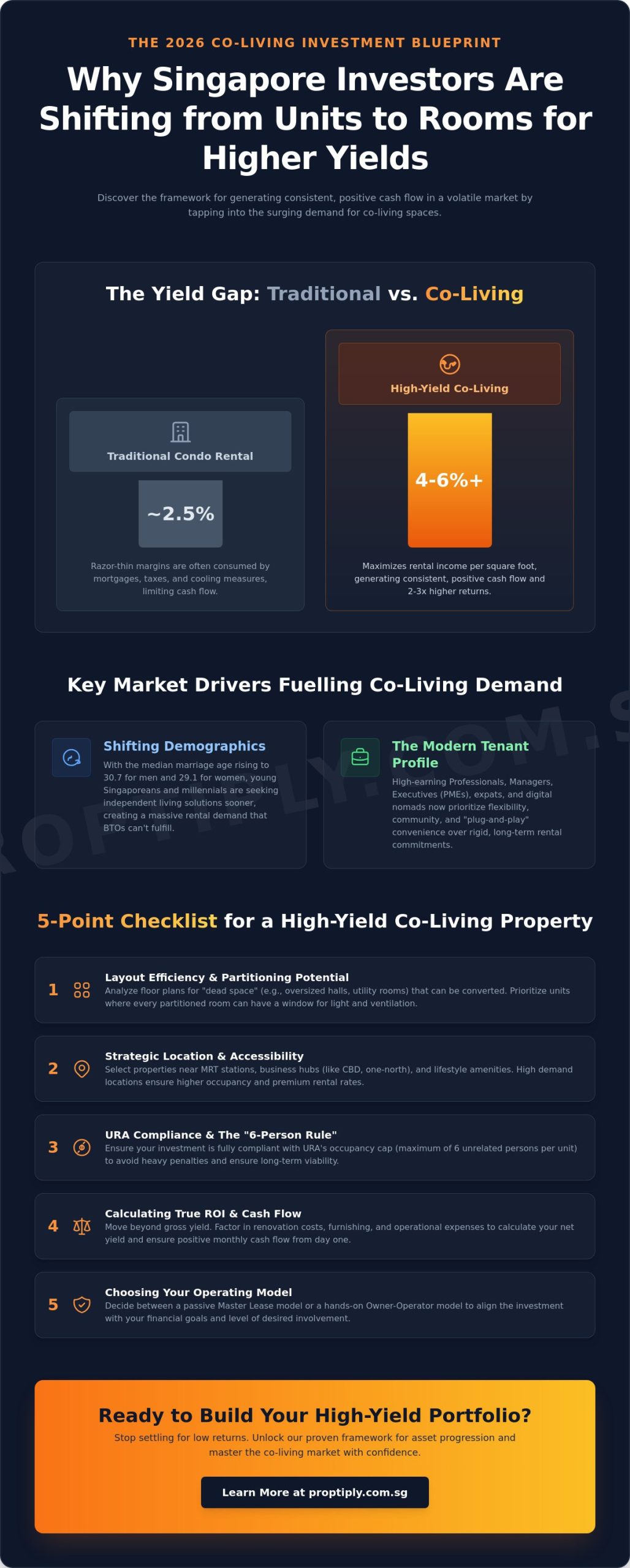
Singapore’s social fabric is shifting rapidly. The Department of Statistics noted the median age for first marriages rose to 30.7 for men and 29.1 for women by 2023. This delay, coupled with a growing desire for independent living among local millennials, has created a massive supply-demand imbalance. These individuals aren’t waiting for a BTO anymore. They want autonomy now. As an investor, you can’t afford to ignore this demographic pivot. You need to master the math that makes these units work.
The “Yield Gap” is the primary reason savvy investors are pivoting. Traditional residential rentals in Singapore typically hover around a 2% gross yield. That’s barely enough to cover maintenance and taxes. Co-living strategies allow you to outperform these figures by 2 to 3 times. By optimizing the layout and renting by the room, investors are achieving yields of 4% to 6% or higher. We focus on “Rental per Square Foot” as our North Star metric for 2026. This approach ensures every inch of your floor plan is generating maximum revenue.
The Evolution of the Singapore Rental Market
The market has matured from “room rentals” in old HDB flats to branded co-living experiences in prime districts. High property prices mean that capital appreciation is no longer a guaranteed exit strategy. You need a proven framework to generate immediate income. Branded operators now offer tech-enabled stays, weekly cleaning, and community events that justify premium pricing. Co-living is a yield-maximisation strategy via space optimisation.
Who is the 2026 Co-living Tenant?
Your target tenant is no longer just the budget-conscious traveler. The 2026 tenant pool consists of high-earning expats, local professionals seeking a “plug-and-play” lifestyle, and remote workers who need a stable home office environment. These groups prioritize flexibility and community over the rigid, two-year commitments of traditional HDB or Condo rentals. They want a lifestyle they can’t get from a standard landlord. Dive deeper into these market shifts by reading The Ultimate Guide to Co-Living in Singapore.
The 5-Point Selection Checklist for Profitable Co-living Apartments
Success in the co living apartments singapore market isn’t about luck. It’s about the disciplined application of a proven framework. You can’t simply buy any residential unit and expect it to generate high yields. Many investors make the expensive mistake of falling in love with a property’s facade while ignoring its structural limitations. To secure a high-performing asset, you must treat the selection process like a cold, hard business transaction.
The goal is to identify properties that allow for maximum “rentable units” without compromising the tenant experience. This requires a “Pragmatic Visionary” mindset. You need to see the potential for conversion where others only see a standard family home. Follow this checklist to filter out the duds and lock in a property that produces consistent passive income.
Point 1: Layout Efficiency and Partitioning Potential
The layout is your primary filter. You’re looking for “dead space” like oversized utility rooms, massive foyers, or unnecessarily wide hallways. These areas can often be reconfigured to create an additional bedroom. However, every partitioned room must have a window for natural light and ventilation. Don’t compromise on this. A windowless “shoebox” is a liability that leads to high turnover.
Check the floor plan for existing en-suite potential. Units with multiple bathrooms are gold mines because they allow you to charge a premium for “Master Suites” with private baths. Before you commit, ensure your plans align with URA Regulations and Legal Compliance regarding occupancy caps and structural safety. Mastering these spatial puzzles is how you unlock the true cash flow potential of a unit.
Point 2: Location and the “10-Minute MRT” Rule
In Singapore, convenience is the ultimate currency. If a property is more than an 800-meter walk from an MRT station, your vacancy risk triples. Focus on “Transport Nodes,” specifically Interchange stations where two or more lines meet, such as Paya Lebar or Buona Vista. These hubs provide tenants with seamless access to the CBD and Jurong Lake District.
While District 9, 10, and 11 (CCR) offer prestige, high-growth Rest of Central Region (RCR) areas often provide better entry prices and higher rental yields. Always cross-reference your choice with the URA Master Plan 2025/2030. If the government is planning a new MRT line or a “Work-Live-Play” hub nearby, you’ve found a winner. Connectivity upgrades are the fastest way to see capital appreciation alongside your monthly rent.
Point 3: Amenities and Communal Appeal
Your target tenant isn’t just renting a room; they’re renting a lifestyle. High-end condo facilities like a 50m lap pool or a well-equipped gym are excellent “hooks” to attract professional tenants. However, external amenities are just as vital. Proximity to 24-hour supermarkets, hawker centres, and “Instagrammable” cafes in areas like Tiong Bahru or Katong creates a sticky environment for tenants. Lifestyle proximity directly correlates to lower vacancy rates and allows you to maintain rental rates even during market fluctuations. Ensure the unit is within a 5-minute walk of basic necessities to keep your tenants satisfied and your cash flow steady.
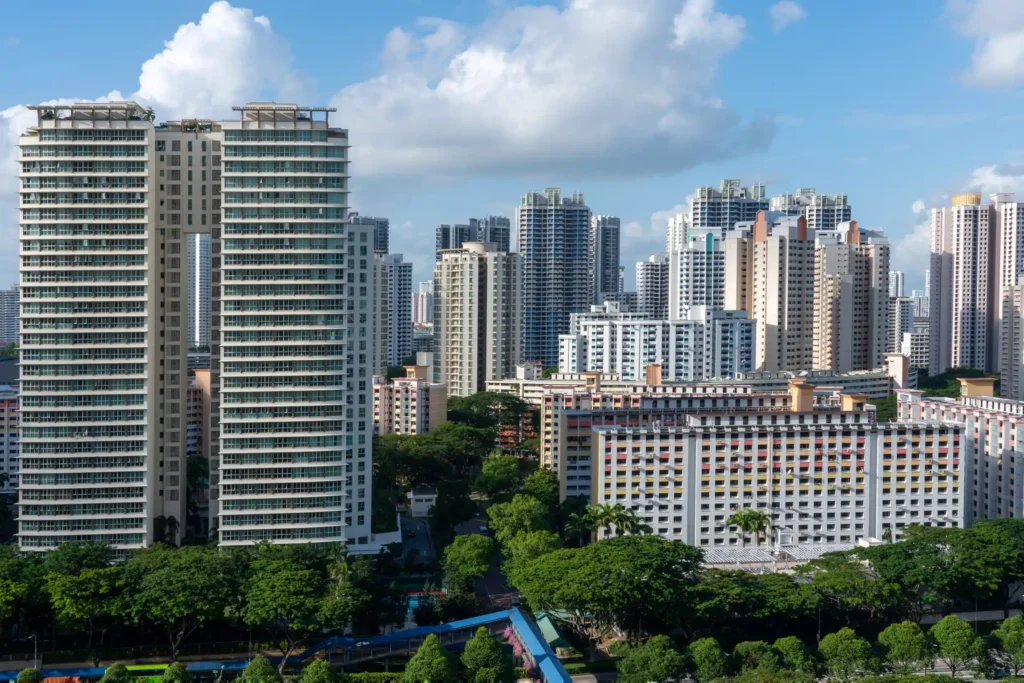
Navigating URA Regulations and Legal Compliance in Singapore
Compliance isn’t just a legal hurdle; it’s the safety net that protects your capital. In the world of co living apartments singapore, the Urban Redevelopment Authority (URA) sets the ground rules that separate professional investors from amateurs. You must respect the 3-month minimum stay requirement for all private residential properties. Attempting to run daily or weekly rentals is a fast track to heavy fines and the potential forfeiture of your rental license. Professionalism starts with following the playbook.
While Calculating Your ROI, you’ll need to factor in the costs of strict fire safety compliance. The Singapore Civil Defence Force (SCDF) has clear mandates regarding partitioning. You can’t simply hack walls or erect new ones without ensuring fire escape paths remain clear and materials meet non-combustible standards. Unauthorized modifications can lead to enforcement actions that force you to tear down your renovations, destroying your yield overnight. Protect your investment by getting your floor plans vetted by a qualified person before you start any work.
Understanding the URA 6-Unrelated Persons Rule
The URA is crystal clear: no more than six unrelated persons can occupy a single private residential unit. “Unrelated” means individuals who don’t belong to the same family nucleus. If you’re housing a group of digital nomads or young professionals, that cap is your absolute limit. Exceeding this number constitutes “unauthorized change of use,” which carries a fine of up to S$200,000 or even jail time for repeat offenders. Don’t risk your entire portfolio for the sake of one extra tenant’s rent.
- Structure your tenancy: Ensure every occupant is named on a formal agreement that explicitly states their move-in date.
- Avoid “Sub-letting” traps: Always obtain written consent from the landlord if you’re operating a rent-to-rent model to avoid illegal sub-letting charges.
- Vetting: Keep copies of NRICs or FIN cards to prove all residents are legally residing in Singapore.
Stamp Duties and Ownership Structures
Your entry strategy determines your long-term scalability. With Additional Buyer’s Stamp Duty (ABSD) rates currently at 20% for a Singapore Citizen’s second property and 30% for the third, high acquisition costs can eat your margins. Smart investors often use decoupling or “Trust” structures to manage these costs legally. By strategically naming owners, you can unlock the ability to acquire multiple co living apartments singapore without being hit by the full weight of ABSD.
Mastering these frameworks is the difference between a struggling landlord and a thriving asset manager. If you want to dive deeper into the mechanics of property acquisition, check out our latest Real Estate Investment Advice. We deconstruct the exact methods used to scale portfolios while staying 100% compliant with IRAS and URA regulations. Don’t let taxes stop your asset progression; learn to navigate the system with precision.
Calculating Your ROI: Co-living vs. Traditional Rental Models
Stop settling for the mediocre 2% to 3% gross yields common in traditional residential rentals. If you want to achieve true financial freedom, you must understand how co living apartments singapore generate superior cash flow through strategic space optimization. The “Co-living Premium” exists because modern tenants value convenience over square footage. A professional millennial will gladly pay S$1,800 for a private, well-designed suite rather than dealing with the headache of splitting a S$5,000 three-bedroom utility bill with unreliable roommates.
You have two primary paths to enter this market. The Master Lease model allows you to rent a unit from an existing landlord and sublet individual rooms. This requires less upfront capital but demands high operational efficiency. Alternatively, the Owner-Operator model gives you full control over the asset, allowing you to capture both high rental yields and long-term capital appreciation. While gross yield looks at your total rent collected, your focus must remain on the net yield. This is the figure that remains after accounting for the “all-in” costs that make co-living attractive to tenants.
The Yield Comparison Table (District 15 Example)
Look at the numbers for a typical 1,200 sq ft condo in District 15 (Amber/Katong area) to see the “Positive Cash Flow” difference:
- Traditional Rental (Whole Unit): Monthly Rent: S$5,500. After maintenance fees and property tax, your monthly take-home is limited.
- Co-living Conversion (5 Rooms): Average Rent per Room: S$1,650. Total Monthly Rent: S$8,250.
- The Surplus: Even after deducting S$800 for utilities, WiFi, and weekly cleaning, you generate roughly S$1,950 more per month than a traditional landlord.
This extra S$23,400 per year is what transforms a standard property into a high-performance investment vehicle.
Operational Expenses (OPEX) to Watch For
Don’t let the fear of maintenance costs hold you back. High-intensity usage is a myth if you have the right systems in place. Budget S$250 to S$400 monthly for professional weekly cleaning. This isn’t just a perk for tenants; it’s your eyes and ears on the ground to spot minor leaks or repairs before they become expensive disasters.
Invest in high-speed mesh WiFi (S$60 to S$100/month) and durable, “Instagrammable” furniture. Staging your unit correctly allows you to command a 15% to 20% rental premium over uninspired, bare-bones rooms.
Net Operating Income (NOI) is the annual income generated by your co-living asset after all operating expenses are subtracted, but before taxes and mortgage payments are deducted. Master this number to evaluate your property’s true performance.
Mastering the Co-living Business with Proptiply’s Proven Framework
You’ve done the research and seen the potential for high yields in the rental market. Now it’s time to build a real business. Proptiply’s “Co-Living Bootcamp” isn’t just another seminar. It’s the definitive shortcut to mastering co living apartments singapore. We don’t just teach you the “what”; we show you the “how” through a lens of actual practice. Theoretical knowledge often crumbles when faced with real-world hurdles like URA regulations or difficult tenant profiles. We bridge that gap with a framework built on years of trial and error in the local market.
Most investors fail because they stay in their heads. They study charts but never step into a property. Our methodology prioritizes “boots-on-the-ground” experience. You learn to spot the nuances that make a property profitable, such as layout potential for room partitions or proximity to strategic MRT hubs like Paya Lebar or Buona Vista. You aren’t just an investor here; you become part of a powerful ecosystem. Networking with other active investors in Singapore allows you to share resources, vetted contractors, and even co-invest in larger deals. This community is your safety net against expensive mistakes.
Scaling from a single unit to a million-dollar portfolio requires a system, not luck. We’ve seen students transition from their first rental to managing ten or more co living apartments singapore by applying our repeatable blueprint. This isn’t about working harder; it’s about working the system we’ve already perfected.
What You Learn in the Co-Living Bootcamp
We teach you to hunt where others don’t look. You’ll learn our system for sourcing “off-market” deals that are perfectly primed for conversion. These are properties where the seller is motivated and the price hasn’t been bid up by the general public. We also dive deep into negotiation tactics. Securing the right entry price is the difference between a mediocre return and a high-yield asset. For a deeper dive into our curriculum, check out our guide on Mastering the Co-Living Bootcamp.
Your Next Step: From Education to Execution
Stop the “analysis paralysis” that keeps most people stuck in a 9-to-5 grind. The most successful members of our community started with one unit and scaled to a diversified portfolio within 24 to 36 months. If you want a bespoke investment roadmap tailored to your specific financial goals, our 1-on-1 Portfolio Consultation is the logical next step. It’s time to stop dreaming about passive income and start building it. Join the next Co-Living Bootcamp and start your journey to financial freedom.
Secure Your Financial Future in the 2026 Property Market
The transition toward co living apartments singapore represents a fundamental shift in how savvy investors generate positive cash flow. Traditional rental models often struggle against rising costs, yet strategic co-living setups can significantly outperform them by maximizing floor area efficiency and meeting the growing demand for flexible housing. Success in this niche hinges on navigating URA regulations with precision and applying a rigorous selection checklist to avoid legal pitfalls. You don’t have to guess your way through these complexities or risk your hard-earned capital on unproven theories.
Proptiply has already empowered over 1,000 students to navigate the Singapore property landscape using our field-tested frameworks. Led by active practitioners Jelene Lum and Ervin Ang, we specialize in high-yield co-living and industrial niches that deliver real-world results. Stop settling for mediocre yields and start building a resilient portfolio backed by expert mentorship and a community of successful investors. Your journey toward asset progression and financial security starts with the right blueprint.
Master the Co-Living Model at Our Next Bootcamp
Frequently Asked Questions
Is co-living legal in Singapore HDB flats?
Yes, co-living is legal in HDB flats provided you follow the Housing & Development Board’s strict occupancy cap of six unrelated persons. You must ensure all tenants sign a lease for at least six months to avoid illegal short-term rental penalties. Unlike private condos, you aren’t allowed to install internal partitions to create extra rooms in HDB units. This regulation ensures the residential character of public housing remains intact for the community.
How many people can legally stay in a co-living apartment in Singapore?
You can legally house a maximum of six unrelated persons in any residential property, including HDB flats and private apartments. This cap is strictly enforced by the Urban Redevelopment Authority (URA) and HDB regardless of how large the unit is. For co living apartments singapore investors, success depends on optimizing the layout within this six-person limit to maximize your rental yield. Exceeding this number can lead to heavy fines or prosecution.
What is the minimum lease period for co-living in Singapore?
The minimum lease period is three consecutive months for private residential properties and six months for HDB flats. Short-term stays like those found on Airbnb are illegal under current URA guidelines. If you rent out your unit for shorter durations, you risk a fine of up to S$200,000. Always verify your tenants’ valid passes to ensure their stay aligns with these legal timeframes for a compliant and secure investment.
Do I need a special license to start a co-living business in my own property?
You don’t need a specific “co-living license” for standard residential units if you stay within the six-person occupancy limit. You must, however, register your tenants’ details through the HDB or URA e-services portals. If you plan to convert an entire building into a large-scale hostel or boarding house, you’ll need to apply for a Change of Use and a hotel-class license. Most individual investors stick to the residential framework to simplify operations.
Which Singapore districts offer the highest rental yields for co-living?
Districts 8 (Little India/Farrer Park), 14 (Geylang/Paya Lebar), and 15 (East Coast) consistently deliver the highest rental yields for co-living investors. These areas attract young professionals because they’re close to the CBD and offer vibrant lifestyle amenities. Data from 2023 shows that well-managed units in these city-fringe locations can achieve gross yields of 4% to 6%. This significantly outperforms the 2% to 3% typically seen in standard long-term residential rentals.
How does ABSD affect my co-living investment strategy?
Additional Buyer’s Stamp Duty (ABSD) increases your initial capital outlay, with Singaporeans paying 20% on their second residential property as of April 2023. This tax makes the high-yield nature of co living apartments singapore even more critical to offset the higher entry cost. Many savvy investors now look at industrial properties or commercial shophouses where ABSD doesn’t apply. This strategy preserves your cash flow while allowing you to build a robust property portfolio faster.
Can I convert a commercial property into a co-living space?
You can convert commercial properties like shophouses into co-living spaces if the URA approves a Change of Use application. This process involves rezoning the property to “Residential” or “Serviced Apartment” status. It’s a powerful way to avoid ABSD while tapping into the high demand for boutique living. Always check the Master Plan 2019 to see if your specific plot allows for residential activity before you commit to a purchase.
Is it better to manage the co-living apartment myself or hire an operator?
Managing the property yourself maximizes your profit margins but requires a significant time investment for tenant screening and maintenance. Professional operators typically charge a management fee of 10% to 20% of the gross rent. If you’re a beginner, hiring an expert helps you avoid expensive legal mistakes and ensures high occupancy rates. Once you master our proven framework, you might choose to DIY to unlock 100% of the positive cash flow.