
A single missing clause in your tenancy agreement singapore can cost you more than 12 months of rental income in legal fees and property repairs. You’ve likely felt that nagging worry about “tenants from hell” damaging your asset or felt confused by the 0.4% stamp duty requirements that often catch new landlords off guard. It’s a common fear for many investors who just want to secure their financial freedom without the drama of hidden maintenance costs eating into their hard-earned cash flow.
We believe that property investment should be a predictable business, not a gamble. This guide provides the proven blueprint you need to master the legal essentials and safeguard your property assets against expensive mistakes. We will walk you through the non-negotiable clauses every landlord must include, show you how to handle security deposits with total confidence, and share our secrets for maintaining a high-yield rental property that generates consistent passive income. Stop guessing and start protecting your portfolio today.
Key Takeaways
- Master the legal essentials of a tenancy agreement singapore to move beyond standard templates and build a robust shield for your property assets.
- Protect your rental yield by implementing “investor-grade” clauses, such as the Minor Repair and Diplomatic clauses, to minimize unexpected maintenance expenses.
- Calculate your real costs with precision, from mandatory IRAS Stamp Duty to industry-standard security deposits, ensuring your passive income remains secure.
- Execute a foolproof “Day 0” handover blueprint using high-resolution documentation and detailed inventory reports to eliminate future tenant disputes.
- Unlock the secrets to professional property management by learning proven frameworks to screen high-quality tenants and accelerate your asset progression.
What is a Tenancy Agreement in Singapore and Why the Standard Template Isn’t Enough
A tenancy agreement singapore is the bedrock of your real estate empire. It’s more than just paperwork. It’s a legally binding contractual arrangement that defines the success of your investment. Most beginners simply download the Council for Estate Agencies (CEA) standard templates and call it a day. That’s a trap. While these templates provide a basic safety net, they don’t cover the complexities of high-yield strategies like co-living or industrial sub-letting. To professionalize your portfolio and secure your passive income, you must customize your TA to address the specific risks of your property niche. Standard forms are a starting point, not the finish line. Use them as a foundation, then build in clauses that protect your positive cash flow and clarify maintenance expectations.
The Legal Framework: Women’s Charter and Common Law
Singapore’s legal landscape changed significantly when the Control of Rent Act was repealed in 2001. Today, no “Rent Control Act” exists to dictate your terms. This makes your TA the ultimate authority in any dispute. It’s your blueprint for conflict resolution. You must also account for the Women’s Charter. Section 161 of this act places the burden on landlords to ensure their property isn’t used for illegal activities. A professional TA includes specific “kick-out” clauses that protect you from being held liable for a tenant’s illicit behavior. Don’t gamble with a verbal “gentleman’s agreement.” If it isn’t in writing, it doesn’t exist in the eyes of the law.
HDB vs. Private Property: Key Regulatory Differences
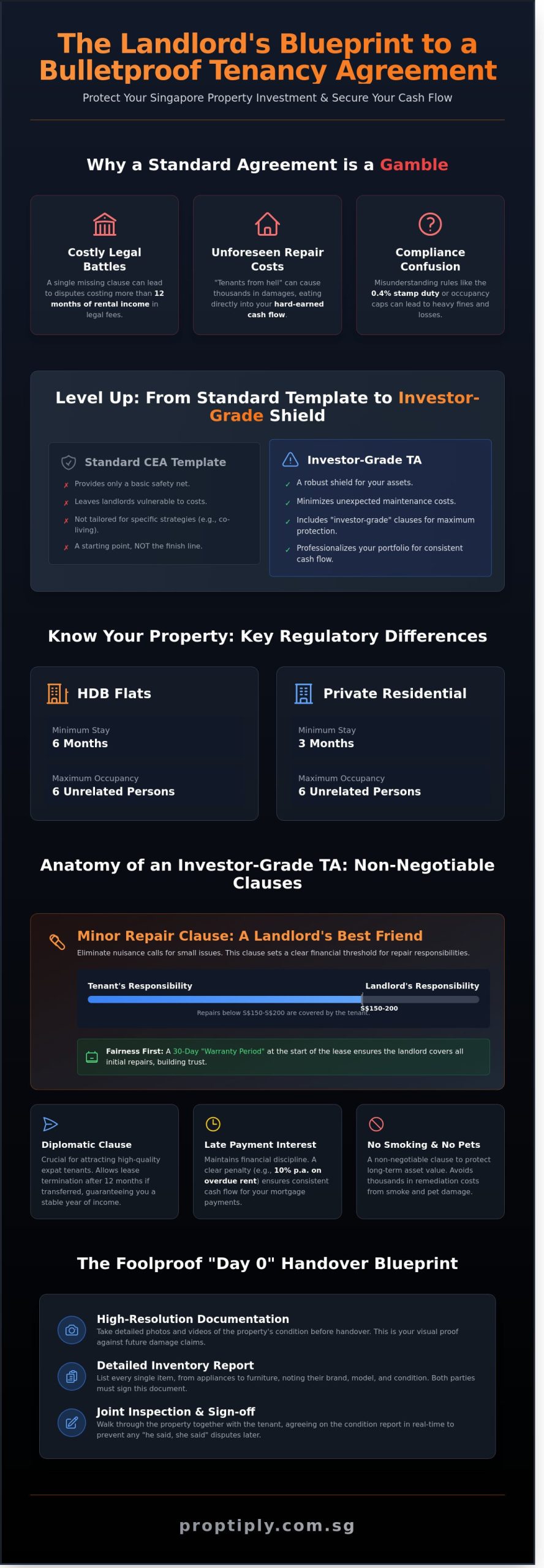
Mastering the nuances between HDB and private property regulations is essential for asset progression. HDB flats require a minimum stay of 6 months. If you sign a shorter lease, you’re violating HDB’s core policies. Private residential properties offer more agility with a 3-month minimum stay requirement. This flexibility allows savvy investors to target shorter-term professional contracts for higher turnover. You must also strictly enforce the Maximum Occupancy Cap. URA and HDB regulations limit occupancy to 6 unrelated persons per unit. Ensure your tenancy agreement singapore explicitly states this limit. Exceeding it can result in heavy fines or the loss of your rental license, destroying your positive cash flow overnight.
Anatomy of an Investor-Grade TA: Essential Clauses You Must Include
A standard tenancy agreement singapore often leaves landlords vulnerable to unexpected costs. You need an investor-grade document that acts as a shield for your passive income. This document isn’t just a formality; it’s a strategic tool to ensure your property remains a high-performing asset. Start by including a Diplomatic Clause. Singapore is a global talent hub, and many high-quality tenants are expats. This clause allows them to terminate the lease after 12 months if they’re transferred out of the country. It provides the flexibility they need while guaranteeing you at least one year of stable rental income.
Protecting your asset value is equally vital. Strict “No Smoking and No Pets” clauses are non-negotiable for investors focused on long-term capital appreciation. Smoke odors and pet damage can cost thousands to remediate, eating into your net yield. You should also include a late payment interest clause. Setting a clear penalty, often 10% per annum on overdue rent, maintains financial discipline. This ensures your cash flow remains consistent so you can service your mortgage without any hiccups. Before finalizing your document, ensure you understand the legalities of Stamp duty on leases to keep your agreement legally binding and enforceable.
The Minor Repair Clause: A Landlord’s Best Friend
Nuisance calls for blown lightbulbs or leaky washers can drain your time and profits. Use a minor repair clause to set a clear responsibility threshold, typically between S$150 to S$200. Anything below this amount is the tenant’s responsibility. To keep things fair, always include a 30-day “warranty period” at the start of the lease. During these first 30 days, the landlord covers all repairs to ensure the property is in good working order. This builds trust and sets a professional tone for the entire tenancy. Clearly define “fair wear and tear” to distinguish between natural aging and active negligence, which prevents messy disputes when the lease ends.
Strategic Clauses for Co-Living and Multi-Tenancy
Co-living models require more granular detail to manage shared spaces effectively. You must incorporate specific “House Rules” directly into the TA to govern communal areas like kitchens and living rooms. This prevents friction between tenants and maintains the property’s condition. For utilities, choose between a fixed monthly rate or usage-based billing. Usage-based billing is often more equitable in a multi-tenancy setup as it encourages energy conservation. Finally, clearly state your Right of Entry. You need the ability to perform periodic maintenance checks or show the property to prospective tenants during the final two months of the lease. Balancing this with a 48-hour notice period respects tenant privacy while protecting your investment interests.
Mastering these clauses is the first step toward a worry-free investment journey. If you want to see the exact blueprints we use for our own portfolios, consider joining our property investment community to learn from active practitioners.
Calculating the Real Costs: Stamp Duty, Deposits, and GST
Mastering the tenancy agreement singapore market requires a clear view of the numbers. You aren’t just collecting rent; you’re managing a professional asset. Beginners often overlook the hidden friction costs that can eat into positive cash flow if not handled correctly. To protect your ROI, you must understand the exact financial obligations that transform a simple handshake into a legally binding, high-yield investment.
IRAS Compliance: Don’t Skip the Stamp Duty
Stamp duty is a mandatory legal requirement, not a suggestion. The tenant typically bears this cost, which is calculated at 0.4% of the total rent for the entire lease period. An unstamped document is a massive liability. It’s inadmissible in court during a dispute, leaving you unprotected if a tenant defaults or damages your property. You have exactly 14 days to complete this via the IRAS e-Stamping portal for documents signed in Singapore. If the agreement is signed overseas, you have 30 days to get it stamped. Do not delay this step. It’s the primary way to lock in the legal validity of your contract and ensure your rights are enforceable.
Managing the Security Deposit and Rental Arrears
Understand the difference between the “Good Faith Deposit” and the “Security Deposit” to avoid common terminology traps. The Good Faith Deposit accompanies the Letter of Intent to show serious interest. It usually converts into the first month’s rent or the security deposit once the tenancy agreement singapore is finalized. For a 1-year lease, the industry standard for the security deposit is 1 month of rent; for a 2-year lease, it’s 2 months. This fund serves as your financial shield.
- Never treat the deposit as the “last month’s rent.” This is a rookie mistake that leaves you with zero leverage for repairs or professional cleaning after the tenant moves out.
- Legally utilize the fund for damages. You can deduct costs for repairs that go beyond “fair wear and tear,” such as deep stains on carpets or holes in the walls.
- Act fast on defaults. If a tenant stops paying, issue a formal “Letter of Demand” immediately. This signals that you are a disciplined investor who follows a proven framework for asset management.
Regarding tax considerations, residential rents remain GST-exempt under current regulations. However, the landscape for commercial and industrial properties is different. As we move through the 2024 to 2026 tax environment, remember that GST-registered landlords must charge the prevailing 9% GST on commercial rent. Always verify the GST status of the landlord before signing to ensure your overhead projections are accurate and your margins remain healthy. To further protect your cash flow, it’s equally important to find a mortgage broker in Singapore who can structure your financing to maximize your net rental yield across market cycles.
The Handover Blueprint: Inventory and Condition Reports
Protecting your investment starts the moment you hand over the keys. You’ve secured a signed tenancy agreement singapore, but that’s only half the battle. A professional handover prevents “he-said, she-said” disputes that can eat into your rental yield. Follow this four-step framework to secure your property’s “Day 0” state and protect your positive cash flow.
First, create a comprehensive Inventory of Contents (IOC) for every room. Second, capture high-resolution photo and video documentation. Don’t just take wide shots; focus on the internals of appliances and the condition of flooring. Third, perform a joint inspection walk-through. Both parties must sign off on the findings immediately. Don’t rush this process. Finally, manage the key handover and SP Services account transfer. Ensure the tenant provides proof of their utility account activation to avoid being billed for their initial aircon usage.
The Importance of the Inventory of Contents (IOC)
The IOC is your primary shield if a dispute arises. List every appliance, piece of furniture, and its current working condition. If you’re providing high-value electronics, include brand names and serial numbers for items like a S$2,000 Bosch refrigerator or a Samsung smart TV. This prevents tenants from swapping your premium appliances with older, faulty models. In Singapore, the Small Claims Tribunal (SCT) can hear cases for claims up to S$30,000. Without a detailed IOC signed by both parties, proving your case at the SCT becomes significantly harder. List everything. Protect your yield.
The “Condition Report” as a Dispute Pre-emption Tool
Think of the Condition Report as an insurance policy for your security deposit. Document every existing scratch on the parquet, stain on the marble, or dent in the cabinetry. Both parties should sign and date every page of the photo evidence to acknowledge the property’s baseline state. This transparency builds trust and sets a professional tone for the entire lease term. You can streamline this process using digital tools like HappyCo or simple shared cloud folders with timestamped files. Using these “boots-on-the-ground” tactics ensures you avoid expensive mistakes and keep your asset progression on track. A solid tenancy agreement singapore backed by a rigorous condition report is the hallmark of a seasoned investor.
Mastering the Landlord Game: How Proptiply Professionalizes Your Investment
Most people enter the rental market as “accidental landlords.” They rent out a spare room or a first investment unit without a clear system, relying on luck rather than logic. This approach is a gamble that often results in late payments, damaged fixtures, or messy legal disputes. Proptiply changes that dynamic. We help you transition into a professional property investor who treats real estate as a disciplined, high-yielding business. Our Residential Acceleration Program provides the exact framework needed to screen for high-quality tenants, ensuring your tenancy agreement singapore is backed by a reliable occupant who respects your asset.
Managing co-living spaces requires a level of precision that standard rental models don’t offer. You aren’t just managing a property; you’re managing a community. Proptiply provides a proven framework for co-living management that utilizes airtight agreements to cover every friction point. We teach you how to set clear boundaries on utility caps, cleaning schedules, and house rules. By using our community-validated templates and checklists, you avoid the expensive mistakes that cost beginners thousands of dollars. You’ll move forward with the confidence of a seasoned pro, knowing your cash flow is protected by a solid legal and operational foundation.
Why Education is Your Best Insurance Policy
A poorly drafted tenancy agreement singapore can lead to losses exceeding S$10,000 in unpaid rent and property restoration costs. Compare that to the investment in a professional bootcamp, and the choice becomes clear. Education is the only insurance policy that pays you back. Students from our 2023 cohorts reported saving an average of S$3,500 by identifying contract loopholes before they became legal nightmares. When you join Proptiply, you’re entering a community of like-minded Singaporean investors. This network provides ongoing support, sharing real-time market insights and vendor recommendations that keep your overhead low and your yields high.
Take the Next Step Toward Financial Freedom
Stop guessing and start growing your wealth through a systematic approach to property. You can unlock the secrets of high-yield property management and master the nuances of asset progression in the local market. It’s time to move beyond theory and apply a blueprint that works in the real world. Our mentors have navigated every market cycle and are ready to share the insider knowledge you won’t find in textbooks. Don’t leave your financial future to chance. Secure your spot at our next bootcamp and master the Singapore property market to begin your journey toward sustainable passive income today.
Secure Your Rental Yield and Scale Your Portfolio Today
Secure your cash flow by treating your rental property like a high-performance business. Relying on a generic tenancy agreement singapore leaves you vulnerable to disputes and unexpected costs that eat into your yield. You’ve learned that success requires specific investor-grade clauses and a meticulous handover blueprint to protect your physical assets. Proptiply founders Jelene Lum and Ervin Ang developed these proven frameworks to manage high-yield co-living portfolios with precision. Their methodology moves you past theoretical talk into real-world application.
You don’t have to guess your way through stamp duty calculations or inventory reports. You can access 1-on-1 personalized portfolio consultations and learn how to scale your residential holdings safely. Before you finalize your next property acquisition, ensure you understand the legal mechanics of the option to purchase process to protect your capital and secure your deal with absolute certainty. Stop playing the amateur landlord game and start mastering the professional strategies that build lasting wealth. Your journey toward a secure, passive income stream is within reach when you follow a tested system.
Master the art of property investment-Join our Residential Acceleration Program today!
The path to financial freedom is a logical progression once you have the right blueprint in your hands. Take the next step toward your asset progression goals today.
Frequently Asked Questions
Is a tenancy agreement legally binding in Singapore if it is not stamped?
A tenancy agreement is legally binding between the landlord and tenant once signed, but it isn’t admissible in court as evidence unless it’s stamped. IRAS requires stamp duty to be paid within 14 days of signing the document locally to ensure its legal validity during disputes. Don’t skip this step. Stamping protects your interests and provides the necessary legal weight if you ever need to escalate a case to the Small Claims Tribunal.
Can a landlord enter the property without the tenant’s permission in Singapore?
Landlords cannot enter the rented premises without the tenant’s prior consent except in genuine emergencies like a fire or a major pipe burst. Your tenancy agreement singapore should explicitly state that the landlord must provide 24 to 48 hours of notice for routine inspections or repairs. Respecting the “quiet enjoyment” clause is a fundamental right for every tenant. Always verify these access terms before signing to avoid unwanted intrusions and maintain a professional relationship.
What is the minimum rental period for a condo vs. an HDB flat in Singapore?
The minimum rental period for private residential properties like condos is 3 consecutive months according to URA guidelines. For HDB flats, the Housing and Development Board mandates a minimum stay of 6 months. Short term rentals like Airbnb remain illegal in Singapore for residential homes. Ensure your lease duration complies with these specific regulations to avoid heavy fines or the potential repossession of your property investment.
Who is responsible for aircon servicing in a Singapore tenancy agreement?
Tenants are usually responsible for routine quarterly aircon servicing and must retain all service receipts as proof for the landlord. Most agreements include a minor repair clause where the tenant pays the first S$150 to S$200 for repairs per item. The landlord typically covers major component failures or chemical washes if the tenant has maintained the units regularly. Clear maintenance schedules prevent costly disputes when the lease ends.
What happens if a tenant wants to break the lease early (Diplomatic Clause)?
A tenant can break the lease early using the Diplomatic Clause, which is typically applicable after the first 12 months of the tenancy. You must provide a 2 month notice period and documentary proof that you’re being transferred out of Singapore or leaving your job. If you exit the lease before this clause kicks in, you’ll likely forfeit your security deposit. It’s a vital safety net for expatriates navigating the local tenancy agreement singapore landscape.
How do I handle a tenant who refuses to pay rent in Singapore?
Issue a formal letter of demand immediately once the rent is overdue by more than 7 days. If the tenant continues to default, you can apply for a Writ of Possession or seek a court order to recover the arrears through the Small Claims Tribunal for amounts up to S$20,000. Don’t take the law into your own hands by locking the tenant out. Follow the legal framework to protect your asset and restore your monthly cash flow safely.
Does the landlord or the tenant pay the agent’s commission in Singapore?
The landlord typically pays the agent’s commission for a 2 year lease when the monthly rent exceeds S$3,500. For 1 year leases or lower rental amounts, the tenant might be expected to pay their own agent’s fee. There’s no fixed statutory scale for commissions in Singapore, so everything is negotiable. Always confirm the commission structure in writing with your CEA registered agent before you commit to a representation agreement.