TL;DR
- Co-living in Singapore is legal for private residential properties under URA’s 3-month minimum stay rule and a strict 6-unrelated-person occupancy cap
- You do not need to own property to start — the rent-to-rent model lets you operate as a master tenant and generate cash flow from the spread between your master lease and room-level rents
- Room inventory in Singapore expanded approximately 17% from 2023 to 2024, with occupancy rates holding at 85–95% across professional operators
- Startup capital typically ranges from $20,000 to $40,000 for a well-furnished 4–5 bedroom unit
- Malaysia — particularly Johor Bahru, Petaling Jaya, and Kuala Lumpur — is an emerging co-living market with lower entry costs and yields reaching 5.47% in JB alone
- The fastest path to getting this right is structured learning from practitioners, not trial and error
What Is a Co-Living Business?
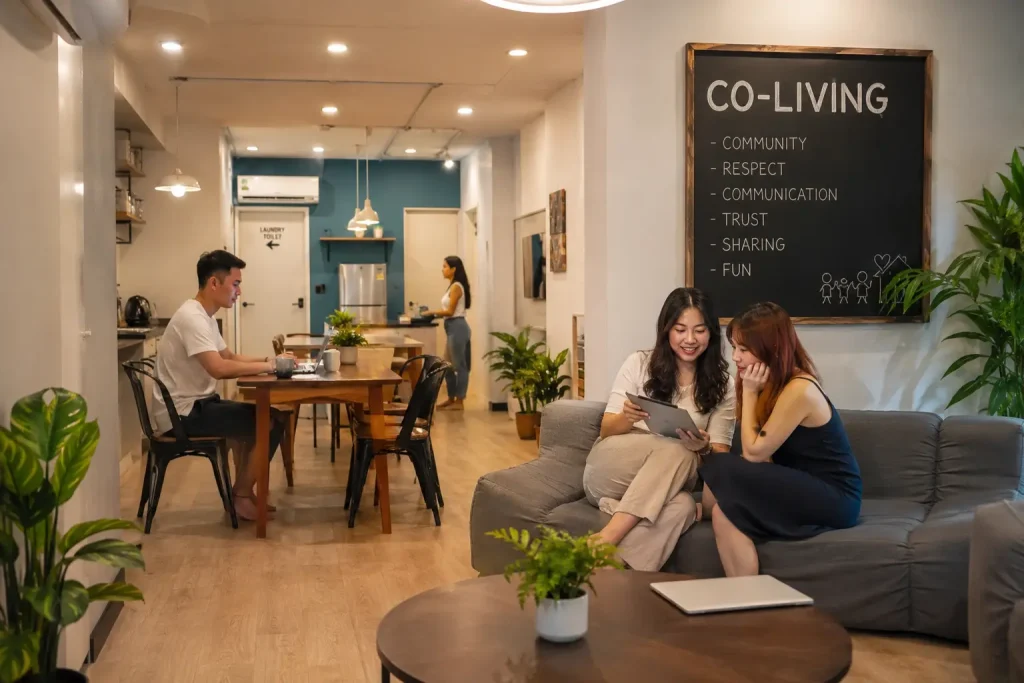
A co-living business is a property operation model where an operator leases or owns large residential units, furnishes them to a high standard, and rents out individual rooms — not the whole unit — to multiple tenants who share communal spaces. The business earns from the difference between per-room rental income and the fixed cost of the master lease, utilities, and management.
This is distinct from conventional landlording in two important ways. First, you charge per room, which means your income per square foot is significantly higher than a whole-unit lease. Second, you are offering a lifestyle product — furnished, managed, community-oriented accommodation — not just four walls.
New to the concept? Start with our foundational guide: What Is Co-Living? A Complete Guide for Singapore Investors
Is Co-Living Legal in Singapore?
Yes, co-living is fully legal in Singapore, provided operators adhere to the regulatory framework set by the Urban Redevelopment Authority (URA) and, where applicable, the Housing & Development Board (HDB).
Here are the non-negotiable rules:
For Private Residential Properties
- Minimum tenancy duration: 3 consecutive months per tenant
- reaffirmed it in 2019, explicitly drawing the line against short-term Airbnb-style subletting
- Maximum occupancy: 6 unrelated persons per unit, regardless of how many bedrooms the property has
- No government pre-approval required to sublet rooms, but all subletting must align with your master lease terms
- Structural modifications — including room partitioning — must comply with Singapore Civil Defence Force (SCDF) fire safety standards; unauthorised partitions can result in mandatory reinstatement at your expense
For HDB Flats
- HDB subletting requires prior written approval from HDB
- Subletting is only permitted to Singapore Citizens and Permanent Residents in most cases
- The minimum subletting period is 6 months per sublet ((https://www.hdb.gov.sg/sitecore/content/hdbinfoweb/home/renting-a-flat/renting-from-open-market/regulations))
- Occupancy limits apply and vary by flat type
The Market Opportunity in 2025–2026
Singapore’s co-living sector has moved decisively from niche to mainstream. The structural tailwinds driving this shift are not cyclical — they reflect permanent changes in how professionals want to live and how investors need to deploy capital.
The data tells a clear story:
- Room inventory in Singapore’s co-living sector expanded approximately 17% from 2023 to 2024, while occupancy rates held at 85–95% among professional operators — a signal of undersupply, not saturation
- 75% of co-living residents are aged 25–40: expats, digital nomads, and young Singaporeans who value flexibility, community, and convenience over the commitment of a solo apartment lease
- BTO completion delays in 2024–2025 pushed large numbers of young Singaporean couples into the rental market, boosting room-level demand across the city
- Singapore’s conventional studio apartment in the Core Central Region now regularly exceeds $3,800/month — making co-living rooms at $1,200–$2,000/month a structurally attractive alternative
- Institutional operators like Ascott’s lyf brand and global co-living platforms like Habyt have entered Singapore, validating the sector’s long-term investability
The market is growing. But professional, well-managed operators consistently outperform. This is not a passive income play for the unprepared — it rewards those who approach it as a real business.
The Rent-to-Rent Operating Model Explained
The rent-to-rent model is the most accessible way to start a co-living business in Singapore without owning property. Here’s how the mechanics work:
You sign a master lease with a landlord — typically a 2–3 year agreement on a large private condo or landed unit. You pay a fixed monthly rent. You then furnish the unit, market individual rooms, and collect per-room rental income from multiple tenants. Your monthly profit is the spread between total room income and total costs.
| Item | Monthly Cost (SGD) |
| Master lease — 5BR condo, District 15 | $4,000 |
| Utilities (power, water, fibre) | $450 |
| Cleaning & maintenance | $250 |
| Management & miscellaneous | $300 |
| Total Monthly Outgoings | $5,000 |
| 5 rooms × $1,700/room (co-living rate) | $8,500 |
| Net Monthly Cash Flow | $3,500 ✅ |
This example reflects a realistic mid-tier scenario. District 9 or 10 units command higher room rates; fringe districts yield narrower spreads but require lower master lease costs. The model scales horizontally: experienced operators run 3–10 units simultaneously, multiplying their cash flow without requiring additional property ownership.
Step-by-Step: How to Start Your Co-Living Business
Learning how to start a co living business Singapore properly means following a sequence — not skipping to the “exciting” parts. Here is the framework practitioners use:
Step 1: Define Your Target Tenant
Co-living accommodation for young professionals looks different from corporate living apartments for expats, or senior co living Singapore for older residents. Your tenant profile determines everything: room size expectations, furnishing quality, amenity priorities, and price tolerance. Defining this early prevents expensive misalignment later.
Step 2: Scout and Qualify Properties
Not all large units work as co-living spaces. Your ideal unit has 4–6 bedrooms, at least 2 bathrooms, adequate common area space, natural ventilation in every room, and an MRT within a 10-minute walk. Cross-reference against the URA Master Plan — a nearby planned interchange or mixed-use hub is a strong indicator of sustained demand.
Step 3: Negotiate Your Master Lease
This is where most beginners leave money on the table. Negotiate for a rent-free fitting-out period (typically 2–4 weeks), explicitly secure the landlord’s written permission for subletting, and aim for a 2–3 year lease term to lock in cost certainty. The lease structure determines your entire risk profile.
Step 4: Furnish and Configure
Co-living tenants expect move-in ready units. Budget $5,000–$15,000 for furnishing depending on the unit size and your target market. Prioritise bed quality, study desks, good lighting, and fast broadband. Communal areas — kitchen appliances, a comfortable living room — convert viewings into signed leases.
Step 5: Market and Fill Rooms
List on co-living platforms, Facebook groups (particularly expat and international professional communities), PropertyGuru, and 99.co. Professional photography is not optional at this stage — it directly correlates with inquiry volume. Target full occupancy within 30 days of listing.
Step 6: Systematise Operations
Once you have tenants, your job is retention and friction reduction. Clear house rules, a tenant WhatsApp group, a reliable maintenance contact, and proactive communication keep turnover low. Low turnover is the single biggest lever on long-term profitability.
URA Co-Living Guidelines You Must Know
The URA coliving guidelines govern every private residential co-living operation in Singapore.
| Rule | Requirement | Why It Matters |
| Minimum Stay | 3 consecutive months | Violations trigger fines and can void your lease |
| Max Occupancy | 6 unrelated persons (private) | Applies regardless of number of rooms |
| HDB Approval | Required for HDB subletting | Operating without approval is a criminal offence |
| Fire Safety | SCDF-compliant partitions | Non-compliant modifications must be demolished at your cost |
| Change of Use | Required for commercial-to-residential | Shophouse conversions need URA approval |
| Tenancy Documentation | Written agreements mandatory | Protects both operator and tenant legally |
The 2024 URA enforcement posture has become more active, particularly around over-occupancy and short-stay violations.
Setting Up the Right Business Structure
Most early-stage co-living operators in Singapore start as sole proprietors or under a private limited company (Pte Ltd). The choice matters more than most realise.
Sole Proprietorship
Lower setup cost, simpler tax filing. Suitable if you are running one or two units and want to test the model before committing to a larger structure. Liability is personal — your personal assets are exposed if the business faces legal action.
Private Limited Company (Pte Ltd)
Preferred for operators planning to scale to 3+ units. Limits personal liability, allows multiple directors and investors, and creates a cleaner structure for future property management or third-party partnerships. Setup via ACRA typically takes 1–3 days.
Regardless of structure, open a dedicated business bank account, maintain clean records of all rental income and expenses, and engage an accountant from year one. Property management income is taxable in Singapore — factor this into your cash flow projections from the start.
Co-Living Beyond Singapore: Malaysia Expansion
Once you have proven your model in Singapore, Malaysia presents a compelling next market — and many operators are already making the move. Co living Malaysia is not a replica of Singapore’s market, but it shares the same structural demand drivers: urbanisation, a young working population, and a growing class of professionals who prefer furnished flexibility over long fixed leases.
Johor Bahru
Co living johor bahru is attracting significant investor attention in 2025–2026. The city has emerged as Malaysia’s strongest property growth region, driven by the upcoming Johor Bahru–Singapore Rapid Transit System (RTS) Link expected to be operational by end of 2026. Rental yields in JB reach up to 5.47%, and cross-border demand from Singapore-linked professionals creates a reliable tenant base. With average property prices a fraction of Singapore’s, the rent-to-rent model runs on much lower capital.
Petaling Jaya and Kuala Lumpur
Co living petaling jaya and co living kuala lumpur serve a different but equally robust tenant profile: domestic professionals, university graduates, and tech-sector workers. Kuala Lumpur apartments average gross rental yields of around 4.93%, while Petaling Jaya consistently delivers above 5.2%. The KL market benefits from the ongoing MRT3 Circle Line project (targeting completion 2030–2031), which is already elevating demand in transit-corridor neighbourhoods.
What Makes a Co-Living Business Fail
Understanding failure modes is as important as knowing the steps to success. The most common reasons co-living businesses in Singapore underperform or collapse:
- Over-occupancy violations: Exceeding the 6-unrelated-person cap, even unintentionally, triggers enforcement action that can end your lease overnight
- Poorly negotiated master leases: A lease without explicit subletting permission or with inflexible rent escalation clauses destroys your margin in year two
- Undercapitalised furnishing: Low-quality furnishing increases tenant turnover, which directly erodes cash flow through vacancy gaps and re-marketing costs
- Skipping tenant screening: A single problematic tenant in a shared unit affects every other room — and therefore your entire unit’s revenue
- No operational system: Operators who self-manage without a process framework spend 20+ hours a week on coordination instead of business development
- Ignoring the numbers: Operators who do not model best-case, realistic, and worst-case occupancy scenarios often discover that their margins disappear the moment two rooms sit vacant simultaneously
Where to Learn How to Start a Co-Living Business
The fastest and most reliable way to compress your learning curve is structured education from practitioners who have already built co-living portfolios in Singapore — not self-directed research and not generic property courses.
Proptiply’s Co-Living Bootcamp is built specifically for this. It covers the rent-to-rent model in depth, walks you through real financial models, addresses URA co living guidelines with practical compliance frameworks, and connects you with a community of active operators.
Workshops that teach you how to start a coliving business are different from generic property investment seminars. The Bootcamp is operator-focused — you leave with a deal-ready action plan, not just theory. For an overview of the investment mechanics before you attend, read: How to Invest in Co-Living Spaces in Singapore.
| 👉 Learn From Operators — Join the Bootcamp → ← Click to register |
Frequently Asked Questions
What is the difference between co-living accommodation and serviced apartments?
Serviced apartments are typically licensed commercial hospitality products — often allowing shorter stays and priced at premium per-night or per-week rates. Co-living accommodation in Singapore is classified as residential, governed by URA’s 3-month minimum stay rule. ((https://www.ura.gov.sg/guidelines/best-practices/co-living-spaces/))
Are there co-living options specifically for seniors in Singapore?
Senior co living Singapore is an emerging sub-segment, driven by an ageing population and the desire for social connection without institutional care. While formal senior-specific co-living operators are still nascent in Singapore, several operators have begun positioning units near amenities relevant to older residents. This is a market segment worth watching as Singapore’s demographic composition shifts through the 2030s.
Is co-living in Malaysia easier to set up than in Singapore?
Entry costs are significantly lower in Malaysia, particularly in co living johor bahru and co living petaling jaya — and regulations are less restrictive. However, tenant demand characteristics, market maturity, and operational infrastructure differ from Singapore. Operators who expand to Malaysia typically do so after proving their model domestically. The JB market in particular benefits from strong Singapore-linked demand and is currently the fastest-growing property region in Malaysia.
Do I need a business licence to operate a co-living business?
For the rent-to-rent model in private residential properties, no specific co-living licence is required in Singapore beyond standard business registration. You will need to register a business entity with ACRA, comply with URA occupancy and subletting rules, and ensure your tenancy agreements are legally sound. If you convert a commercial property to residential co-living use, URA’s Change of Use approval is required.
The Bottom Line
Starting a co-living business in Singapore is one of the most accessible, high-yield property strategies available in 2025 — precisely because it decouples cash flow from capital. You do not need to own property. You need the right knowledge, the right lease, and the right operational framework.
The market is growing. Institutional capital has already validated the sector. The question is whether you approach it with the depth of understanding that converts an interesting idea into a real income stream.
For more hands on guidance on how to run a coliving model, join our bootcamp.