Investing in coliving starts with understanding what it actually is. And if you have spent any time searching for rooms in Singapore recently, you have probably noticed the rental landscape looks a little different from five years ago. The options sitting between a traditional long-term lease and a hotel room have multiplied, and a lot of them go by the same name: coliving.
But what exactly is coliving in Singapore, and why has it become such a recurring conversation in both property investment circles and expat communities?What Is Co-Living?
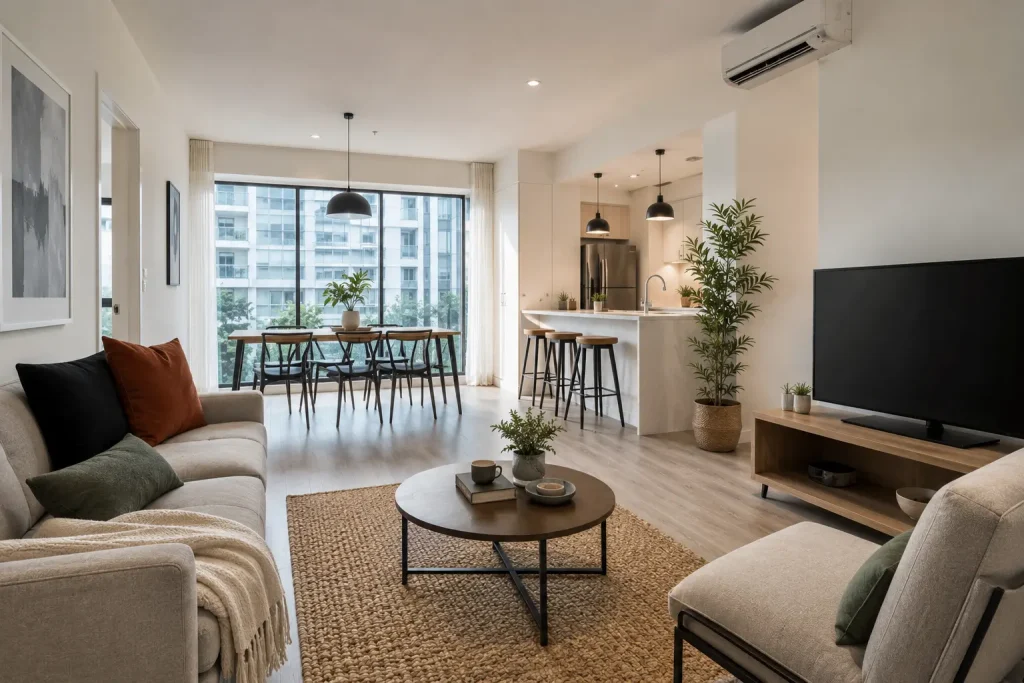
At its core, co-living is a form of shared housing where residents have their own private rooms but share common areas — living rooms, kitchens, coworking corners, sometimes even gyms and cinema rooms.
The co-living concept is built around three core principles: flexibility, convenience, and community. You sign a lease that fits your timeline (typically three to twelve months), move into a fully furnished space, pay one all-inclusive monthly bill, and immediately have a network of neighbors around you.
What distinguishes the modern coliving space from a traditional share-flat is the hospitality-grade level of management behind it. You are not hunting down the landlord when the dishwasher breaks. You are submitting a ticket on an app.
Why Singapore? The Market Context
Singapore’s property market creates the exact conditions where coliving thrives.
Land is finite, ownership is expensive, and the city draws a constant flow of expatriates, young professionals, and remote workers who need quality housing without committing to a two-year lease on an unfurnished unit. Add in the fact that Singapore prohibits short-term rentals of less than three consecutive months for private residential properties — effectively ruling out the Airbnb model — and the coliving model slots in as the logical alternative.
The numbers reflect how far the sector has come. According to JLL research published in early 2026, 65% of investors now view Singapore’s co-living sector as stable rather than speculative, a complete reversal from 2024 when 73% of the same investor cohort categorized it as high-risk. The sector has grown into a S$1.4 billion investment market, and institutional appetite is only accelerating.
In November 2025, homegrown co-living operator Coliwoo became the first co-living company to list on the SGX Mainboard, raising S$101 million in an IPO that was oversubscribed 20.7 times in the public tranche. The Assembly Place followed in January 2026 with its own Catalist listing. With co-living companies start going public in Singapore, the market is no longer a niche play.
How Does Co-Living Work in Practice?
For Renters
The mechanics are straightforward. You find a room through a co-living operator and sign a lease (usually three months minimum), pay a deposit, and move in.
What you get: a fully furnished private room, often with an en-suite or semi-private bathroom, and access to shared common areas. Your monthly payment typically covers rent, utilities, Wi-Fi, and cleaning.
Most co-living spaces also have a community layer such as events, communal dinners, or group activities, though how active this is depends on the operator and the specific property.
For Investors
On the investment side, co-living operates on a per-room rental model. Instead of leasing a three-bedroom condo to a single family at a fixed monthly rate, the owner, or the operator they partner with, leases each room individually. That shift in unit economics is where the yield advantage comes from.
Singapore’s average gross rental yield for private condominiums sits at around 3.36% in 2025–2026, according to Global Property Guide data. A well-run coliving conversion, renting by the room across four or five tenants instead of one family, can push gross rental income 20% to 40% higher than the traditional model, depending on the property location, configuration, and operator efficiency.
What You Must Know About the Regulations
Coliving in Singapore is legal, but it operates within a clear set of rules that both landlords and tenants need to understand.
Minimum Rental Period. Private residential properties cannot legally be rented out for stays of less than three consecutive months. This is the URA regulation that makes the Airbnb short-stay model non-viable for private homes, and the same rule that positions coliving’s three-to-twelve-month lease structure as the compliant, higher-yield alternative.
Occupancy Cap. The standard URA rule limits private residential properties to a maximum of six unrelated persons per unit. However, in January 2024, the government temporarily relaxed this for larger private residential properties (90 sqm and above), allowing up to eight unrelated persons upon registration with URA. This relaxation has been extended and currently runs through 31 December 2028, providing a meaningful window for investors planning room configurations on appropriately sized properties.
Partitioning Rules. Landlords who wish to convert a space (say, splitting a large master bedroom into two smaller rooms) must apply for Planning Permission from URA before works commence. Operating a partition without approval is a regulatory violation.
What This Means Practically. For a co-living investor, the compliance checklist is not optional. The occupancy cap determines how many rooms you can legally rent out, which directly affects your income ceiling. Getting this right from the acquisition stage is foundational.
Yield Comparison Between Co-Living vs. Traditional Rental
Let’s put concrete numbers around the comparison.
In early 2026, private residential rents posted modest growth of 1.9% for the full year 2025, reversing 2024’s slight decline. Analysts project 0% to 4% rental growth for 2026, with most forecasts clustering around the lower end. In this environment, traditional buy-and-rent strategies are generating yields of roughly 2.5% to 4% depending on district, and those gross figures drop by 1.5 to 2 percentage points once management fees, maintenance, and vacancy periods are factored in.
Cushman & Wakefield projects private residential rents in Singapore to grow at 4.6% per year between 2025 and 2029, a tailwind that benefits co-living operators whose room rates track the broader rental market.
Types of Co-Living: Knowing What You Are Choosing
Not all co-living spaces in Singapore are the same, and the distinctions matter whether you are renting or investing.
Purpose-Built vs. Converted Properties
Purpose-built co-living developments are designed from scratch for communal living — think extensive amenity decks, thoughtfully planned common areas, and professionally managed communities. These typically require institutional capital and are the domain of major operators.
Individual investors more commonly work with the conversion model: acquiring an existing condominium or landed property and reconfiguring it for multiple occupants. A large four-bedroom condo in a mature estate with en-suite or semi-shared bathrooms, soundproofed rooms, and smart-lock access per door is the archetypal co-living conversion. The formula works in areas with strong rental demand — Tiong Bahru, Novena, River Valley, Queenstown — where proximity to the CBD and key MRT lines sustains occupancy.
By Tenant Profile
Different co-living spaces target different demographics, and your design and marketing should follow the tenant type.
Corporate expatriates are the most stable co-living tenant segment. They prioritize proximity to the CBD, premium finishes, and reliable property management. Their stays tend to run six to nine months, and lease renewals are common. l.
Young professionals and digital nomads gravitate toward spaces with strong community programming, fast internet, and central or city-fringe locations. They are more sensitive to pricing but are also the segment that drives word-of-mouth referrals when a space gets the community element right.
International students form a smaller but consistent segment, particularly around Buona Vista, one-north, and areas near the National University of Singapore. Operators like Bespoke Habitat, Figment and niche boutique providers serve this demand.
What to Look for as a Co-Living Renter
All-inclusive pricing. The headline rent figure should cover utilities, Wi-Fi, and at minimum basic cleaning. Some operators also bundle laundry access and community events. Get clarity on what is and is not included before signing, because a S$1,800/month room that excludes utilities could end up costing S$2,100+.
Lease flexibility. The best co-living operators let you start with a three-month minimum and extend month-to-month thereafter. If you are new to Singapore and unsure of your timeline, avoid any arrangement that locks you into a full year upfront.
Bathroom ratios. The general quality benchmark is one bathroom per two tenants. En-suite rooms command a premium for good reason.
Management responsiveness. Read the reviews carefully, and specifically look for comments about how issues get resolved. A co-living space where maintenance requests go unanswered for weeks is a landlord relationship wearing a co-living brand.
Location-to-price fit. Co-living rooms in the city core (Orchard, River Valley, Robertson Quay) run S$1,800 to S$3,000+ per month for a private room. City-fringe areas like Tiong Bahru or Novena offer S$1,400 to S$2,200. Further out, pricing drops but so does accessibility. Know what you are optimizing for.
What to Evaluate as a Co-Living Investor
Property Selection
The unit’s floor plan matters more in co-living than in traditional rental. You are looking for efficient layouts with minimal wasted circulation space, a high bedroom-to-bathroom ratio (or the structural feasibility of adding bathrooms), and sufficient square footage to meet the occupancy cap without cramping common areas.
Properties of 90 sqm or above are worth particular attention because they qualify for the temporarily relaxed occupancy cap of eight persons, which directly expands your room count ceiling and income potential. Older condominiums in mature estates often offer the footprint advantage that newer, more compact units do not.
Operator vs. Self-Managed
Running a co-living space yourself means handling viewings, tenant screening, lease administration, maintenance coordination, and community management. It is operationally intensive — closer to hospitality management than traditional landlording.
Most investors outside the full-time property business are better served by partnering with a professional co-living operator who takes a revenue share (typically 15% to 25%) and handles day-to-day operations.
The trade-off is real but worth it: an operator with a strong pipeline of tenant leads and a track record of 90%+ occupancy will, over a twelve-month period, generate more net income than a self-managed operation that sits vacant for two months between tenancies.
Risk Factors to Price In
Higher wear and tear. Multiple unrelated adults sharing kitchens and common areas accelerates depreciation. Budget for cosmetic refreshes every twelve to eighteen months and a deeper refurbishment every three to five years.
Vacancy risk. Flexible leases are a feature for tenants and a risk variable for investors. In an economic slowdown that triggers expatriate departures, occupancy can drop quickly. The mitigation is operator quality and location — properties in prime areas with strong operator networks consistently outperform during market softness.
Regulatory changes. Singapore’s regulatory environment is active. The current eight-person cap relaxation runs through 2028 and is subject to review. Underwrite your investment using the standard six-person cap as the conservative baseline.
Is Co-Living the Right Move for You?
The honest answer is that it depends on what you are optimizing for.
For renters, co-living makes the most sense when you value flexibility over raw square footage, when you are new to Singapore and have not yet mapped out your neighbourhood preferences, or when you want a move-in ready solution without the friction of setting up a household from scratch. The all-inclusive pricing model also provides genuine financial predictability in a city where the cost of living can surprise you.
For investors, co-living offers a structurally higher-yield alternative to the traditional single-tenancy rental model in a market where conventional condo yields have compressed to around 3.36% gross. The per-room model, executed well and managed professionally, can meaningfully outperform that baseline — as evidenced by the sector’s occupancy rates and the institutional capital now flowing into it.
The risks are real — operationally intensive management, wear and tear, and regulatory exposure — but they are manageable with the right operator partnership, property selection, and a clear-eyed compliance framework from day one.
Ready to Go Deeper?
Understanding co-living in Singapore at a conceptual level is one thing. Knowing how to evaluate a specific property, run the yield numbers, structure an operator partnership, and stay on the right side of URA regulations is another.
If you want the full framework — from deal evaluation to tenant experience to exit strategy — attend our Co-Living Workshop → where we walk investors through the end-to-end playbook.